How JWrada-33 Solves High-Temperature Radar Level Meter Challenges at 450°C
In conventional storage tanks, radar level meters typically operate in relatively stable conditions. In high-temperature applications, however, steam, hot gases, vaporized media, and reflections from internal structures can interfere with radar signals, while the instrument itself must withstand continuous thermal stress.
Therefore, high-temperature radar level measurement is not simply about how many degrees an instrument can withstand. Antenna design, echo processing, mechanical structure, and overall application adaptability all affect measurement performance.
For demanding applications with process temperatures of up to 400°C and above, Jiwei JWrada-33 high-temperature radar level meter is designed specifically for complex industrial conditions. It combines an independently developed antenna and lens, proprietary echo-learning software, simulation-based design, and 80 GHz radar technology to improve measurement reliability in challenging high-temperature environments.
1. Why Is High-Temperature Radar Level Measurement Challenging?
In high-temperature storage tanks, reactors, towers, and other process vessels, the radar signal received by the instrument is not limited to the actual material surface.
Steam, tank walls, flanges, heating coils, agitators, inlet pipes, support structures, and other internal components can all generate reflected signals. As temperature increases, changes in the process medium and gas phase can further complicate the echo environment.
At the same time, the antenna, seals, process connection, and internal components of the radar level meter must withstand long-term exposure to high temperatures.
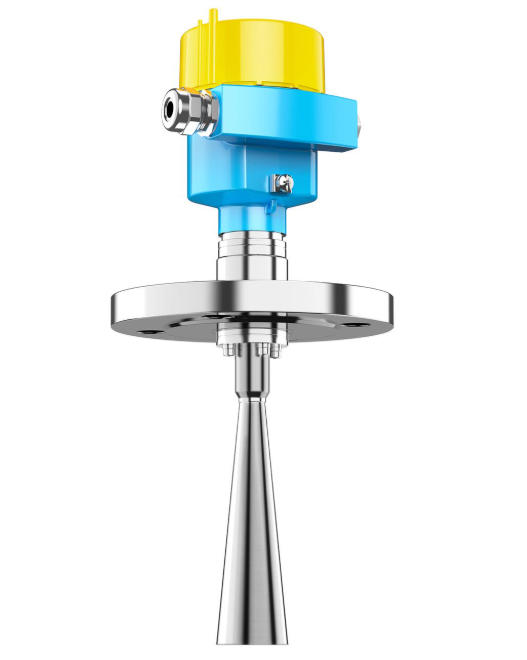
The JWrada-33 radar level meter supports process temperatures up to 450°C and is designed for demanding conditions involving high temperature and pressure, steam, dust, agitation, and electromagnetic interference.
High-temperature level measurement is therefore not a single temperature-resistance issue. It is a comprehensive test of measurement technology, mechanical design, and long-term operating capability.
2. Independently Developed Antenna and Lens
Radar measurement begins with the stable transmission of electromagnetic waves and the reception of reflected signals from the material surface. As the front end of the measurement chain, the antenna directly affects echo quality.
The JWrada-33 high-temperature radar level meter uses an independently developed antenna and lens design. Its structure can be matched to the operating frequency, beam characteristics, installation configuration, and application conditions instead of relying on one universal antenna structure for every installation.
In high-temperature vessels containing heating coils, support structures, or other metal components, an excessively wide radar beam can receive more unwanted reflections. Antenna design therefore needs to balance signal strength, beam width, and installation requirements.
JWrada-33 uses 80 GHz radar technology and supports multiple horn antenna sizes, including 21 mm, 26 mm, 40 mm, 48 mm, and 75 mm, allowing the antenna configuration to be selected according to nozzle size, installation space, and site conditions.
Compared with a fixed standard configuration, an independently developed antenna gives greater flexibility to optimize the radar level meter around the actual process conditions.
3. Proprietary Echo-Learning Software
In complex industrial applications, radar echoes often consist of multiple overlapping signals. In addition to the actual liquid or solid surface echo, tank walls, nozzles, internal components, and other structures can generate fixed or periodic interference echoes.
If a radar level meter relies only on general-purpose parameters, commissioning can become more difficult when process conditions vary significantly.
JWrada-33 uses proprietary echo-learning software to identify and process echo characteristics at the installation site. By learning the reflection characteristics generated by fixed structures inside the vessel, the system can reduce the influence of unwanted echoes and improve its ability to identify the actual material level.
This is also one reason why radar level meters using the same 80 GHz frequency can deliver different results in different applications.
Frequency determines the basic conditions for radar measurement, while echo processing capability plays an important role in reliable level identification under complex conditions.
4. Simulation-Based Design
The performance of a high-temperature radar level meter also depends on whether different installation conditions have been considered during product development.
Radar beam propagation can be affected by antenna geometry, nozzle dimensions, installation position, and internal vessel structures.
During the development of JWrada-33, simulation-based design is used to analyze the antenna, radar beam, and related structural configurations. Electromagnetic propagation under different structural combinations can be evaluated before the product is deployed in the field, helping optimize the antenna and installation structure.
For example, different nozzle diameters can change the available beam propagation space, while large metal components inside a vessel can create additional reflection paths.
Considering these factors during product development can reduce the need for repeated on-site adjustments.
Compared with a fixed structure and fixed-parameter solution, this approach emphasizes coordinated matching of the antenna, radar structure, and echo-processing algorithm according to the actual process conditions.
5. More Than Just a 450°C Temperature Rating
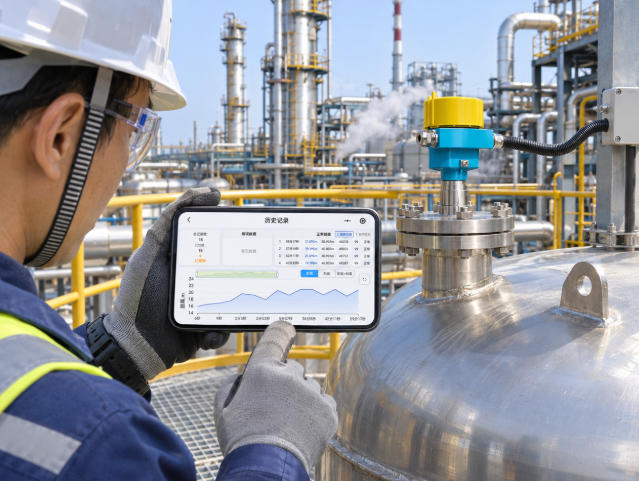
JWrada-33 supports process temperatures of up to 450°C, but its high-temperature capability does not come from temperature-resistant construction alone.
It is the result of multiple technologies working together:
- Independently developed antenna and lens for stable radar signal transmission and reception
- 80 GHz radar technology for a relatively narrow beam and high spatial resolution
- Proprietary echo-learning software for identifying valid level echoes and reducing interference
- Simulation-based design for optimizing antenna, structure, and radar beam propagation
- Multiple horn antenna sizes for different vessel and installation conditions
JWrada-33 also provides a 150 m measuring range, ±1 mm accuracy, and no blind zone, and can be used for liquid level measurement as well as conventional dielectric-constant powders and granular solids.
These specifications, combined with antenna design, echo processing, and structural engineering, form a complete high-temperature radar level measurement solution.
6. From Standard Configuration to Application-Specific Adaptation
80 GHz radar technology is now widely used for industrial level measurement. If products are compared only by frequency, measuring range, and temperature rating, different radar level meters may appear similar on paper.
However, differences become more apparent in applications involving high temperature, steam, agitation, and complex internal structures.
JWrada-33 does not rely on a single specification to handle complex conditions. Instead, it integrates an independently developed antenna and lens, proprietary echo-learning software, and simulation-based design into one radar level measurement platform.
This approach allows the product to be designed around actual application requirements rather than relying entirely on standardized structures to cover different process conditions.
For relatively simple storage tanks, general-purpose radar level meters can meet many measurement requirements. In applications where high temperature, steam, agitation, and complex internal structures occur simultaneously, application-specific radar design becomes increasingly valuable.
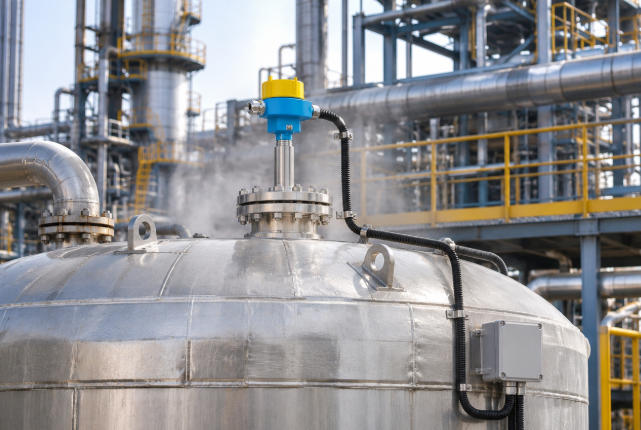
JWrada-33 radar level meter for high-temperature tank level measurement
7. How to Select a High-Temperature Radar Level Meter
When selecting a high-temperature radar level meter, process temperature is only the starting point.
First, check the actual process temperature range. Then evaluate whether the antenna, process connection, housing, and mechanical structure are suitable for the installation.
The radar’s performance under steam, internal reflections, and complex echo conditions should also be considered.
If the vessel contains agitators, heating coils, support structures, or narrow installation nozzles, selection should take into account the radar beam width, antenna type, and installation position.
High-temperature level measurement is a system engineering task.
The temperature-resistant structure determines whether the instrument can operate reliably over the long term. The antenna establishes the foundation for signal transmission and reception. The echo-processing algorithm determines how effectively the instrument identifies the target signal. Simulation-based design helps optimize the product for different installation conditions.
These independently developed technologies demonstrate Jiwei Automations’ approach to level measurement technology. From the antenna and lens to echo-learning software and simulation-based design, Jiwei Automations focuses on controlling the key technologies that influence measurement performance within its own R&D system.
For industrial instrumentation, the value of independent development is not simply the ability to manufacture a product. More importantly, when field conditions change, the R&D team can identify the source of a measurement challenge and continue improving the antenna, algorithms, and mechanical structure accordingly.
This is the value of continuous investment in high-temperature radar level measurement technology.