Why a Southeast Asian Building Materials Giant Chose 118 Jiwei JWrada Radar Level Meters
A major building materials supplier operating across Singapore, Malaysia, Vietnam, and other Southeast Asian markets recently upgraded its silo level measurement systems with 118 Jiwei JWrada radar level meters.
The project focused on improving the measurement of cement, fly ash, ground granulated blast-furnace slag (GGBS), and other powdered raw materials stored in silos.
Previously, some silos relied primarily on point-level switches to provide high-level and low-level alarms. Although these switches could indicate when material reached a preset level, they could not provide continuous level data for inventory tracking and consumption analysis.
The company aimed to replace manual level inspections with continuous radar measurement and integrate the data into its PLC system and AiR Digital platform.
After evaluating the demanding dust conditions, measurement stability, diagnostic capabilities, communication requirements, and maintenance needs across overseas facilities, the customer selected 118 Jiwei JWrada radar level meters for multi-silo monitoring.
Continuous Level Measurement for Digital Powder Inventory Management
The customer operates in the ready-mixed concrete, cement, and building materials sectors, with production and supply operations across multiple Southeast Asian markets.
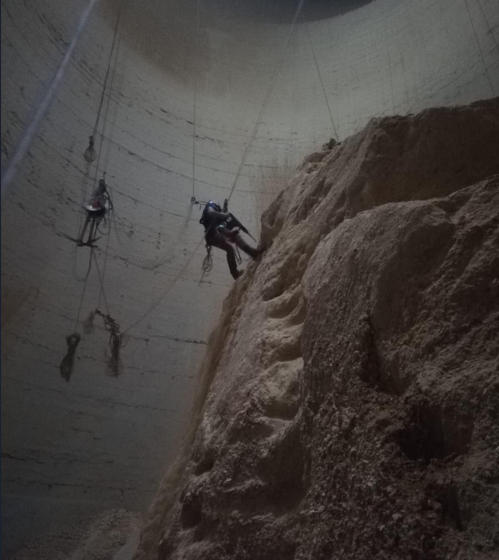
Its facilities store cement, fly ash, GGBS, and other powdered materials in silos. These materials are consumed according to production requirements and concrete mix designs, making accurate inventory information essential for raw material procurement, production planning, and delivery scheduling.
From Point-Level Alarms to Continuous Measurement
Previously, some silos used point-level switches to trigger high-level and low-level alarms.
While this arrangement provided basic overfill and low-level warnings, it did not show the actual material level continuously. Operators still needed to rely on manual silo inspections, delivery records, and estimated consumption to determine inventory levels.
As the number of silos and production demands increased, manual inspection became more labor-intensive. Inventory information was also difficult to maintain as a continuous, consistent data record.
The customer therefore sought a more efficient approach: continuous radar level measurement combined with automated data collection and digital inventory management.
By installing radar level meters, the company could obtain real-time level data and use it as a basis for tracking raw material inventory and consumption.
Why Dusty Silo Conditions Challenge Radar Level Measurement
Continuous level measurement in powder silos presents several technical challenges.
Cement, fly ash, and GGBS are commonly transported into silos through pneumatic conveying systems. During tanker unloading, high-velocity airflow carries large quantities of powder into the silo, generating dense airborne dust.
The material surface also changes continuously. Incoming material can form a conical pile, while discharge may create a depression or uneven surface. Meanwhile, silo walls, inlet pipes, and internal structures can generate unwanted radar echoes.
Over extended operating periods, fine powder may also accumulate around the silo roof and radar antenna, potentially affecting measurement performance and increasing maintenance requirements.
For this project, the customer needed more than a high-specification instrument. The key requirements included:
- Stable measurement during material filling and discharge.
- Reliable detection of uneven powder surfaces under dusty conditions.
- Effective suppression of unwanted echoes from fixed structures.
- Convenient diagnostics when abnormal readings occurred.
- Compatibility with PLC-based data acquisition and the AiR Digital platform.
- Practical maintenance and technical support across overseas facilities.
The customer had previously used radar level meters from other manufacturers. Some devices had experienced measurement deviations and fluctuating readings, while resolving technical issues across geographically dispersed facilities could be challenging.
Based on its operating experience, the customer considered ±5 mm measurement accuracy sufficient for its inventory management requirements. Measurement stability, diagnostics, system integration, and long-term maintenance were therefore important selection criteria alongside nominal accuracy.
How JWrada 80 GHz Radar Level Meters Meet the Application Requirements
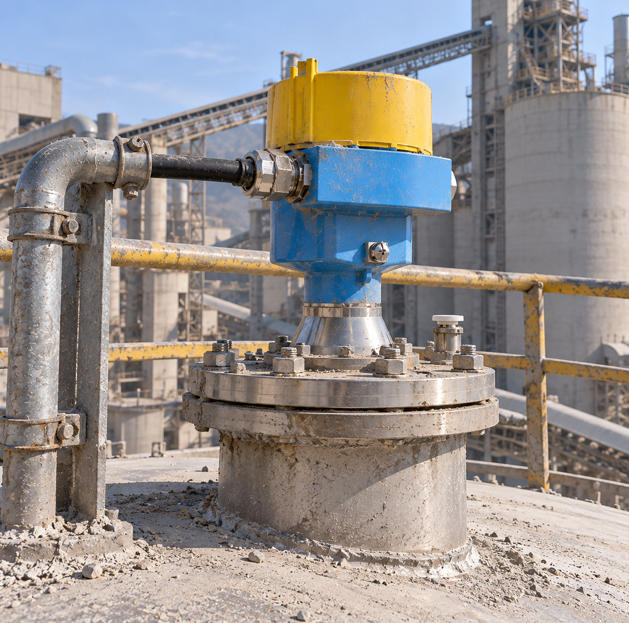
The project adopted Jiwei JWrada 80 GHz radar level meters to provide continuous, non-contact measurement in powder silos.
1. Non-Contact Radar Level Meter for Bulk Powder
Radar level meters measure the distance to the material surface using reflected electromagnetic signals.
Because the instrument does not need to contact the material directly, it avoids mechanical wear, jamming, and burial-related problems associated with certain contact-based measurement methods.
This makes radar technology suitable for monitoring powdered materials such as cement, fly ash, and mineral additives stored in industrial silos.
2. Focused Radar Beam and Intelligent Echo Processing
The 80 GHz Radar Level Meter operating frequency enables a focused radar beam, which can help reduce interference from silo walls and other fixed structures when the instrument is correctly positioned.
Combined with intelligent echo processing, the system can identify useful reflections in challenging measurement environments involving dust, uneven material surfaces, and unwanted structural echoes.
Actual performance depends on silo geometry, installation position, material conditions, and instrument configuration. Proper installation and commissioning remain essential to reliable measurement.
3. Integration with PLC and Digital Inventory Systems
After integration, the original approach of point-level alarms, manual inspections, and estimated inventory can progressively shift toward a data-driven workflow:
Radar Level Measurement → PLC Data Acquisition → AiR Digital Inventory Management
Operators can use the collected level data to monitor changes across multiple silos and support inventory calculations, material consumption analysis, raw material procurement, and production scheduling.
The radar level meters therefore serve not only as measurement instruments but also as data sources for the customer’s broader digital inventory management system.
Bluetooth Commissioning Simplifies Silo Maintenance
Maintenance accessibility was another important consideration in the project.
In conventional installations, checking instrument status or changing configuration parameters may require personnel to climb onto the silo roof. For tall cement and powder silos, repeated work at height increases maintenance time and introduces additional safety management requirements.
Jiwei JWrada radar level meters support Bluetooth 5.0 wireless communication. Using the Jiwei Tools mini program or JW Tools app, authorized personnel can connect to compatible instruments to:
- View real-time measurement values.
- Configure instrument parameters.
- Check operating status.
- Review echo curves.
- Perform commissioning and troubleshooting.
These functions can reduce the need to repeatedly climb onto the silo roof for routine parameter adjustments and instrument checks.
When measurement abnormalities occur at overseas facilities, local personnel can also share relevant instrument information, configuration parameters, and echo data with Jiwei technical engineers. Both parties can then investigate potential causes, including filling disturbances, fixed obstacles, changes in the material surface, and configuration issues.
Subject to network availability and the supported functions of the installed system, remote technical assistance can complement on-site Bluetooth commissioning.
Combining wireless on-site commissioning with remote technical support helps simplify maintenance across geographically dispersed production facilities.
Purge Design Helps Reduce Dust Accumulation on the Antenna
In addition to commissioning convenience, long-term operation in dusty silos requires attention to antenna cleanliness.
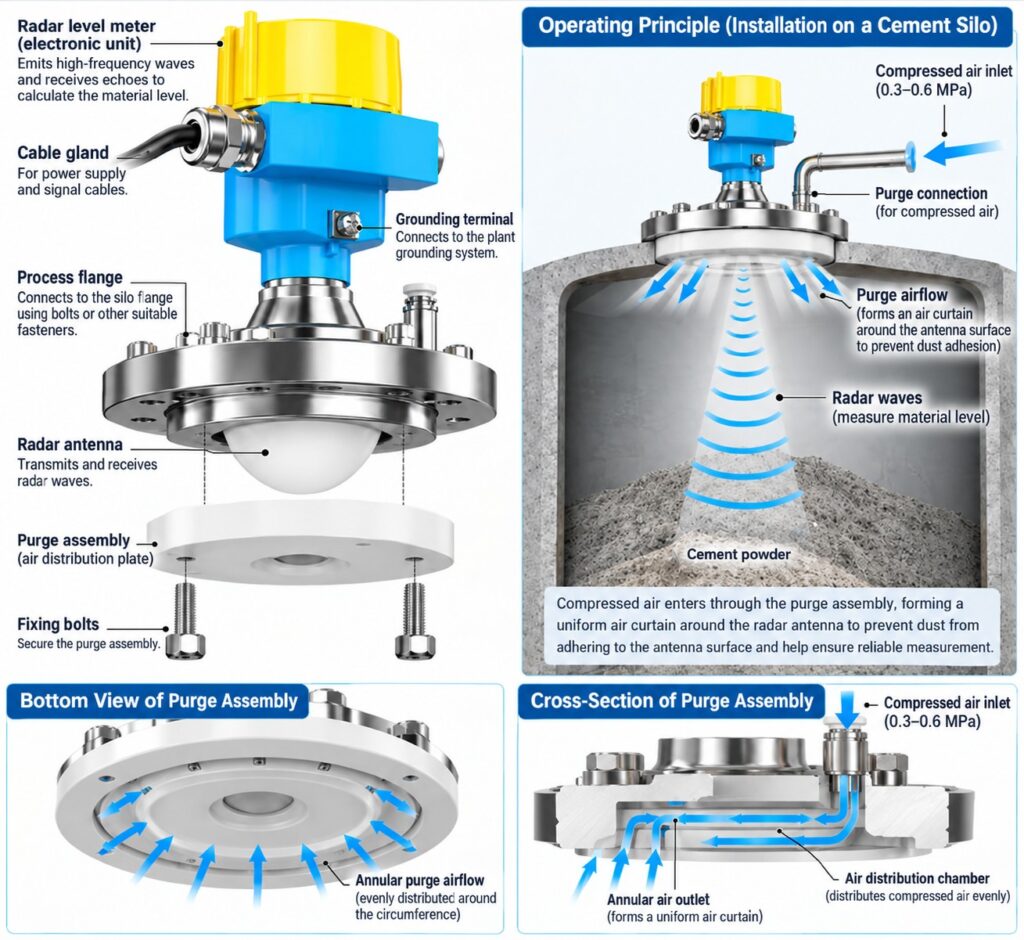
Pneumatic conveying of cement, fly ash, and mineral powders can produce substantial quantities of fine dust. Over time, dust may accumulate around the radar antenna and potentially affect signal transmission or measurement stability.
For applications with demanding dust conditions, the Jiwei JWrada-34 radar level meter features a purge structure that allows clean compressed air to be introduced into the antenna area to help remove accumulated powder.
Depending on the installation and air supply arrangement, the purge system can be operated continuously or periodically to help maintain a cleaner antenna surface.
This design can help reduce dust buildup and the frequency of manual cleaning, particularly in silos subject to frequent filling and high airborne dust concentrations.
The effectiveness of purging depends on factors such as dust characteristics, air pressure, flow rate, and installation configuration. Proper system design is therefore important for achieving the intended maintenance benefits.
From Level Measurement to Digital Inventory Management
The deployment of 118 radar level meters represents more than a straightforward instrument replacement. It supports a broader upgrade in how the customer monitors and manages raw material inventory.
By obtaining continuous level data from cement, fly ash, GGBS, and other powder silos, the company can establish a more consistent data foundation for inventory monitoring and material consumption analysis.
The main benefits of the project include:
- Continuous level data: Improved visibility into material levels compared with point-level alarms alone.
- Reduced reliance on manual inspections: Less dependence on manual measurements and estimated inventory records.
- Improved measurement adaptability: 80 GHz radar technology and intelligent echo processing support demanding powder silo applications.
- Simplified commissioning: Bluetooth communication facilitates parameter configuration, status checks, and diagnostics.
- Reduced antenna dust buildup: The JWrada-34 purge structure helps address dust accumulation in suitable installations.
- Digital system integration: Level data can be collected through the PLC and used by the customer’s AiR Digital platform, subject to system integration requirements.
Together, these capabilities help establish a practical foundation for digital inventory management in cement and building materials production.
Conclusion: A Practical Radar Solution for Demanding Powder Silos
The selection of 118 Jiwei JWrada radar level meters reflects the customer’s need for reliable continuous measurement, convenient commissioning, and integration with its existing digital management infrastructure.
With 80 GHz FMCW radar technology, intelligent echo processing, Bluetooth 5.0 communication, diagnostic functions, and remote technical support, the JWrada series addresses several key requirements of modern bulk powder storage.
For applications involving high dust concentrations, the JWrada-34 adds a purge structure to help reduce antenna dust accumulation and support long-term operation.
By combining continuous radar measurement with PLC data acquisition and digital inventory management, Jiwei helps building materials producers improve visibility into silo inventory and establish a stronger data foundation for raw material planning and production operations.
For cement, fly ash, GGBS, and other bulk powder applications, selecting the right radar level meter requires evaluating silo geometry, filling conditions, dust levels, installation constraints, communication requirements, and maintenance expectations.
Jiwei JWrada radar level meters provide a configurable solution for industrial users seeking to move from basic level alarms and manual inspections toward continuous measurement and data-driven inventory management.
To identify a suitable configuration for your silo application, contact Jiwei Automations with your silo dimensions, material characteristics, operating conditions, and required output signals.