Cement Silo Level Measurement Solution — Jiwei Radar Level Transmitter and Tuning Fork Level Switch
1. Application Background
Cement silos are one of the most critical buffer and storage units in cement production lines, serving as a key interface between grinding systems and packaging or bulk dispatch systems. Cement is typically transported into silos via pneumatic conveying, resulting in continuous high-dust conditions during both filling and discharging processes.
In real operating conditions, cement silo environments are highly complex. The pneumatic conveying process generates extremely high dust concentration, sometimes forming a dense “dust cloud” that significantly reduces the signal-to-noise ratio of electromagnetic wave propagation. In addition, cement is a typical low-dielectric dry bulk material with weak reflection characteristics. During dynamic accumulation, signal fluctuations are further intensified due to uneven particle distribution and suspended dust interference.
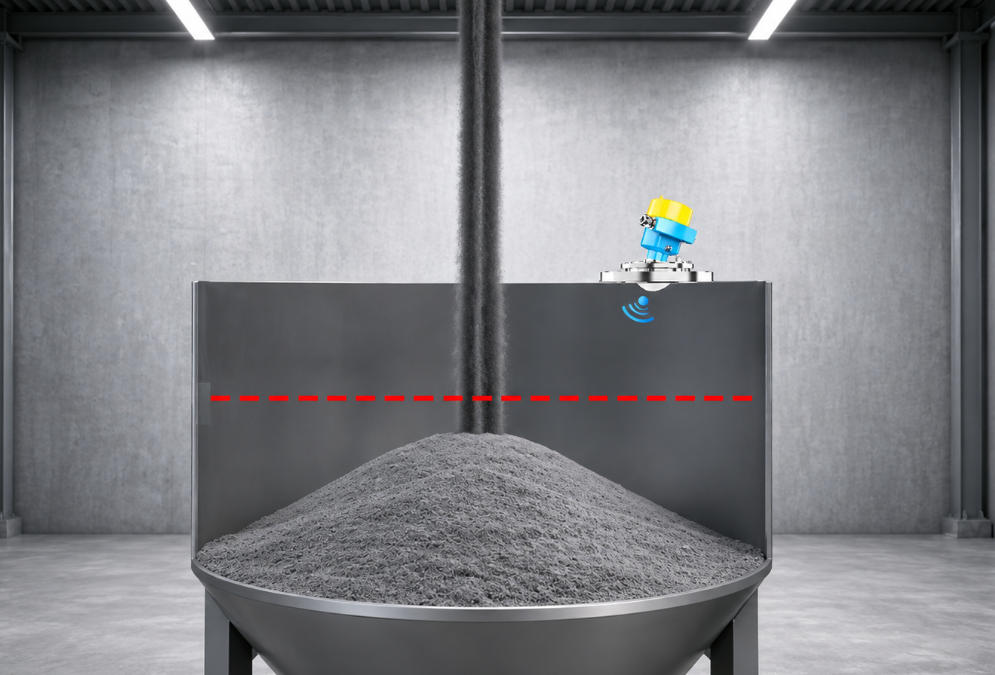
Moreover, silo structures often contain internal obstacles such as support beams, inlet chutes, and dust collection systems, which introduce multiple echo reflections and increase signal interpretation complexity. Over long-term operation, material buildup and wall adhesion gradually form on silo walls, making it difficult to distinguish between real level and false echoes. During frequent pneumatic conveying cycles, the material surface itself becomes highly unstable, requiring higher response speed and stronger anti-interference capability from the measurement system.
Based on these engineering challenges, cement silo level measurement systems must meet two key requirements:
First, continuous level measurement must remain highly stable and immune to interference, ensuring reliable output even under dust, buildup, and structural reflection conditions without signal loss or fluctuation.
Second, an independent high and low point level protection system must be implemented to form a redundant safety layer, ensuring reliable alarm and interlock functions in case of abnormal measurement conditions, thereby guaranteeing safe and continuous silo operation.
Based on field engineering experience, Jiwei Automation provides an integrated solution consisting of the JWrada® 80GHz high-precision radar level transmitter and the Fork-11 cable-type tuning fork level switch, achieving a dual system architecture of continuous measurement and safety interlocking.
2. Process and Measurement Requirements
- Measuring task: Continuous level monitoring + high/low point level protection
- Measuring location: Cement silo (height ≤ 50 m)
- Medium: Cement powder
- Process temperature: -40 … +50 °C
- Typical conditions: Strong dust, material buildup, pneumatic conveying disturbance
3. System Solution Architecture
3.1 Continuous Level Measurement — JWrada® 80GHz High-Precision Radar
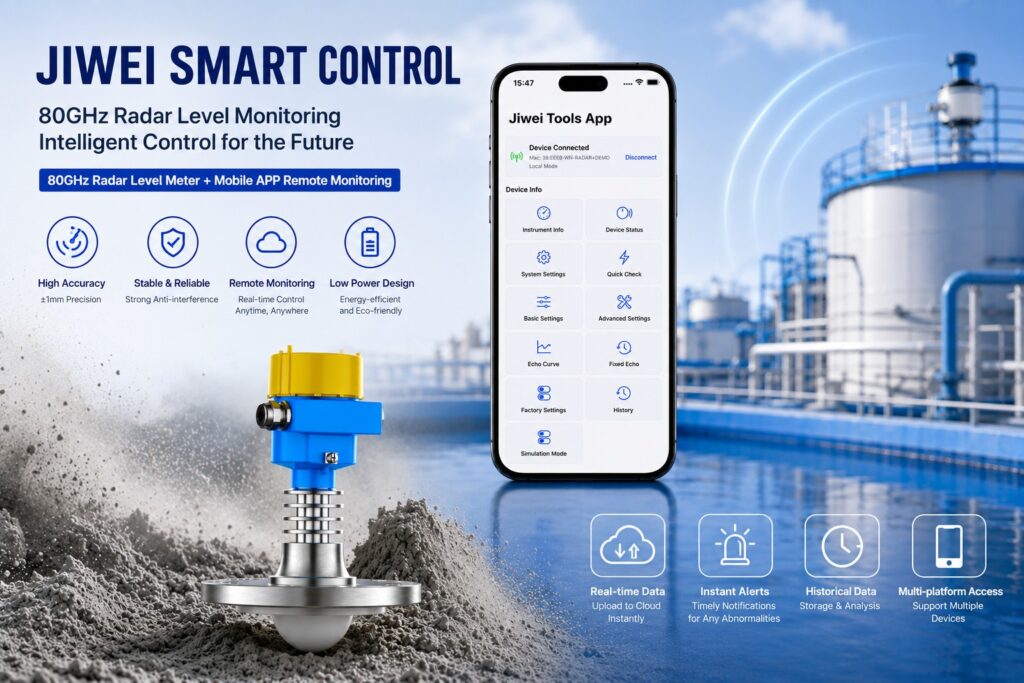
JWrada® adopts 80GHz FMCW (Frequency Modulated Continuous Wave) radar technology, enabling highly focused beam transmission for precise level detection. It is particularly suitable for cement, fly ash, and mineral powder applications under heavy dust conditions.
Core features include:
- 80GHz high frequency → narrower beam angle, reduced tank wall interference
- Strong echo processing capability → effective dust and particle suppression
- Dynamic echo tracking → stable performance during fast filling/discharging
- Non-contact measurement → no wear, no blockage risk
- Maximum range up to 150 m (fully covering cement silo applications)
- Bluetooth commissioning + Jiwei Smart Control App support
In cement silo applications, the radar is typically installed at the top center of the silo, measuring vertically downward to avoid structural interference and beam deviation.
3.2 Point Level Protection — Fork-11 Cable-Type Tuning Fork Level Switch
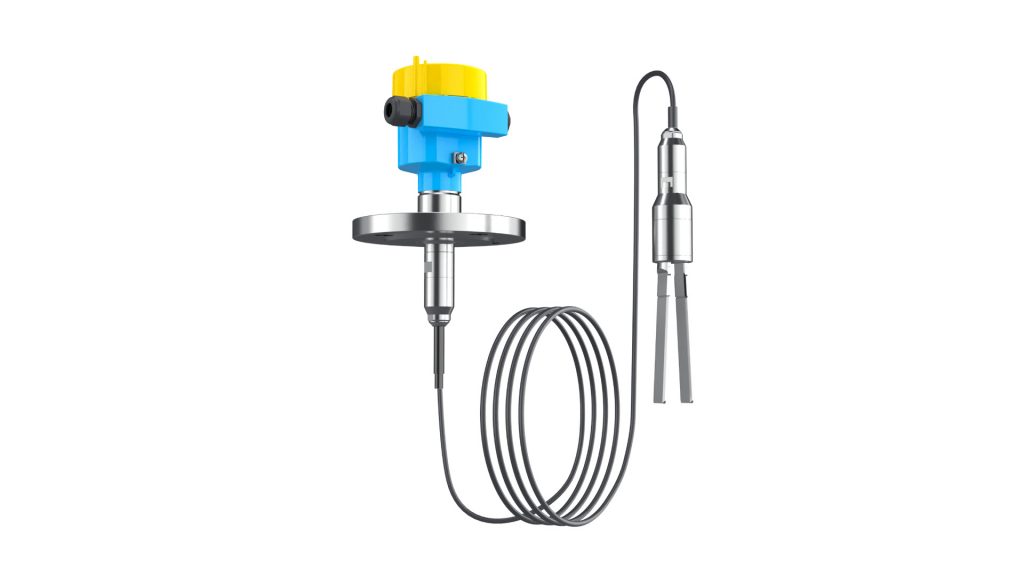
Fork-11 is used for safety interlock control in cement silos and serves as an independent protection unit in the system.
Functions:
- High level alarm (overfill protection)
- Low level alarm (empty silo protection)
- Conveying system interlock control
Technical features:
- Suitable for solids with density ≥ 0.008 g/cm³
- Cable-type design suitable for tall silos
- Resistant to dust adhesion and false triggering
- No calibration required, ready to use after installation
4. Real Project Feedback Case
In a large cement production line in China (2 million tons/year clinker grinding system), the customer originally used a low-frequency radar combined with mechanical level switches for silo monitoring and safety protection. However, long-term operation revealed incompatibility with the harsh cement silo environment.
Field feedback showed that the low-frequency radar experienced significant signal fluctuation during pneumatic filling due to rapid dust concentration changes, resulting in unstable echoes and occasional signal loss. Mechanical level switches also suffered from reliability issues under dust and material buildup conditions, requiring cleaning approximately every six months to prevent jamming failures.
In addition, limited roof space made maintenance difficult, often requiring shutdowns for servicing, which affected production continuity. These issues led to discontinuous inventory data, operator dependence on manual estimation, and delayed alarm responses, reducing overall system reliability.
To address these problems, the system was upgraded to the Jiwei solution, using the JWrada® 80GHz radar for continuous level measurement and Fork-11 tuning fork switches for independent high/low level protection, forming a redundant architecture combining continuous measurement and safety interlocking.
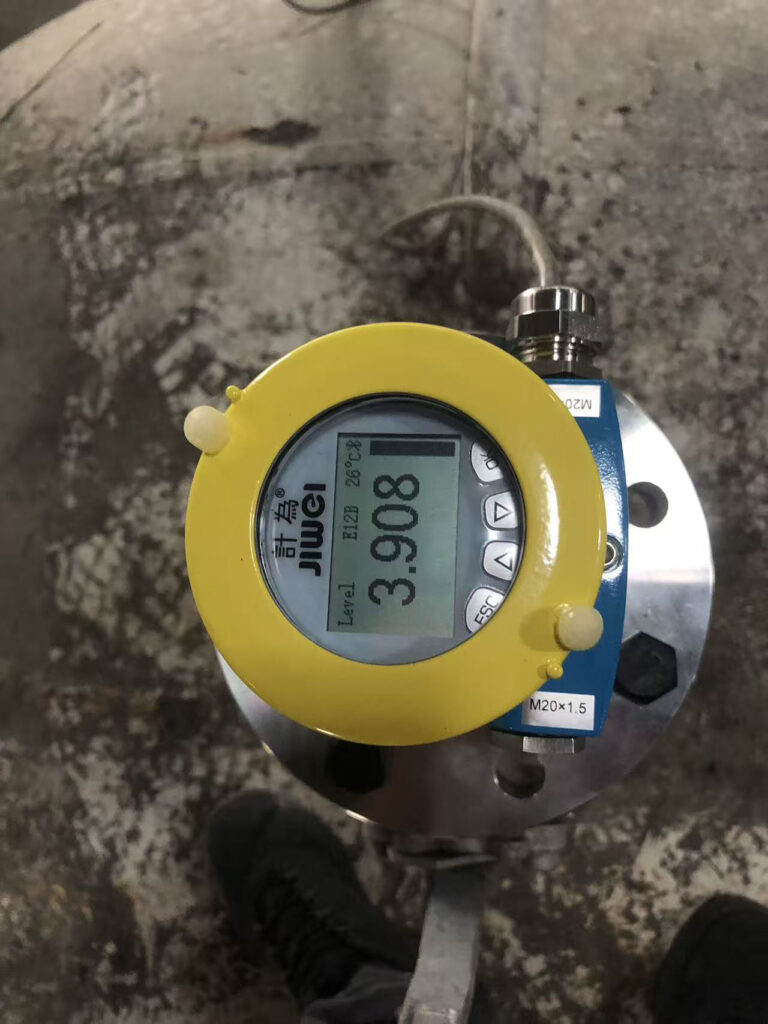
After six months of continuous operation, field results showed that the JWrada® radar maintained stable output even under extreme dust and pneumatic conveying conditions, without noticeable signal jumps or interruptions. Even in the presence of wall buildup, it continued tracking true material surface changes. Fork-11 switches operated reliably without false triggering. Maintenance frequency was significantly reduced from monthly inspections to quarterly checks. PLC data continuity improved significantly, enabling direct use for inventory calculation and production scheduling.
A field engineer commented:
“Now the level curve is basically continuous, and we no longer need to estimate the material level manually. System stability is much better than before.”
5. Installation Recommendations
JWrada® Radar Installation
JWrada® radar should be installed at the top center of the silo to achieve the most stable vertical measurement path. It should avoid direct material inlet flow to reduce interference from falling material. The antenna must remain vertically aligned with the material surface to minimize measurement deviation and false echoes. Flange mounting is recommended to ensure long-term mechanical stability and sealing reliability.
Fork-11 Installation
Fork-11 cable-type tuning fork switches are typically installed at key high and low level positions. They should not be placed directly in the material impact zone to avoid mechanical stress or false triggering. Sufficient operating space should be reserved to ensure proper material coverage and release for accurate switching behavior.
6. Application Value Summary
The system provides the following benefits:
6.1 Improved Data Stability
Eliminates unstable “jumping” readings and enables continuous inventory data.
6.2 Enhanced Operational Reliability
Independent safety protection reduces overflow and material shortage risks.
6.3 Reduced Maintenance Cost
Decreases manual cleaning, calibration, and shutdown maintenance frequency.
6.4 Improved Industrial Adaptability
Suitable for high-dust, high-buildup, and highly dynamic cement silo environments.
7. Conclusion
In cement silo applications characterized by heavy dust and strong process disturbances, conventional measurement methods often fail to provide stable long-term performance.
The Jiwei JWrada® 80GHz radar level transmitter combined with the Fork-11 tuning fork level switch offers a robust dual-system architecture of continuous measurement and independent safety protection, effectively solving issues such as unstable readings, false alarms, and frequent maintenance.
This solution has been successfully deployed in multiple cement plants, demonstrating strong reliability and engineering adaptability in complex industrial environments.