Application of Radar Level Sensors in Cement and Sand Mixing Tanks: Truck Loading Control in Dusty Environments
In the production of dry-mix mortar, pre-mixed building materials, and bulk engineering materials, cement and sand are the most common and easiest-to-form stable base materials. Cement provides binding properties, while sand, as aggregate, improves volumetric stability and workability. After metering, feeding, mixing, temporary storage, and unloading, these materials are used to produce mortar, plaster materials, masonry materials, and other building substrates. For this type of mixing tank operation, level control using a Radar Level Sensor is not simply “full or empty”; it directly affects recipe stability, mixing efficiency, unloading rhythm, truck loading safety, and production continuity.
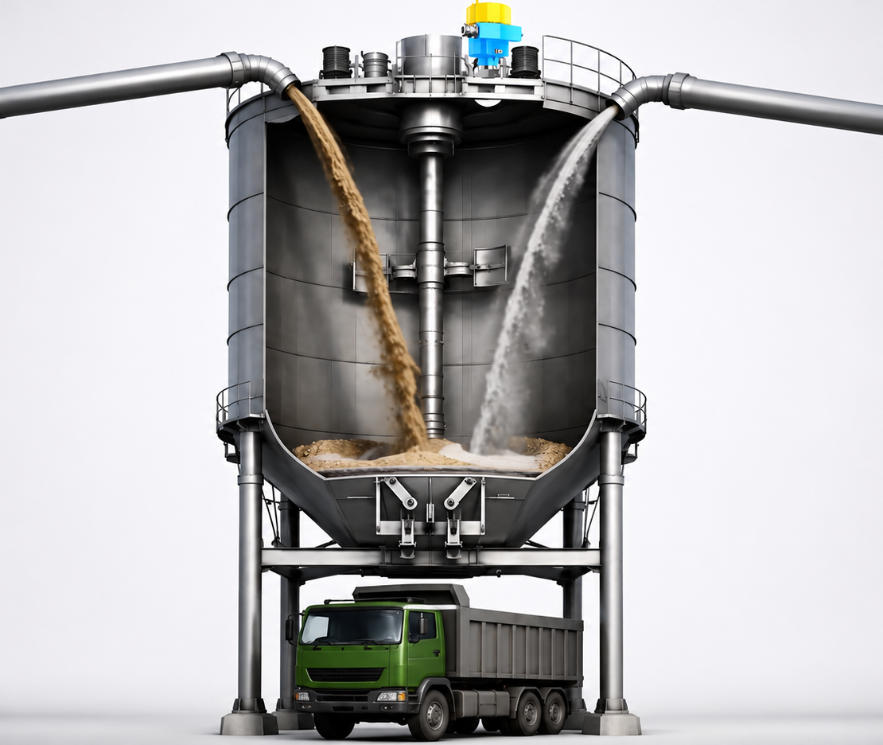
In this case, the user installed a large vertical mixing tank on-site, with cement powder and dry sand fed from pipelines on two sides at the top. When entering the tank, the two materials generate significant dust, especially during high-speed pneumatic conveying, material impact, and agitator operation, forming short-term high-density dust clouds inside the tank. A mixing mechanism is installed in the middle of the tank, with a conical discharge at the bottom, where bulk transport trucks are stationed. Once the mixed materials reach the set height and the mixing is completed, the system opens the bottom discharge port to load the finished dry mix into trucks for transport to the construction site or intermediate warehouse.
1. Project Background: Traditional Level Measurement Fails in High-Dust Mixing Tanks
Previously, the customer relied on manual observation, timed feeding, and low-level switch combinations for control. Due to high dust generation during cement and sand feeding, observation windows quickly became obscured, making it impossible to accurately judge real-time material levels. Low or high-level switches only provide point alarms and cannot continuously reflect material changes. Incorrect feed estimates could lead to three main issues: first, insufficient materials in the tank, wasting mixing time and making trucks wait; second, overfeeding, increasing mixing load and risking material overflow; third, inability to judge remaining material during unloading, causing trucks to be underloaded or delays in connecting the next batch.
In cement and sand powder or granular mixtures, the material surface is uneven. Cement powder has good flowability but produces strong dust, while sand particles are coarser and tend to form conical or uneven surfaces when piled. During mixing, the material surface fluctuates continuously, with local interference from agitators, supports, feed pipes, and tank walls. Therefore, the customer required a continuous level measurement solution capable of maintaining stable output under dust, mixing, internal structural interference, and irregular material surfaces.
2. Solution: 80GHz Non-Contact Radar Level Sensor
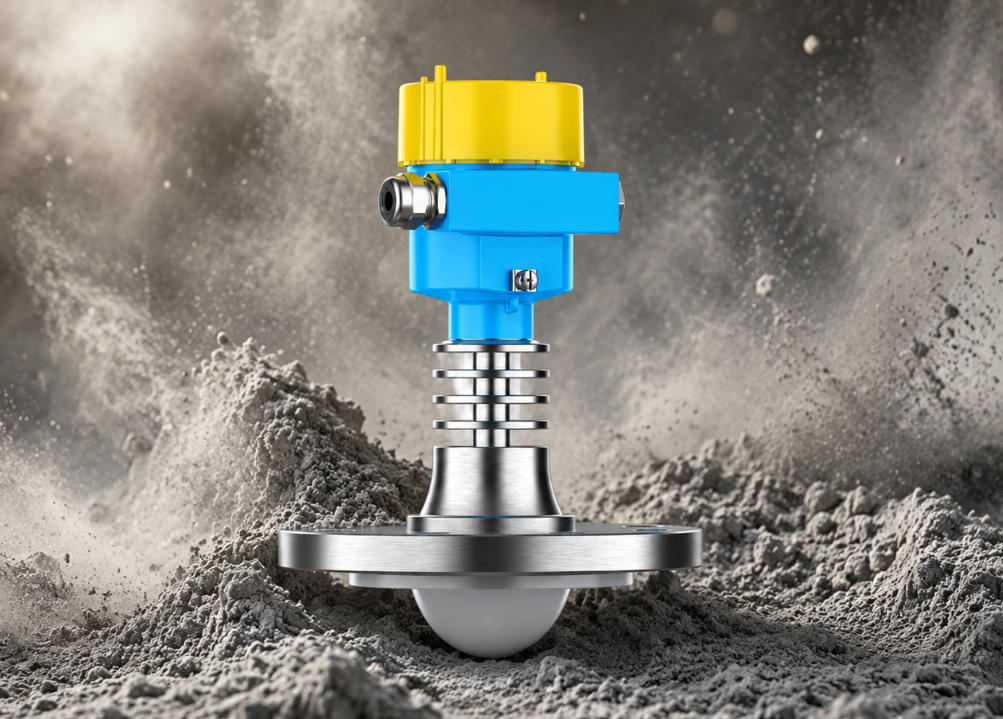
After on-site evaluation, the project selected Jiwei Automations’ independently developed 80GHz FMCW radar level sensor installed at the top of the mixing tank. The radar sensor adopts a non-contact measurement method, eliminating the need for probes inside the tank, thereby avoiding mechanical wear, material buildup, agitator blade collisions, and maintenance difficulties. The 80GHz radar has a narrow beam angle, allowing it to focus on the target material surface and reduce false echoes from tank walls, platforms, agitators, and feed pipes. For high-dust powder silos, 80GHz radar is often used for continuous level measurement due to its focusing capability and signal processing ability, making it suitable for complex surfaces and dusty environments.
During installation, engineers avoided placing the radar directly above the central agitator, instead positioning it away from the agitator, feed impact zones, and internal reinforcements, ensuring the beam targeted representative material areas. During commissioning, empty tank echoes, full tank echoes, mixing state echoes, and discharge state echoes were recorded separately, identifying fixed interference locations via echo curves. Tank height, blind zones, output range, false echo suppression, and damping time were configured so that the sensor would not excessively fluctuate during rapid feeding and would promptly reflect material level changes during discharge.
3. Process Flow: From Dual Material Feeding to Truck Loading
In actual production, cement is fed through the left pipeline while sand enters through the other side either simultaneously or in stages. The materials fall under gravity to the bottom mixing zone, where the agitator operates, allowing cement powder to coat sand particles uniformly, forming a stable dry-mix mortar base. Due to the high proportion of fine cement powder, significant airborne dust is generated upon feeding; sand particles, although coarser, also lift fine dust during high-speed feeding and impact with the tank wall. At this time, the radar continuously outputs material level data to the PLC or DCS system.
The control system adjusts feed valves in stages based on the radar’s continuous level feedback. When the material reaches a low-speed refill zone, feed speed is reduced to minimize impact and dust; as the level nears the target height, main feeding stops early, allowing residual pipe material to complete final compensation, preventing overshoot. After mixing, the bottom discharge valve opens, and the mixed material flows into the truck. The radar sensor monitors the remaining material level in real time, enabling the system to judge unloading progress. When the level drops to the set low point, an unload completion signal is issued, the valve closes, and the truck is prompted to depart.
4. Application Benefits: Improved Truck Loading Efficiency and Production Stability
Post-upgrade, the most noticeable change was the shift from “experience-based” to “data-driven” production. Operators can monitor real-time tank levels from the control room, eliminating the need for manual inspection or indirect judgment via motor load. During feeding, the radar enables precise target height control, reducing overfeeding, underfeeding, and repeated compensation. During mixing, the continuous level curve reflects whether materials remain within proper mixing ranges. During unloading, the system determines truck loading progress based on the descending material curve, preventing unnoticed bottom blockages.
For the customer, the radar’s value extends beyond level measurement, transforming cement and sand mixing into a monitored, recordable, and optimizable process. Each batch’s feed height, mixing time, discharge time, and residual material level are recorded, supporting quality traceability and production optimization. In scenarios with multiple trucks queued for loading, stable level measurement reduces waiting time, increases loading rhythm, and minimizes dust exposure and manual intervention risks.
5. Why Radar Level Sensors are Suitable for Dusty Mixing Tanks
Compared with ultrasonic level sensors, radar is less affected by dust, airflow, temperature fluctuations, and noise. Compared with weight-based level sensors, radar has no mechanical downward motion, avoiding interference with mixing and feeding. Compared with guided wave radar, non-contact radar does not require a probe in contact with materials, reducing buildup and bending risks. For bulk solid materials such as cement, sand, fly ash, lime powder, and mineral powder, non-contact radar achieves continuous measurement from the tank top, especially suitable for high silos, narrow hoppers, internal structures, or dusty conditions.
In this case, Jiwei Automations’ radar solved three key challenges: dust interference, surface fluctuations from mixing, and truck loading rhythm control. Through proper selection, correct installation, and on-site echo tuning, the sensor maintained stable measurement during feeding, mixing, resting, and unloading stages, providing reliable data for automated control.
6. Conclusion
Cement and sand mixing tanks represent typical dusty bulk material measurement scenarios. High dust concentration during feeding, fluctuating surfaces during mixing, and the need for rapid residual level judgment during unloading make continuous monitoring essential. Using 80GHz radar level sensors, the site achieved continuous, non-contact, low-maintenance level measurement, significantly improving batching accuracy, mixing stability, and truck loading efficiency.
For dry-mix mortar, building powders, concrete additives, mineral processing, and bulk material logistics enterprises, radar level sensors are not merely instruments but critical devices for automated mixing tanks, dust condition safety control, and smart truck loading management. Deploying high-performance radar at the tank top enables stable management of cement and sand mixing, reduces manual intervention, enhances production efficiency, and lays a solid data foundation for digital factory construction.