Remote Radar Level Sensor for Stormwater and Underground Drainage Level Monitoring
In urban drainage, rainwater and sewage separation, underground pipelines, and forebays of pumping stations, liquid level monitoring has always been a critical part of operation and maintenance management. Especially during heavy rain seasons, the water level in stormwater wells, inspection wells, sewage wells, and underground drainage channels can rise rapidly. If the changes in well water levels are not monitored in time, it can easily cause road flooding, backflow in pipelines, pump station overload, and even urban waterlogging risks. This case, combined with schematic conditions, introduces an underground well liquid level monitoring solution centered on Remote Radar Level Sensors, highlighting the 80GHz radar measurement principle and the advantages of Jiwei JWrada® Radar Level Sensors in on-site commissioning, remote operation, and complex liquid level conditions.
1. Project Background: Why Remote Radar Level Sensors are Needed for Underground Well Monitoring
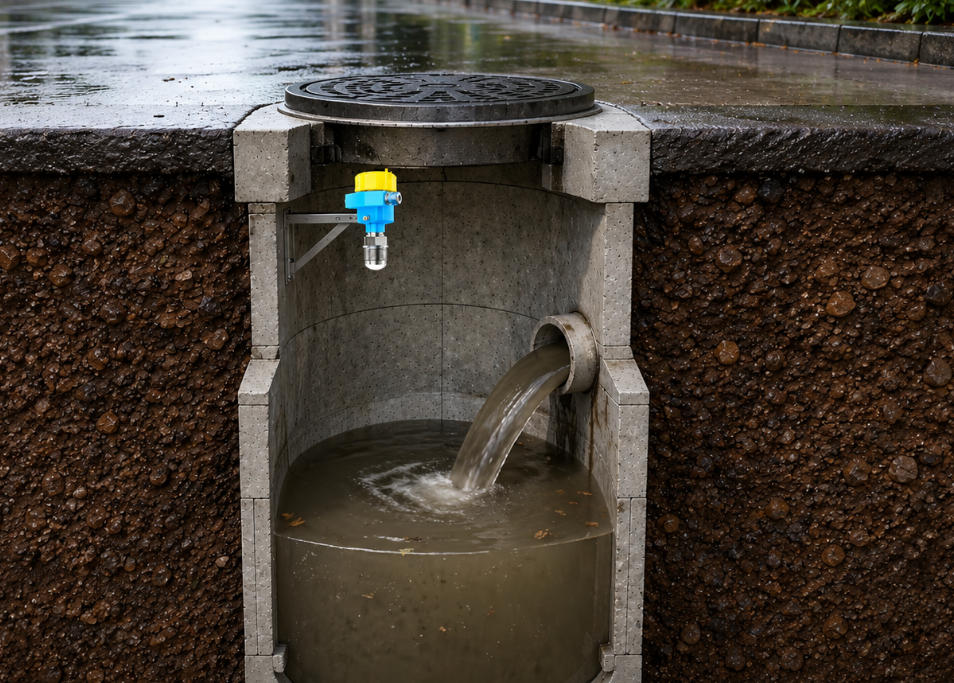
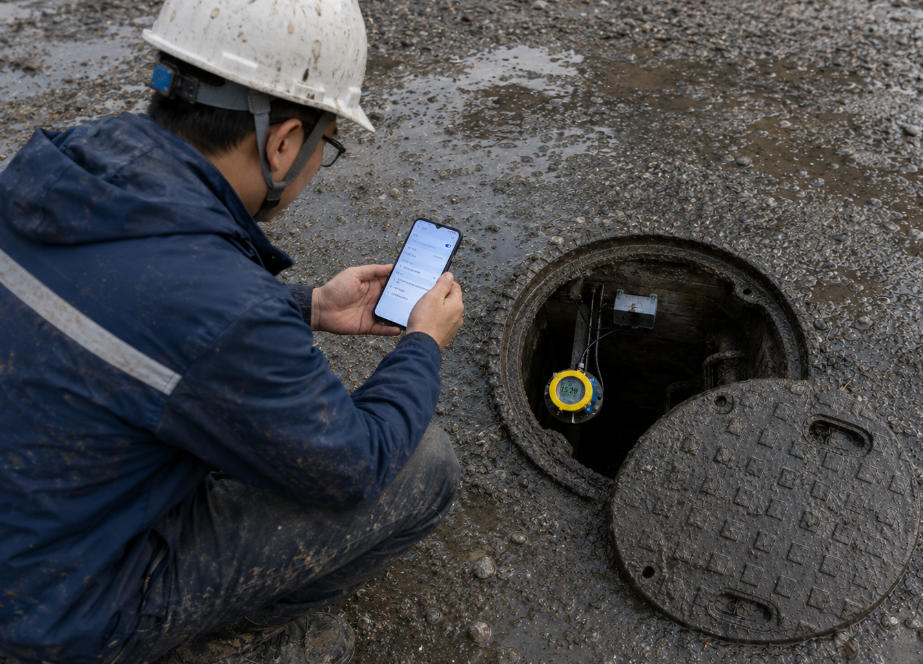
This case applies to a municipal stormwater inspection well. The well is located under a road, with a manhole cover and slippery surface above. Side water inlet pipes are installed inside the well. During rainfall, a large volume of turbid water mixed with silt, leaves, and debris flows into the well through the side pipes. Due to water impact, the liquid surface fluctuates, forming foam and floating debris. At the same time, the well space is narrow, humid, and contains odors and harmful gases, making manual inspection unsafe and inefficient.
Traditional submerged level sensors are easily affected by sediment accumulation, entanglement, and corrosive media, requiring high maintenance frequency. Ultrasonic level sensors often suffer from stability issues in humid, condensation-prone, or foamy well environments. In contrast, Remote Radar Level Sensors use non-contact measurement methods, installed on well brackets or under manhole covers, without directly contacting sewage. They continuously detect liquid levels and are especially suitable for stormwater wells, sewage wells, underground water tanks, drainage channels, storage basins, and pump station level monitoring.
2. Measurement Principle of 80GHz Radar Level Sensors
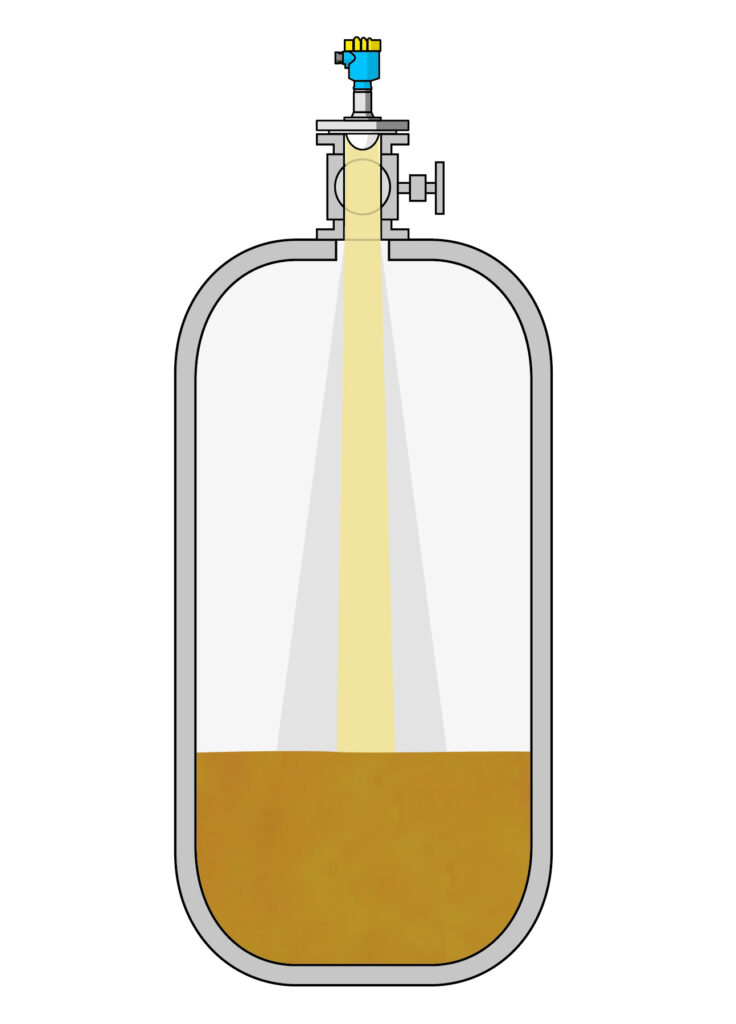
The 80GHz radar sensor typically uses FMCW (Frequency-Modulated Continuous Wave) technology. The sensor emits high-frequency electromagnetic waves toward the liquid surface. When the waves encounter the liquid, they are reflected back and received by the sensor. The system calculates the distance from the sensor to the liquid surface based on the frequency difference or time difference between emitted and received signals. Combined with well depth or tank height, the current liquid level is derived.
Compared with lower-frequency radar, the 80GHz radar has a narrower beam angle and more concentrated energy. In narrow wells, concrete walls, pipe entries, supports, and environments with multiple internal structures, it can more accurately target the liquid surface, reducing false echoes from walls or internal fixtures. For the illustrated inspection well scenario, where liquid continuously flows in from the side pipe with surface fluctuations and local disturbances, the 80GHz radar can output continuous and reliable liquid level data using stable echo recognition and filtering algorithms.
Importantly, radar measurement does not rely on sound propagation, so it is less affected by temperature, humidity, condensation, airflow, or noise. Even if the well contains condensation, light foam, or turbid water, as long as the surface forms a reflective interface, the radar sensor can maintain stable measurement.
3. On-Site Challenges: Complex Underground Environment and Maintenance Difficulty
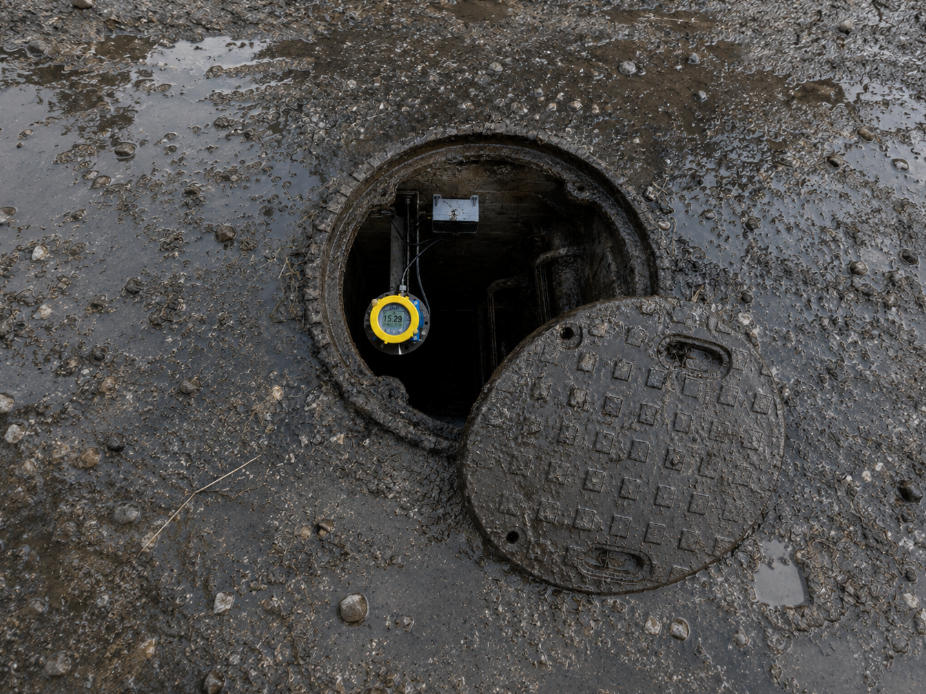
Earlier, the project relied on manual inspection and ordinary level switch combinations. Before and after heavy rain, maintenance staff needed to frequently open the manhole cover to check water levels, facing traffic, slippery surfaces, toxic gases, and fall hazards. Level switches could only provide high/low alarms without continuous level trends, leaving management unable to anticipate changes in pipeline pressure.
Additionally, commissioning in underground wells is difficult. Sensor installation near the well opening provides limited space, and rain complicates operations. If every sensor requires engineers to enter menus individually for wiring and parameter configuration, it is time-consuming and increases operation costs. For multiple inspection wells distributed across urban roads, campuses, industrial areas, or drainage nodes, the efficiency of bulk commissioning directly affects project implementation schedules.
Therefore, the customer sought a Remote Radar Level Sensor that is both stable in measurement and convenient for remote commissioning and batch parameter replication.
4. Solution: Jiwei JWrada® Radar Level Sensor for Underground Well Monitoring
For this scenario, the project installed Jiwei JWrada® Radar Level Sensors on the upper inner wall of the inspection wells, fixed via metal brackets, with radar beams directed vertically toward the liquid surface. Installation avoided side inlet pipes to prevent water impact on the measurement area. Appropriate parameters for range, blind zone, damping time, and false echo suppression were set to ensure the sensor could reflect rapid water level rises while avoiding output fluctuations caused by splashes, floating debris, or local turbulence.
The JWrada® Radar Level Sensor integrates stable Bluetooth connectivity, an intuitive app, an LCD display, and physical buttons, accommodating different countries, on-site practices, and maintenance team requirements. Devices can have their measurement range preset according to well depth at the factory, ready for on-site installation. Parameters can also be quickly adjusted on-site via physical buttons or Bluetooth app. Even if liquid is present in the well, a single device can typically complete parameter setup in 2–5 minutes, significantly reducing commissioning time.
For overseas or multi-point municipal projects, the Bluetooth app is especially valuable. Engineers can connect via Bluetooth to view real-time liquid levels, echo curves, signal strength, and device status. Chinese engineers can remotely guide local personnel without on-site visits. Furthermore, for wells with similar structures, parameters from one sensor can be copied to multiple devices with a single command, avoiding repeated configuration and improving batch deployment efficiency.
5. Application Benefits: Improved Drainage Visualization and Maintenance Efficiency
Once operational, the system allows the client to monitor inspection well water levels in real time. During heavy inflow, the Remote Radar Level Sensor provides continuous level data, enabling the platform to assess water rise rates. When levels approach warning thresholds, the system triggers alarms, prompting maintenance staff to check downstream pipelines or coordinate pump station discharge. After rainfall, declining level trends reflect drainage efficiency and help identify potential blockages, insufficient pump capacity, or localized drainage issues.
Compared with contact-type sensors, JWrada® Radar Level Sensors do not contact sewage or sediment, reducing fouling, corrosion, and maintenance. The combination of Bluetooth app and physical interface provides dual operation modes: LCD display and buttons for local confirmation, and Bluetooth app for full functionality including parameter setting, status monitoring, software updates, and batch replication—ideal for project-scale deployment and long-term maintenance.
6. Advantages of Jiwei Radar Level Sensors
In underground well monitoring, JWrada® Radar Level Sensors offer four main advantages:
- 80GHz high-frequency radar with concentrated beam, suitable for narrow wells and complex internal structures.
- Non-contact measurement reduces interference from sewage, sediment, and floating debris.
- Three interaction modes—Bluetooth app, LCD display, and physical buttons—support remote, local, and manual operation.
- Supports factory presets, fast on-site commissioning, and multi-device parameter replication, ideal for large-scale municipal deployments.
Regarding brand replacement, JWrada® Radar Level Sensors have replaced international brands such as VEGA in multiple projects. For users seeking lower procurement costs, faster delivery, and better local service response, JWrada® offers a high-performance, flexible, and adaptable solution. As a representative Chinese radar level sensor, JWrada® is increasingly serving global liquid level measurement markets with superior usability and reliability.
7. Conclusion
Liquid level monitoring in stormwater wells, sewage wells, and underground drainage networks requires instruments capable of withstanding moisture, sewage, foam, sediment, confined spaces, and rapid level changes, while being easy to install, commission, and maintain. Remote Radar Level Sensors, as exemplified by JWrada®, provide continuous, non-contact level measurement. Using 80GHz radar technology, Bluetooth app, LCD display, and physical buttons, the system delivers efficient support for both on-site operation and remote commissioning.
For municipal drainage, smart water management, industrial sewage tanks, underground storage, and pump station forebays, Jiwei JWrada® Radar Level Sensors are more than just measurement instruments—they are key devices that enhance the digitalization, visualization, and intelligent management of drainage systems.