Radar Level Meters and Tuning Fork Level Switches Are Suitable for Chemical Storage Tanks
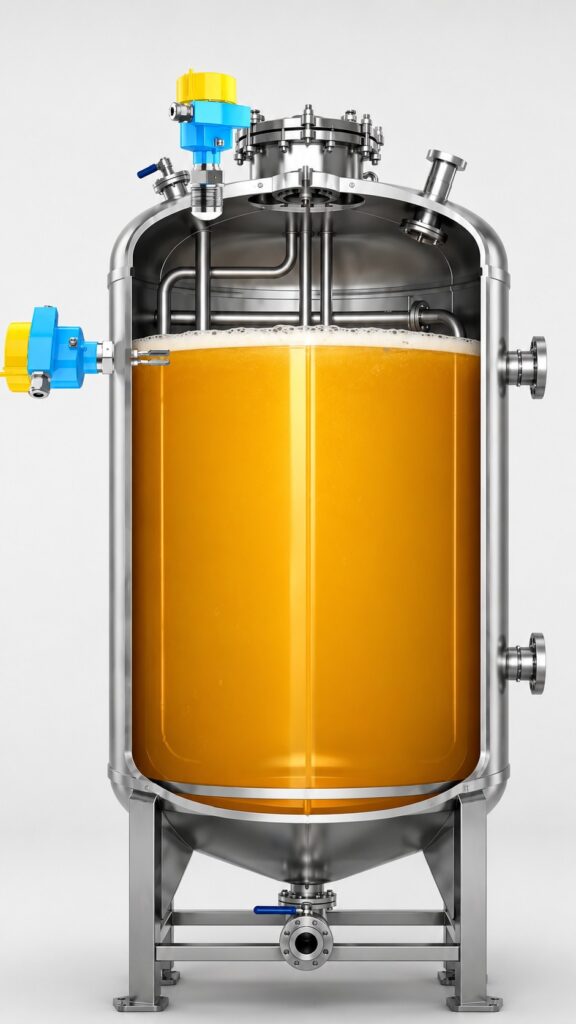
Chemical storage tank level measurement should not only solve the problem of “level display”. It should also consider continuous monitoring, high and low level alarms, overflow protection, pump dry-run protection, and the leakage risk of hazardous media. For most chemical storage tanks and buffer tanks, a more reasonable configuration is to use the Jiwei radar level meter for continuous level measurement, and the Ring-11 tuning fork liquid level switch for independent high-high level or low-low level protection.
Chemical storage tank level measurement is usually recommended to adopt a combination of “continuous level measurement + independent limit protection”, rather than relying on a single instrument only. The continuous level meter is responsible for providing real-time level, inventory, and process control signals; the level switch is responsible for outputting independent alarm or interlock signals at key positions such as high-high level and low-low level.
1. Why Should Chemical Storage Tank Level Measurement Not Rely on a Single Level Meter Only?
Chemical storage tanks and buffer tanks are commonly used for the temporary storage of raw materials, intermediates, solvents, acid and alkali liquids, oils, additives, or process liquids.
VEGA’s chemical storage tank application information also points out that storage tanks and buffer tanks need to continuously obtain accurate level data in order to refill materials in time, ensure continuous production, and provide a basis for consumption statistics, verification, and quality monitoring.
At the same time, this type of application also requires overflow protection. When this logic is applied to Jiwei product selection, it corresponds to the JWrada radar level meter being responsible for continuous measurement, and the Ring-11 tuning fork liquid level switch being responsible for limit protection.
If chemical storage tank level measurement is unreliable, the on-site risk is often not simply “inaccurate reading”, but may lead to chain consequences. For example, if high level is not alarmed in time, it may cause tank overflow, liquid accumulation in the containment area, medium volatilization, environmental pollution, or personnel exposure.
If low level is misjudged, it may cause pump dry running, mechanical seal damage, and production interruption. For flammable, explosive, corrosive, or toxic media, level measurement failure may further lead to fire, explosion, corrosion injury, and major shutdown losses.
2. What May Happen Without Reliable Level Measurement and High Level Protection?
Public accident information has repeatedly shown that high-risk liquid storage tanks cannot rely on a single measurement method only.
In the 2009 CAPECO storage tank accident, gasoline overflowed from a large aboveground storage tank, formed a large vapor cloud, and was ignited. According to the U.S. CSB information, if independent high level alarms or automatic overflow protection systems had existed on site, this type of large-scale leakage could most likely have been avoided; however, these additional protection layers were not used at that time. The CSB accident video also shows that in this accident, gasoline overflow formed a vapor cloud of approximately 107 acres and was ignited, indicating that tank overflow is not a minor fault, but may quickly develop into a major safety event.
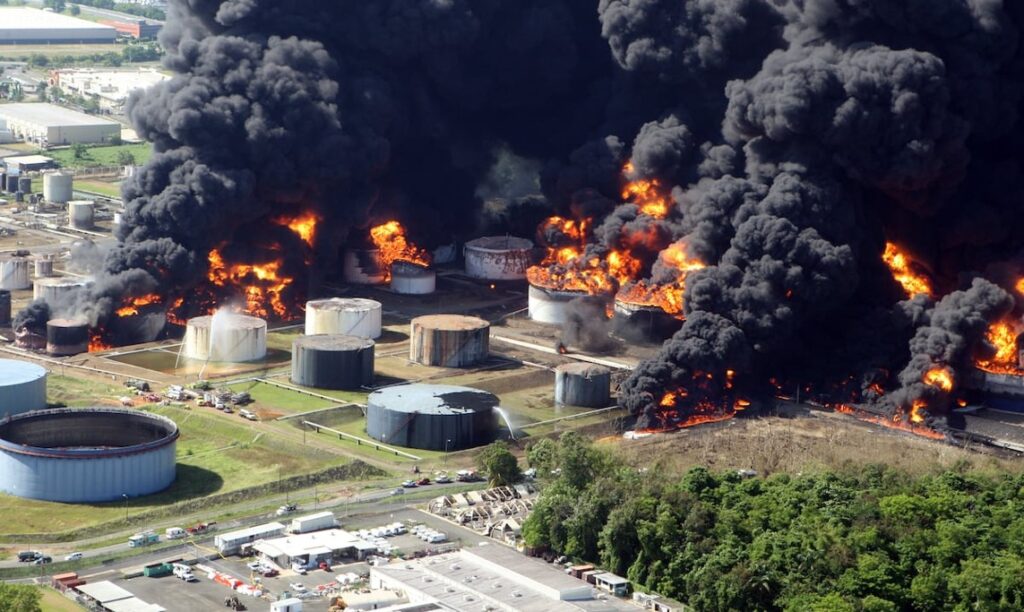
The Buncefield accident was also related to the failure of level measurement and high level protection. Public investigation information shows that during the level rise of Tank 912, both the automatic level gauge and the independent high level switch failed to work effectively, which was one of the direct causes of the accident. This case reminds us that even if level instruments are installed, if selection, commissioning, maintenance, and regular testing are not properly carried out, the protection layer may also fail at a critical moment.
These cases are not Jiwei customer cases, nor do they mean that a single type of instrument can prevent all accidents alone. What they truly show is that chemical storage tank level measurement should adopt a layered protection concept. Continuous measurement instruments, independent limit switches, alarm systems, interlock logic, regular testing, and on-site management are all indispensable.
3. The Role of JWrada Radar Level Meter in Chemical Storage Tank Level Measurement
In chemical storage tank level measurement, the radar level meter mainly undertakes the task of continuous level measurement. Its basic principle is that the radar antenna emits electromagnetic waves toward the liquid surface. After the electromagnetic waves reach the liquid surface, they are reflected back. The instrument calculates the distance from the antenna to the liquid surface according to the echo signal, and then converts it into the liquid level height.
The reason why radar level meters are suitable for chemical storage tanks is that they usually adopt non-contact measurement, reducing the influence of medium corrosion, adhesion, and density changes on measurement. For raw material tanks, intermediate tanks, or buffer tanks where the medium is frequently changed, non-contact radar is easier to reduce maintenance workload than many contact measurement solutions.
4. Why Is the Ring-11 Tuning Fork Liquid Level Switch Still Needed?
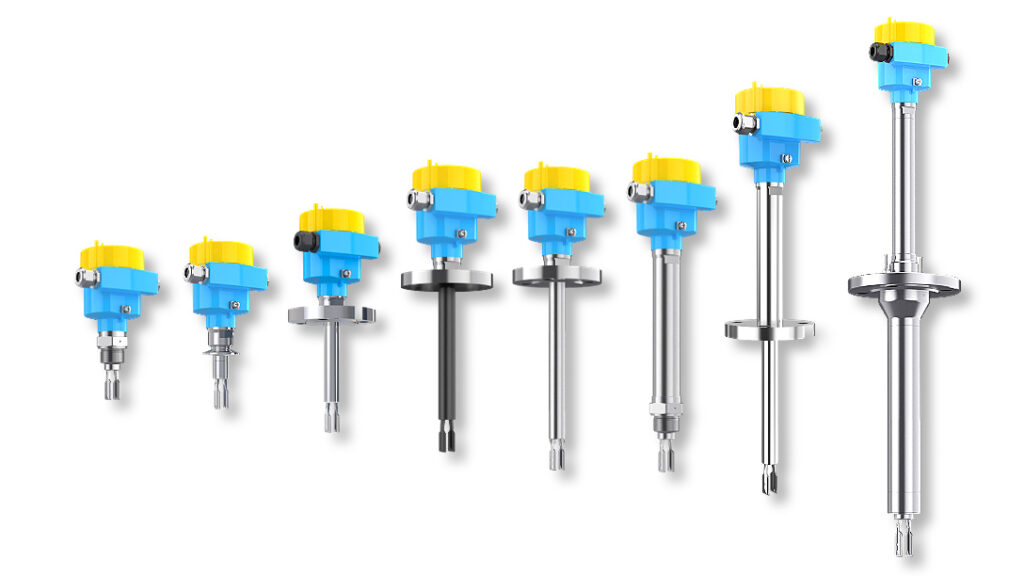
The radar level meter can provide continuous level signals, but for high-high level and low-low level protection of chemical storage tanks, it is still recommended to configure an independent level switch. The role of the Ring-11 tuning fork liquid level switch is not to replace radar, but to provide an independent point level signal at key positions.
The working principle of Ring-11 is to determine whether the fork is in contact with the liquid through the change of fork vibration frequency. When the fork contacts the liquid, the resonant frequency changes, and the detection circuit identifies the change and outputs a switch signal. From the perspective of reasonable product selection, Ring-11 is recommended for chemical storage tank level measurement, rather than Fork-11 or Tube-11, because Ring-11 is a liquid level switch; Fork-11 and Tube-11 are more suitable for powder, granular, and bulk solid level detection. For high level alarm, low level alarm, overflow protection, or pump dry-run protection in liquid storage tanks, Ring-11 is more consistent with the product application.
For strongly corrosive chemical liquids, Ring-11 also needs to be selected according to the wetted material. In acid, alkali, salt solution, or solvent media, it is not enough to only consider “whether it can detect the level”; the long-term compatibility between the wetted material and the medium must also be confirmed.
5. Questions That Must Be Asked During On-Site Selection
When selecting instruments for chemical storage tank level measurement, at least the following information should be confirmed:
First, it is necessary to confirm the medium name, whether it is flammable or explosive, whether it is corrosive, whether it is toxic, and whether it is easy to crystallize or adhere. The medium determines the antenna, seal, fork, and process connection materials.
Second, it is necessary to confirm the storage tank height, actual measuring range, tank roof structure, nozzle height, nozzle diameter, whether there is an agitator, heating coil, internal floating roof, feed impact, or steam condensation. The installation environment directly affects the radar echo quality.
Third, it is necessary to confirm the process temperature, process pressure, ambient temperature, and hazardous area classification. Especially for JWrada-35, the pressure rating of the flange connection needs to be confirmed, and it cannot be quoted according to a threaded connection.
Finally, it is necessary to confirm the output signal and control logic. Continuous level measurement usually uses 4–20mA/HART or RS485/Modbus; the level switch should select relay, NAMUR, two-wire, or transistor output according to the requirements of PLC, DCS, or safety circuit.
6. Conclusion: The Key to Chemical Storage Tank Level Measurement Is “Matching the Working Conditions”, Not Blindly Adding Configurations
There is no single model suitable for all chemical storage tank level measurement applications, and relying only on a continuous level meter is not enough to form complete protection. If you are selecting level instruments for chemical storage tanks, buffer tanks, solvent tanks, acid and alkali tanks, reactors, or intermediate tanks, you can provide Jiwei Automation with the medium, temperature, pressure, measuring range, installation opening, flange standard, output signal, and explosion-proof requirements. Jiwei can assist in recommending a suitable JWrada radar level meter and Ring-11 tuning fork liquid level switch configuration according to the on-site working conditions.
7. FAQ
Q1: Why is it still necessary to install a Ring-11 tuning fork liquid level switch after installing a radar level meter?
The radar level meter is responsible for continuous level measurement, while Ring-11 is responsible for independent high-high level or low-low level protection. For chemical storage tanks, an independent level switch can serve as an additional protection layer, reducing overflow and dry-running risks caused by radar, control system, or human operation errors.
Q2: Can Fork-11 or Tube-11 be used for chemical liquid storage tanks?
Generally, it is not recommended. Fork-11 and Tube-11 are more suitable for powder, granular, and bulk solid level detection. For high and low level alarms, overflow protection, and pump dry-run protection in liquid applications, Ring-11 tuning fork liquid level switch should be preferred.
Q3: For strongly corrosive media, should radar or tuning fork be selected?
For continuous level measurement, anti-corrosion radar level meters should be prioritized. For example, JWrada-35 can be evaluated according to the working conditions, with antenna materials such as PFA, 316L+PTFE, or 316L+PFA. For high-high level or low-low level protection, Ring-11 anti-corrosion tuning fork liquid level switch can be used, and wetted materials such as PFA, ECTFE, enamel, and Hastelloy can be selected according to the medium.
Q4: What parameters are most easily missed in chemical storage tank level measurement?
The most easily missed parameters include flange pressure rating, nozzle height, medium corrosiveness, steam and foam conditions, explosion-proof classification, alarm point height, interlock logic, and regular testing requirements. Especially for high-high level protection, it should not only stop at “having an alarm point”; it is also necessary to confirm whether the alarm is reliable, independent, and regularly tested.