Why Add a Level Switch When a Radar Level Meter Is Already Installed on a Reaction Vessel?
Reaction vessel level measurement should not only focus on whether the level is “displayed”. It should also consider stirring, foam, vapor, temperature and pressure changes, corrosive media, high-level overflow, and low-level dry-running risks.
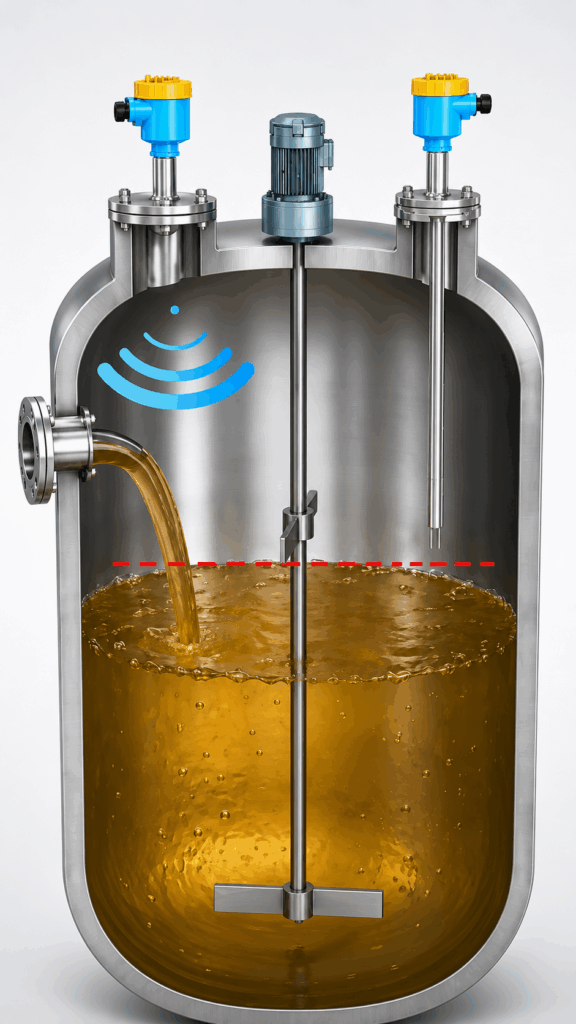
For most chemical reaction vessels, a more reasonable configuration is to use a JWrada radar level meter for continuous level measurement, and a Ring-11 tuning fork liquid level switch for independent high-level or low-level protection. The radar level meter is responsible for real-time continuous measurement and outputs the level signal to the PLC, DCS, or local display system; the tuning fork liquid level switch is responsible for outputting independent alarm or interlock signals at key points such as high-high level and low-low level.
Reaction vessels are different from ordinary storage tanks. Internally, they commonly include agitators, heating coils, vapor, foam, liquid surface fluctuation, and medium changes. During the reaction process, temperature, pressure, and medium conditions may change continuously, so the level instruments need to maintain stable measurement under these changing conditions. Typical difficulties in reaction vessels include medium changes, disturbed liquid surfaces, foam, agitators, and heating coils, which is why reaction vessel level measurement and point level detection need to be considered together.
1. Why Is Reaction Vessel Level Measurement More Complex Than Ordinary Storage Tanks?
Chemical reaction vessels are usually used for mixing, synthesis, polymerization, neutralization, extraction, dissolution, crystallization, and other processes. The liquid level is not only related to material inventory, but also directly affects reaction space, feeding ratio, stirring efficiency, heat transfer effect, and safety margin.
In actual field applications, the following problems are common in reaction vessel level measurement:
First, the reaction medium may change continuously. Before reaction, it may be raw material liquid; during the reaction, emulsification, foam, precipitation, crystallization, or viscosity changes may occur; after the reaction, it may become another material state. Contact-type instruments may be affected by adhesion, buildup, or corrosion.
Second, agitators and heating coils may cause interference. Stirring causes liquid surface fluctuation, and internal structures may generate false echoes. If the radar level meter is installed in an improper position, the echo may be affected by agitator blades, inlet flow, or coils.
Third, temperature and pressure changes are obvious. Many reaction vessels involve heating, temperature holding, cooling, vacuuming, or pressurization processes. Instruments need to be selected according to the actual temperature, pressure, and sealing requirements, and cannot be treated simply as normal-temperature and normal-pressure storage tanks.
Fourth, the safety risk is higher. High level may cause reaction liquid to enter the exhaust, condensation, or safety relief system; low level may cause heating coil dry burning, pump dry running, or stirring failure. For flammable, corrosive, toxic, or exothermic reaction media, level loss of control may lead to more serious safety and property losses.
Therefore, the key point of reaction vessel level measurement is not simply installing one level meter, but establishing a clear measurement and protection hierarchy.
2. The Role of JWrada Radar Level Meter in Reaction Vessels
The JWrada radar level meter mainly undertakes continuous level measurement in reaction vessels. Its measurement logic is: the radar antenna emits electromagnetic waves toward the liquid surface; after the electromagnetic waves reach the liquid surface, they are reflected back; the instrument calculates the distance from the antenna to the liquid surface according to the echo signal, and then converts it into the liquid level height.
For reaction vessels, the advantage of radar level meters lies in non-contact measurement. It does not require a probe rod to be immersed in the medium for a long time, which can reduce the influence of corrosion, buildup, crystallization, and adhesion on the measuring components. For reaction vessels with frequent medium changes, obvious liquid surface disturbance, or limited maintenance space, non-contact radar is more conducive to reducing daily maintenance workload.
In selection, it is not recommended to classify all reaction vessels directly into one model. The judgment should be based on measuring range, temperature, pressure, corrosiveness, foam, vapor, stirring intensity, installation opening, and explosion-proof requirements.
3. What Should Be Noted When Installing a Radar Level Meter on a Reaction Vessel?
The installation position of the reaction vessel radar level meter is very important. The radar should not face the inlet directly, nor should it face the agitator shaft, agitator blades, heating coils, or obvious internal structures. Inlet impact may cause liquid surface fluctuation and splashing, while agitators and coils may generate false echoes, all of which will affect echo judgment.
A more reasonable approach is to install the radar in an area where it can stably view the liquid surface, avoiding inlet flow and strong interference structures. If the tank top space is limited, the nozzle height, nozzle diameter, antenna structure, beam angle, and internal structure drawing should be confirmed together. For reaction vessels with obvious vapor or condensation, attention should also be paid to antenna corrosion resistance, anti-condensation, and sealing material selection.
If the reaction vessel has explosion-proof requirements, the explosion-proof type should also be confirmed according to the field area classification. For acids and alkalis, solvents, chlorine-containing media, or other corrosive liquids, the antenna, seal, and process connection materials should be confirmed first, rather than only looking at measuring range and output.
4. Why Does the Reaction Vessel Still Need a Ring-11 Tuning Fork Liquid Level Switch?
The radar level meter can provide continuous level signals, but it should not replace all safety protection functions. For high-high level alarm, low-low level alarm, pump protection, or prevention of abnormal heating, it is still recommended to set an independent point level switch.
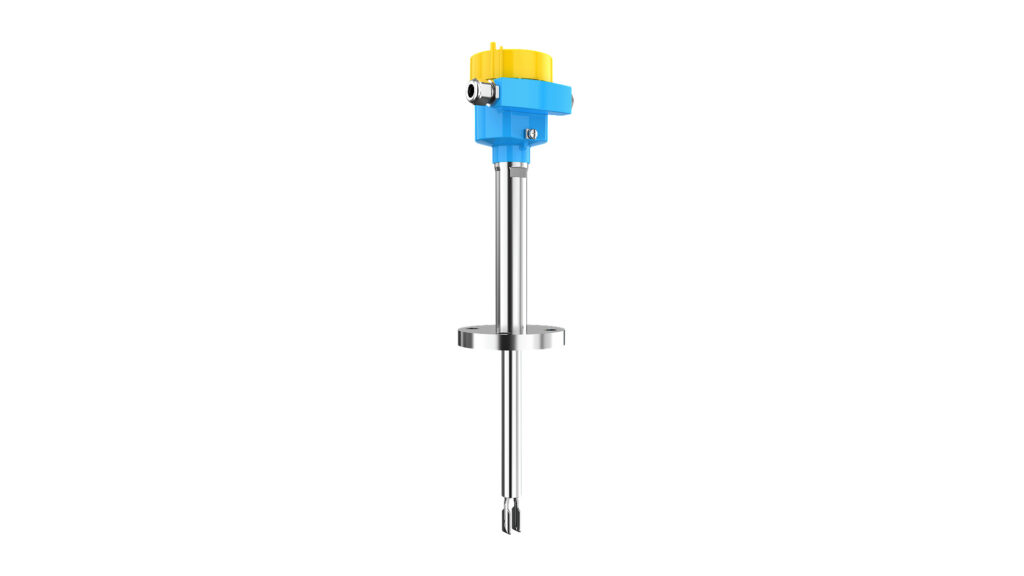
The working principle of the Ring-11 tuning fork liquid level switch is to determine whether the fork is in contact with the liquid through the change of fork vibration frequency. When the fork contacts the liquid, the resonant frequency changes significantly, and the detection circuit identifies it and outputs a switch signal. Unlike continuous radar, Ring-11 outputs a key point level signal, which is suitable for high-level alarm, low-level alarm, overflow protection, and pump dry-run protection.
For reaction vessel level measurement, Ring-11 is recommended instead of Fork-11 or Tube-11 for a clear reason: Ring-11 is a liquid level switch, while Fork-11 and Tube-11 are more suitable for powder, granular, and bulk solid level detection. For high and low level alarms, overflow protection, and pump dry-run protection in liquid reaction vessels, a tuning fork liquid level switch that matches liquid working conditions should be preferred.
5. What Information Must Be Confirmed During Field Selection?
For reaction vessel level measurement selection, at least the following information needs to be confirmed.
First, confirm the medium name, density, viscosity, dielectric constant, corrosiveness, toxicity, flammable and explosive characteristics, and whether it will crystallize, build up, foam, or generate precipitation.
Second, confirm the reaction vessel height, actual measuring range, working level, highest level, lowest level, alarm point position, nozzle height, nozzle diameter, tank top structure, agitator position, heating coil position, and inlet position.
Third, confirm the process temperature, process pressure, vacuum condition, ambient temperature, explosion-proof area classification, protection rating, and cleaning method.
6. Conclusion: The Key to Reaction Vessel Level Measurement Is to Let Measurement and Protection Perform Their Own Functions
Reaction vessel level measurement is not a single instrument selection issue, but the result of process safety, process control, and equipment protection working together. The JWrada radar level meter is suitable for continuous level measurement, while the Ring-11 tuning fork liquid level switch is suitable for independent high and low level limit protection. When used together, they can form a clearer hierarchy for level trend, process control, overflow alarm, and pump protection.
If you are selecting level instruments for chemical reaction vessels, stirred vessels, polymerization vessels, neutralization vessels, solvent reaction vessels, or strongly corrosive reaction containers, you can provide Jiwei Automation with the medium, temperature, pressure, measuring range, installation opening, stirring structure, flange standard, output signal, and explosion-proof requirements to obtain a more suitable configuration recommendation for JWrada radar level meters and Ring-11 tuning fork liquid level switches.