Level Measurement Technology Selection in Flour Mills: Vibrating Rod vs. Rotary Paddle Level Switches
In the flour processing industry, the selection of level measurement devices directly affects production continuity and operational safety. Flour, as a typical low-density, high-dust, and adhesive powder material, imposes higher requirements on level measurement during storage and conveying. Therefore, making an informed choice between rotary paddle (rotary vane) level switches and vibrating rod level switches is a critical step in engineering design.
This article provides a systematic analysis of the two common types of level switches based on operating principles and adaptability to actual working conditions, offering a technical solution better suited for flour mills.
1. Key Requirements for Level Measurement in Flour Mills
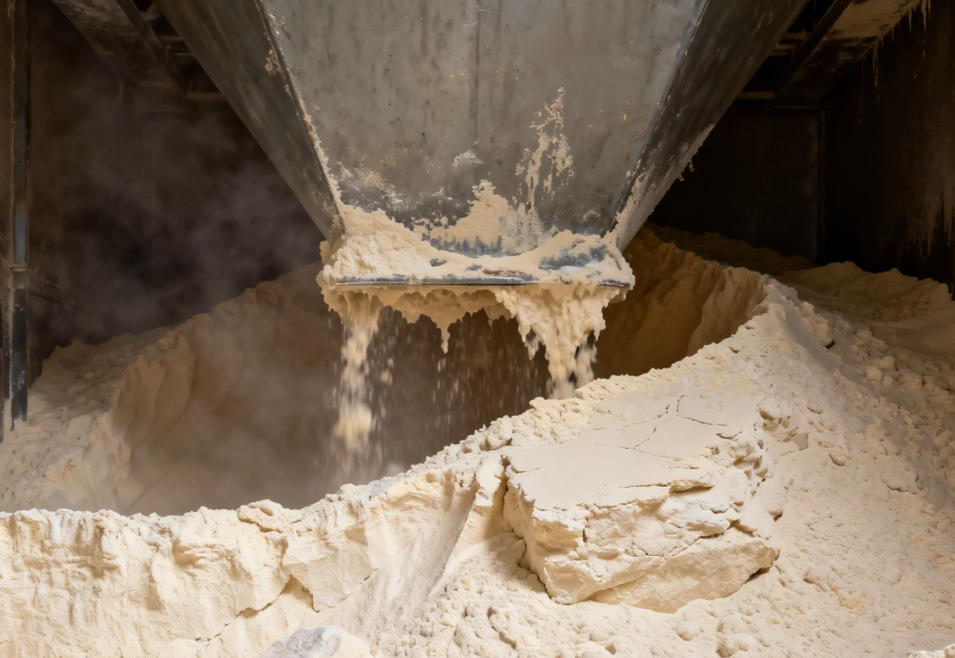
Typical Characteristics of Flour in Industrial Production
1. Low and variable material density
Flour is a low-density powder with a typical bulk density of approximately 0.4–0.6 g/cm³. In pneumatic conveying or loose piling conditions, the density may further decrease, with some regions approaching ultra-light powders. This characteristic can reduce the sensitivity of certain level detection devices, leading to delayed or missed detection.
2. High dust concentration and strong penetrability
During feeding, conveying, and discharge, large amounts of fine dust particles are generated. These particles can penetrate tiny gaps in equipment, accumulate over time, and potentially cause electrical failures or mechanical jams, affecting the device’s stability.
3. Bridging and arching, uneven material distribution
Due to humidity, temperature, and storage conditions, flour may form bridges or arches in silos, resulting in uneven material distribution. This can cause false empty or false full readings, interfering with accurate level detection.
4. Continuous production with high stability requirements
Flour production usually operates continuously. If level detection fails, it can cause equipment to run empty, blockages, or system downtime, increasing the need for reliable long-term operation.
5. Micro-positive pressure conditions in some scenarios
In pneumatic conveying or sealed silos, slight positive pressure often exists. This requires high sealing performance, as inadequate sealing could allow dust ingress, affect measurement accuracy, and pose safety risks.
Level Switch Selection Requirements Based on Working Conditions
Based on these characteristics, flour mills should focus on the following capabilities when selecting level switches:
1. Excellent sealing performance
Devices should have high protection ratings to prevent dust from entering critical components and ensure long-term stable operation in high-dust environments.
2. High sensitivity for low-density material detection
The device should reliably detect low-density or lightweight powders, maintaining stable signal output even when material is loosely piled or density fluctuates.
3. Strong anti-dust interference capability
The device should remain stable in high-dust conditions without false alarms or signal drift caused by adhesion or accumulation.
4. Long-term maintenance-free operation
Designs should minimize mechanical wear and reduce maintenance frequency to support continuous production and enhance overall operational efficiency.
2. Rotary Paddle (Rotary) Level Switch: Principles and Limitations
1. Working principle
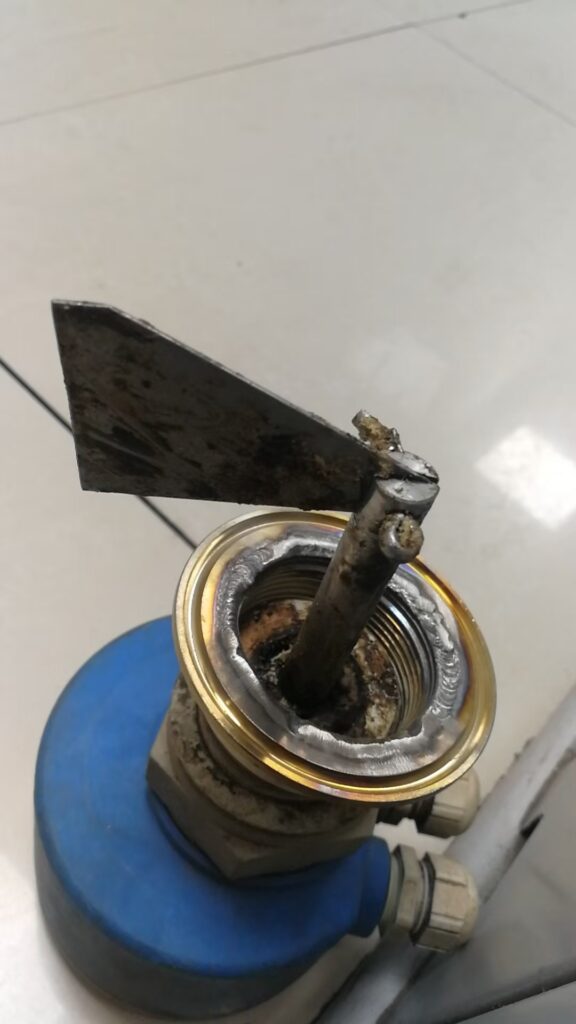
Rotary paddle level switches use a motor to continuously rotate a blade. When material contacts the blade and creates resistance, the torque change triggers the level signal.
2. Challenges in flour mill applications
(a) Limited sealing structure
The rotary paddle relies on a mechanical shaft, requiring a clearance between the shaft and housing. In dusty environments, this can cause:
- Dust ingress into the device
- Decreased performance due to long-term wear of seals
- Difficulty maintaining protection rating over time
(b) Material layer disturbance
Rotating blades can disturb surrounding material, resulting in:
- Localized material loosening or voids
- Inconsistent readings with actual material level
- More pronounced effects for low-density flour
(c) Jamming and false alarm risk
Moist or clumped flour may cause the blade to jam, leading to:
- False alarms
- Increased motor load
- Accelerated wear of mechanical components
(d) High maintenance requirements
Due to motors, bearings, and sealing structures, rotary paddle switches are prone to:
- Mechanical wear and aging
- Regular inspection and replacement needs
- Increased maintenance cost and downtime
3. Vibrating Rod Level Switch: Technical Advantages
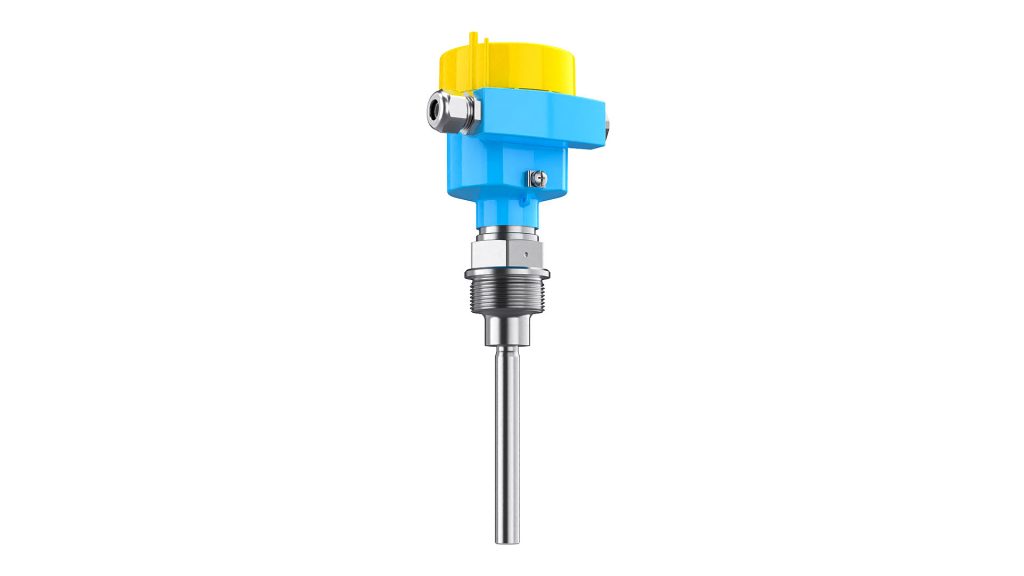
1. Working principle
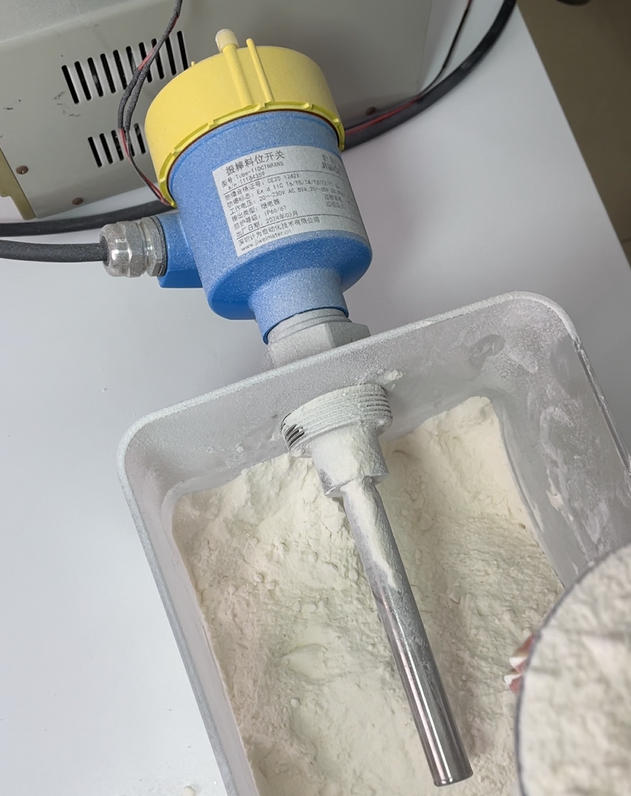
Jiwei Vibrating rod switches use a piezoelectric element to drive the probe into stable vibration. When material covers the probe, the vibration state changes (e.g., amplitude or frequency), triggering a level signal.
Core feature: No rotating parts and no mechanical transmission.
2. Adaptation to flour mill conditions
(a) Excellent sealing performance
- Shaftless, fully sealed design
- No dynamic seals
- High protection rating
Effectively prevents dust ingress and ensures stable operation in high-dust environments.
(b) Minimal disturbance to material
- Vibration amplitude is small, preserving natural material state
- Improves measurement accuracy
(c) Strong anti-adhesion ability
- Self-cleaning effect reduces material adhesion
- Lowers false alarm probability
(d) Low maintenance requirement
- No motor or mechanical transmission
- No wear-prone components
- Suitable for continuous operation
4. Tube-11 Vibrating Rod Level Switch: Technical Features
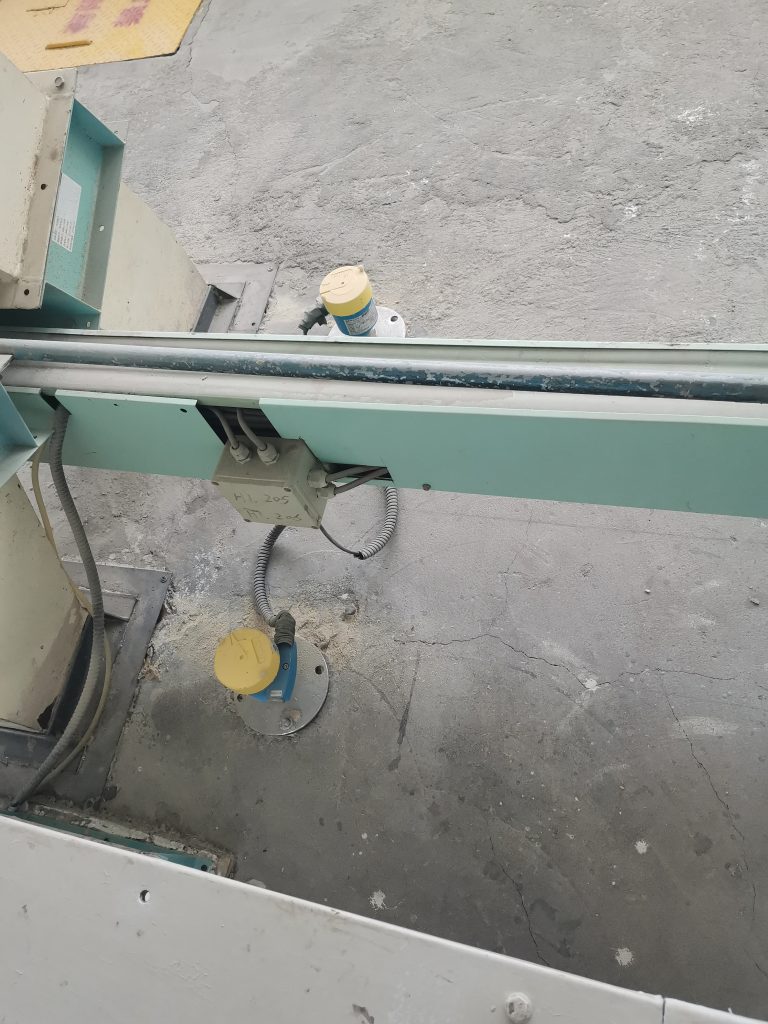
Tube-11 Verified in Flour Mills: 8 Years of Fault-Free Operation
1. Dual-tube nested vibration structure
Tube-11 uses inner and outer nested tubes, precisely tuned to the same resonance frequency. This ensures consistent vibration, significantly improving overall performance:
- Enhanced vibration stability, even under complex working conditions or external disturbances
- Improved anti-interference, resisting dust adhesion, material impact, and environmental changes
- Optimized measurement consistency, maintaining reliable readings over time
This design is a Chinese first, protected by multiple invention patents (ZL201510009538.3, ZL201510059187.7, ZL201610511184.7) and several utility model patents.
2. High-sensitivity detection
Tube-11 can detect very low-density materials, down to 0.02 g/cm³. Its high vibration sensitivity ensures reliable level detection even for loose or low-density powders, making it ideal for flour, bran, and other lightweight powders.
3. Adaptation to complex environments
- High protection rating prevents dust ingress
- Suitable for pressure environments in sealed silos or pneumatic conveying
- Ensures reliable long-term operation in continuous flour mill production
5. Technical Comparison
| Feature | Rotary Paddle Switch | Vibrating Rod Switch (Tube-11) |
|---|---|---|
| Working Principle | Mechanical rotation | Vibration state detection |
| Sealing Performance | Limited by shaft | Fully sealed |
| Dust Adaptability | Moderate | Excellent |
| Material Layer Impact | Causes disturbance | Minimal impact |
| Jamming Risk | High | Very low |
| Maintenance Requirement | High | Low |
| Low-Density Detection | Limited | Strong (0.02 g/cm³) |
6. Conclusion
Analysis of operating principles and adaptation to flour mill conditions shows that the limitations of rotary paddle switches stem from their mechanical structure, particularly in sealing and long-term stability.
In contrast, vibrating rod switches, with shaftless design and high sealing performance, provide clear advantages in dusty environments, low-density detection, and maintenance-free operation.
Therefore, for flour mill level measurement applications, vibrating rod switches—especially the dual-tube Tube-11—offer superior engineering value and long-term reliability.