JWrada®-21 Radar Level Transmitter for Sludge Monitoring in Overseas Water Plants
In the modern water utility industry, sludge treatment is not only related to the stable operation of wastewater treatment plants, but also directly affects transport scheduling, chemical dosing, thickening efficiency, and resource recovery performance. Especially in projects involving distributed sludge storage tanks, open sludge basins, and multiple remote sites, how to achieve continuous, reliable, and low-cost level monitoring using radar level transmitters has become an important issue for water utilities advancing digital operations.
BlueRiver Water Services, a water utility located in a coastal region of Southern Europe, has long been responsible for wastewater treatment and centralized sludge disposal for several towns. As its sludge resource recovery program continues to advance, the company plans to further process sludge into agricultural improvement materials and energy recovery feedstock, which has raised higher requirements for level monitoring during sludge storage, transfer, and thickening processes. Traditional manual inspection methods could no longer meet its needs for real-time visibility, accuracy, and remote management. For this reason, the company introduced the Jiwei JWrada®-21 radar level transmitter and established an intelligent monitoring system for remote sludge sites.

I. Project Background: Traditional Sludge Level Monitoring Exposed Multiple Problems
BlueRiver Water Services operates sludge sites across a wide geographical area. Some of these sites are far from the main plant, with complex field conditions and relatively limited infrastructure. In the past, levels in these sludge storage tanks and temporary sludge basins were mainly monitored through regular manual inspections. Operators had to visit the site, check the tank level or basin height, and then report the information back to the dispatch center by handwritten records and phone calls.
This method was manageable in the early stages, but as the treatment scale expanded, its shortcomings gradually became apparent:
First, manual records were obviously delayed and could not truly reflect real-time level changes in sludge basins. Once the level approached a high alarm point without being identified in time, it could easily cause an imbalance in transfer scheduling and affect subsequent thickening and dewatering processes.
Second, the frequency of manual inspection was limited, and judgment standards varied among personnel, resulting in poor data consistency. For a sludge dispatching system that requires refined management, such discrete and discontinuous data is difficult to use for scientific decision-making.
In addition, remote sites are often humid and odorous, and some areas are exposed to direct sunlight, rainfall erosion, and corrosive gases. Manual inspection is not only inefficient, but also increases operation and maintenance safety risks as well as management costs.
Therefore, BlueRiver Water Services urgently needed a level measurement solution that could adapt to outdoor sludge environments, be easy to install, deliver stable data, and allow remote access.
II. Solution Selection: JWrada®-21 Radar Level Transmitter Became the Core Device for Smart Sludge Monitoring
After evaluating multiple level measurement technologies, BlueRiver Water Services ultimately selected the Jiwei JWrada®-21 radar level transmitter as the core device for sludge level monitoring. This product adopts a high-frequency radar measuring principle, transmitting electromagnetic waves and receiving reflected echoes from the material surface to achieve non-contact continuous level measurement.
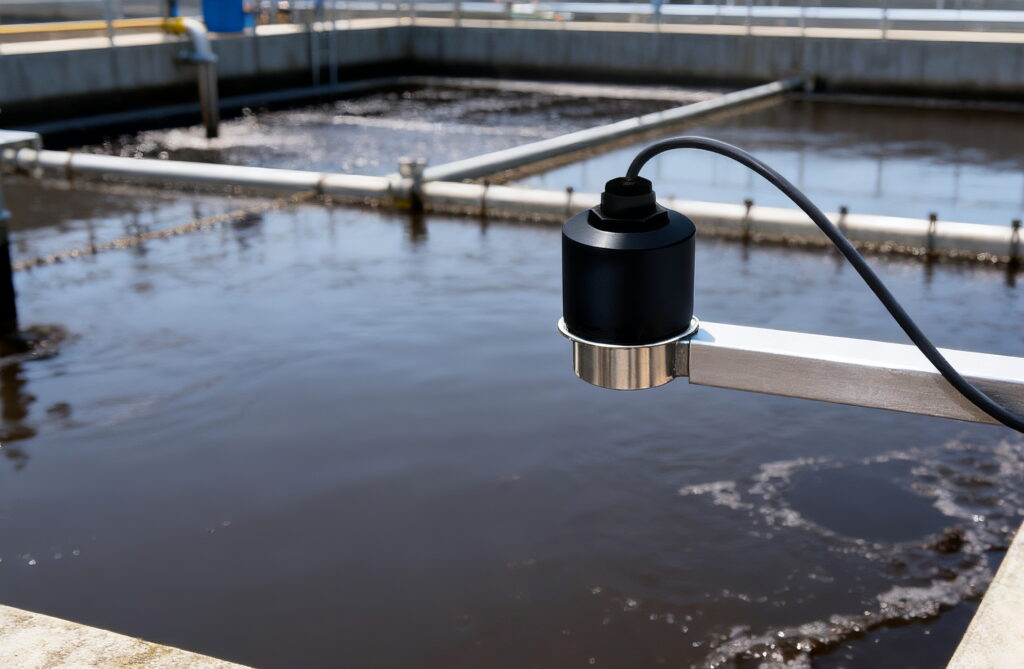
For applications such as sludge storage tanks and sludge basins, the advantages of the JWrada®-21 are particularly prominent.
On the one hand, sludge media are often accompanied by surface fluctuations, light foam, odorous vapors, and environmental dust. Traditional contact measurement devices are easily affected by contamination and buildup, while radar measurement, because it does not contact the medium, can effectively reduce maintenance frequency.
On the other hand, most sludge sites are open or semi-open structures, which place high demands on environmental durability. The JWrada®-21 can be installed above the tank top or on a bracket, avoiding direct contact with the medium while maintaining stable echo recognition capability and continuously providing reliable measurement data under complex process conditions.
More importantly, such remote sites often lack complete cable communication systems and large-scale automation infrastructure. In this project, the JWrada®-21 was deployed as a lightweight and easy-to-implement monitoring node, helping the utility achieve digital access to distributed sludge measurement points with lower investment.
III. Why Radar Technology Is Better Suited to Sludge Monitoring Applications
In this project, BlueRiver Water Services prioritized radar technology over float switches, ultrasonic instruments, or traditional contact level measurement solutions mainly for the following reasons.
1. Non-contact measurement reduces maintenance pressure in sludge applications
Sludge media typically have high adhesion, sedimentation tendencies, and a certain degree of corrosiveness. Contact measurement devices immersed in the medium over a long period are prone to scaling, blockage, and drift. In contrast, the JWrada®-21 uses a non-contact measurement principle, with the sensor installed above the medium and not directly touching the sludge, fundamentally reducing maintenance burdens caused by contamination and wear.
2. Flexible installation suitable for rapid deployment at remote sites
Many sludge basins and storage tanks in this project were not equipped with complex instrument interfaces. The JWrada®-21 could be installed simply with a top-mounted bracket, without requiring major modifications to the original basin structure. This installation method significantly shortened the construction period and reduced shutdown and retrofit costs.
3. Stable measurement suitable for open outdoor environments
For open sludge basins, ambient temperature fluctuations, humid air, and localized vapor interference may all affect measurement results. Radar technology is not sensitive to temperature changes and has strong anti-interference capability, enabling it to provide a more continuous and trustworthy data foundation for remote dispatch systems.
4. Strong data visualization capability supporting remote management
Compared with manual inspection, which can only provide a single level value at a specific moment, the JWrada®-21, once integrated into the centralized monitoring system in this case, can support level trend visualization, abnormal fluctuation identification, and high- and low-level warnings. Dispatch personnel can monitor sludge inventory changes at each site without going to the field, significantly improving operational decision-making efficiency.
IV. Project Implementation: From Pilot Application to Multi-site Rollout
To reduce the overall implementation risk, BlueRiver Water Services did not deploy the solution across all sites at once. Instead, it first carried out pilot testing at two representative sludge sites. These two sites were used to verify measurement performance under different conditions: one was an open temporary sludge basin, and the other was a covered sludge storage tank.
During the pilot stage, the JWrada®-21 was installed on brackets above the tanks and sludge basins, continuously monitoring level changes and transmitting data to the plant monitoring platform. After several months of operation, the device remained stable during routine sludge inflow and outflow fluctuations, post-rain high-humidity conditions, and peak transport scheduling periods, with the level data showing good consistency with actual operating conditions.
After confirming the effectiveness of the pilot, BlueRiver Water Services began expanding the solution to more remote sites. Because the installation process of the JWrada®-21 was simple, on-site personnel could complete basic deployment and parameter settings after short-term training, enabling smooth overall rollout. The project team also established a unified point management and maintenance mechanism so that level monitoring data from different sites followed consistent collection standards and display logic.
V. Project Results: More Accurate Sludge Dispatching and Significantly Improved Operational Efficiency
After the JWrada®-21 radar level transmitter was put into use, BlueRiver Water Services achieved significant improvements in sludge management.
First, the company’s understanding of sludge inventory shifted from “manual estimation” to “continuous monitoring.” The dispatch center can now view the sludge level status of each site in real time, arrange pumping and thickening plans in advance, and avoid tank overflow or empty transport runs caused by delayed information.
Second, on-site operation and maintenance pressure was significantly reduced. The previously high-frequency manual work was replaced by remote monitoring, and personnel no longer needed to frequently travel to remote sites to verify levels, saving substantial labor and transportation costs.
Third, the coordination of sludge treatment processes was improved. Continuous level data provided a clearer planning basis for subsequent sludge thickening, dewatering, transport, and resource recovery, making the overall operation more predictable.
More importantly, the project helped the company take an important step toward digital sludge management. By integrating level monitoring into its smart water utility system, BlueRiver Water Services not only improved current operating efficiency, but also laid the foundation for future sludge resource recovery projects and broader networked site management.
VI. Application Value of JWrada®-21 in the Water Industry
This case shows that the JWrada®-21 radar level transmitter is not merely a single-purpose level measurement device, but also an important sensing node for water utilities seeking refined management and smart operation and maintenance. Radar technology demonstrates strong application suitability for sludge basins, sludge storage tanks, waste liquid pits, and other open or semi-open containers requiring remote monitoring.
As the water industry continues to advance digitalization, low-carbon development, and resource recovery utilization, real-time acquisition and centralized analysis of level data are becoming essential capabilities. With its non-contact measurement, convenient installation, stable operation, and suitability for deployment at distributed points, the JWrada®-21 provides overseas water plants with a more efficient and flexible sludge level monitoring solution.
VII. Conclusion
For sludge treatment sites that are widely distributed, environmentally complex, and limited in infrastructure, traditional manual inspection can no longer meet the refined management requirements of modern water utilities. By deploying the Jiwei JWrada®-21 radar level transmitter, BlueRiver Water Services successfully achieved continuous, remote, and intelligent sludge level monitoring.
This case demonstrates that, in sludge storage, transfer, and treatment scenarios, radar level measurement can not only improve data accuracy and operational efficiency, but also help utilities optimize scheduling, reduce hidden costs, and accelerate the development of smart water systems. For overseas water plants seeking to upgrade their sludge monitoring solutions, the JWrada®-21 is undoubtedly a reliable option worthy of attention.