Can Radar Level Transmitters Still Operate Reliably in Freezing Environments? – Anti-Icing Application Case of Jiwei Radar
1. Introduction: Can Radar Level Transmitters Remain Stable in Freezing and Icing Environments?
In northern winter regions, cold-climate industrial parks, and low-temperature chemical, water treatment, and energy storage and transportation facilities, equipment icing, probe frosting, and ice accumulation on tank edges are very common operating conditions.
For many traditional measurement technologies, ice layers, condensation, humidity, and low temperatures can significantly affect measurement stability, even causing false alarms, signal fluctuations, or equipment failure.
Therefore, whether radar level transmitters can still maintain stable measurement in icing environments has become an increasingly important concern for industrial users.
This article is based on typical field conditions and focuses on the application of Jiwei JWrada® radar level transmitters in freezing environments. It systematically analyzes why radar probes can still operate reliably under icing, frosting, and condensation conditions, and discusses their engineering value in industrial applications.
2. Project Background: Open Storage Tanks Facing Icing Challenges in Low-Temperature Environments
In many industrial sites—especially wastewater treatment basins, circulating water tanks, chemical intermediate tanks, open storage tanks, environmental treatment basins, and low-temperature buffer tanks—equipment is usually installed outdoors.
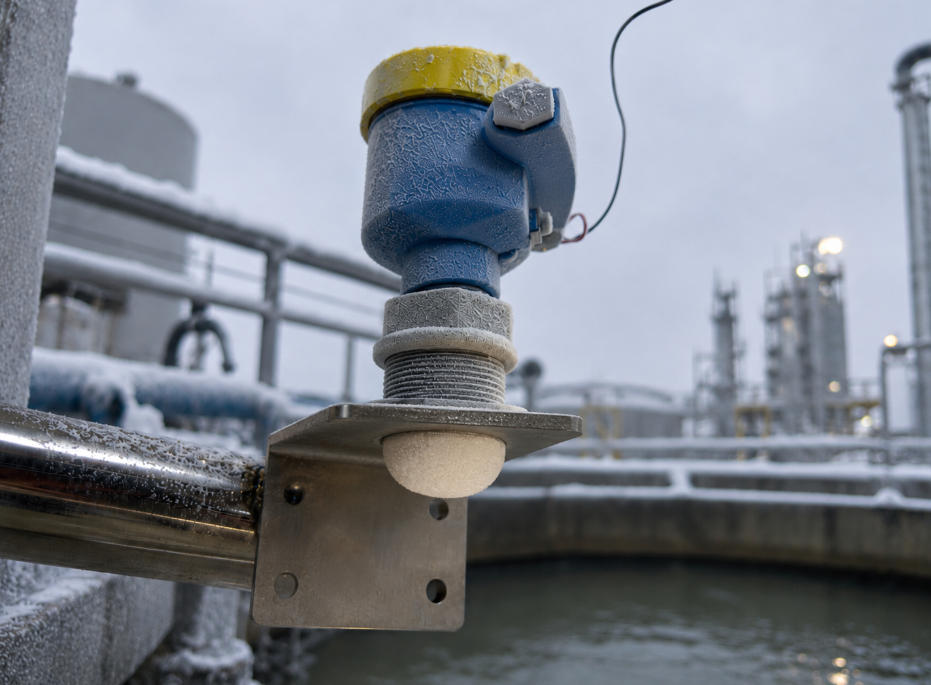
During winter, low air temperatures, continuous cold wind, and high humidity lead to visible frost and ice accumulation on tank edges, brackets, connection parts, and even instrument housings.
Typical characteristics of such open tank applications include:
- Outdoor installation with large day-night temperature differences
- High humidity, prone to condensation and frosting
- Ice accumulation on tank edges and support structures
- Exposure to wind, snow, and long-term cold conditions
- Continuous requirement for stable level signal output
In such conditions, users are mainly concerned about whether frost or ice on the radar probe will affect measurement accuracy, weaken echo signals, or cause unstable output.
3. Why Traditional Measurement Technologies Become Unstable in Icing Conditions
In freezing environments, traditional level measurement technologies are affected in different ways:
3.1 Contact-type instruments affected by adhesion
Some contact-based devices rely on probes, floats, or mechanical structures that directly contact the medium. When ice forms, it may cause sticking, delay, or signal distortion.
3.2 Ultrasonic systems affected by air conditions
Ultrasonic measurement depends on sound wave propagation in air. In cold environments, changes in air density, wind, condensation, and steam disturbances can affect signal transmission and echo interpretation.
3.3 Mechanical structures degrade in long-term outdoor use
Long-term exposure to low temperatures can reduce sealing performance, stability, and increase maintenance requirements for certain traditional instruments.
Therefore, in icing environments, industries tend to prefer non-contact, high anti-interference radar level transmitters with strong echo processing capabilities.
4. Why Jiwei Radar Probes Are Not Affected by Icing Conditions
4.1 Non-contact measurement ensures inherent stability
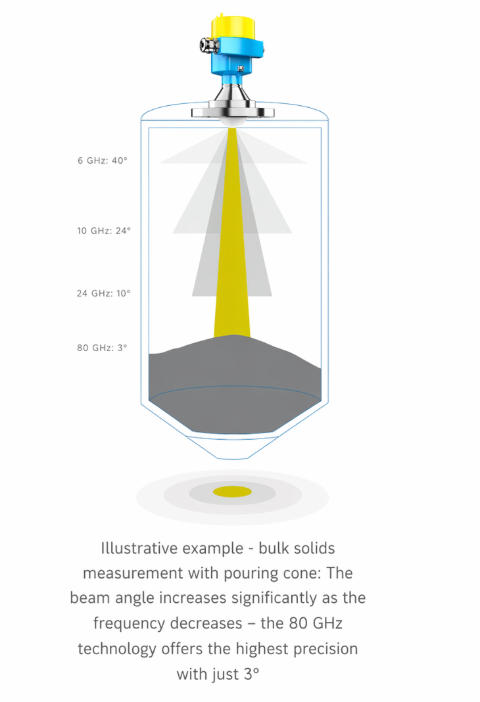
The Jiwei JWrada® radar level transmitter adopts 80GHz FMCW frequency-modulated continuous wave technology, measuring level by transmitting and receiving high-frequency microwave signals.
It is fundamentally a non-contact measurement method. The probe does not need to contact the medium, eliminating mechanical sticking, float freezing, or rod adhesion issues.
Even if frost appears on external structures such as brackets or housings, stable measurement can still be maintained as long as the radar emitting surface is not severely obstructed.
4.2 Narrow beam angle with concentrated energy
One of the major advantages of 80GHz radar is its narrow beam angle, highly concentrated energy, and strong directivity.
In open tanks or process basins, this allows the radar beam to focus more accurately on the liquid surface, reducing false reflections from tank walls, railings, and iced structures.
This significantly improves true echo recognition in complex and icy environments.
4.3 Frost does not equal failure: echo processing is the key
Many users assume that “frost on the probe means the device cannot work,” but this is not entirely correct.
What truly determines measurement stability is not surface condition alone, but:
- Microwave penetration capability
- Signal processing algorithms
- False echo suppression ability
The Jiwei JWrada® radar level transmitter includes:
- False echo recognition
- Multi-echo separation
- Dynamic target tracking
- Adaptive algorithms
- Echo learning functions
These capabilities ensure that even in low-temperature, humid, and lightly frosted conditions, the device can continuously identify the true liquid level echo instead of being disturbed by structural reflections or surface attachments.
4.4 Proper installation improves measurement reliability
From an engineering perspective, radar probes should be installed perpendicular to the liquid surface.
This ensures the strongest and most stable echo return signal.
In open tank applications, as long as installation is reasonable and the probe faces the liquid surface without obstruction, icing or frost around the structure will not affect the fundamental measurement principle.
5. Field Case: Continuous Measurement in a Frozen Open Process Basin
In a project located in the Zhungeer Economic Development Zone, Ordos, Inner Mongolia (China), an open process basin operates under long-term low-temperature winter conditions.
During winter, significant frost and ice accumulation were observed on tank edges, mounting brackets, and surrounding pipelines.
The system requires continuous level monitoring and data transmission to PLC and upper-level control systems for interlock control and operational management.
Customer concerns included:
- Whether frost on the probe would distort measurements
- Whether low-temperature conditions would cause signal fluctuations
- Whether icing would affect long-term reliability
- Whether false echoes could cause level jumps
After adopting the Jiwei JWrada® radar level transmitter, the system performed stably.
Even when frost formed on the probe housing and mounting structure, the device continuously output stable level data without abnormal fluctuations or false alarms.
Field results confirmed:
- Light frosting does not affect measurement stability
- 80GHz radar provides stronger real surface recognition in open tanks
- Non-contact radar is more suitable for long-term outdoor operation
- Proper installation ensures reliable measurement even in icing conditions
6. Technical Reasons Why Jiwei Radar Is Suitable for Freezing Conditions
6.1 High-frequency radar is better for open complex spaces
Compared with low-frequency radar, 80GHz radar provides better focusing ability in open tanks, silos, and complex structures.
6.2 Strong anti-interference capability
Even in environments with railings, tank walls, wind, snow, and condensation, signal processing algorithms effectively suppress false echoes.
6.3 No moving mechanical parts
Mechanical devices are more prone to failure in freezing conditions, while radar systems operate without mechanical contact, ensuring long-term stability.
6.4 Intelligent commissioning and diagnostics
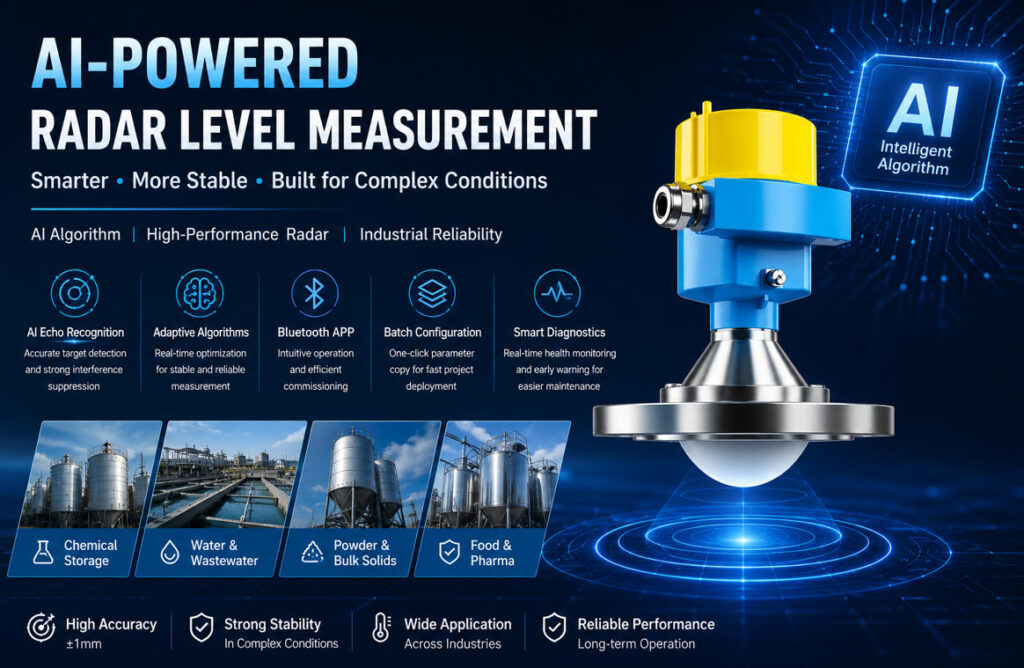
Jiwei radar supports Bluetooth wireless commissioning and the “Jiwei Smart Control®” APP, allowing users to view parameters, device status, and echo curves.
This significantly improves maintenance efficiency in winter outdoor environments.
7. Industries That Require Attention to Icing Conditions in Level Measurement
The Jiwei JWrada® radar level transmitter is particularly suitable for:
- Open wastewater and clean water tanks in northern regions
- Chemical intermediate and waste tanks in winter outdoor conditions
- Low-temperature energy storage systems
- Environmental treatment facilities with open tanks
- Level measurement points with frost, condensation, and cold disturbance
These environments share a common requirement: high reliability of continuous level data under harsh conditions.
8. Conclusion: Icing Is Not the Problem – Measurement Principle and Engineering Design Are
From an engineering perspective, frost or ice on the radar probe does not necessarily mean measurement failure.
The real determinants of performance are:
- Measurement principle
- Radar frequency characteristics
- Echo processing capability
- Installation design
With 80GHz high-frequency radar technology, non-contact measurement, narrow beam angle, intelligent echo algorithms, and strong anti-interference capability, the Jiwei JWrada® radar level transmitter can maintain stable and reliable measurement even in freezing and icing environments.
For industrial users operating in low-temperature, frost-prone, and icy conditions, Jiwei radar not only answers the question “can it measure?”, but also “can it measure stably, accurately, and reliably for long-term operation?” — which is the core value of advanced industrial level measurement systems.