Oil Tank Truck Level Measurement | Jiwei JWrada® Radar Level Transmitter in Mobile Tanker Storage Systems
I. Project Overview
In modern hazardous chemical transportation and liquid logistics industries, tanker trucks serve as critical transport equipment responsible for long-distance delivery of diesel, gasoline, lubricating oil, chemical solvents, and even food-grade liquids.
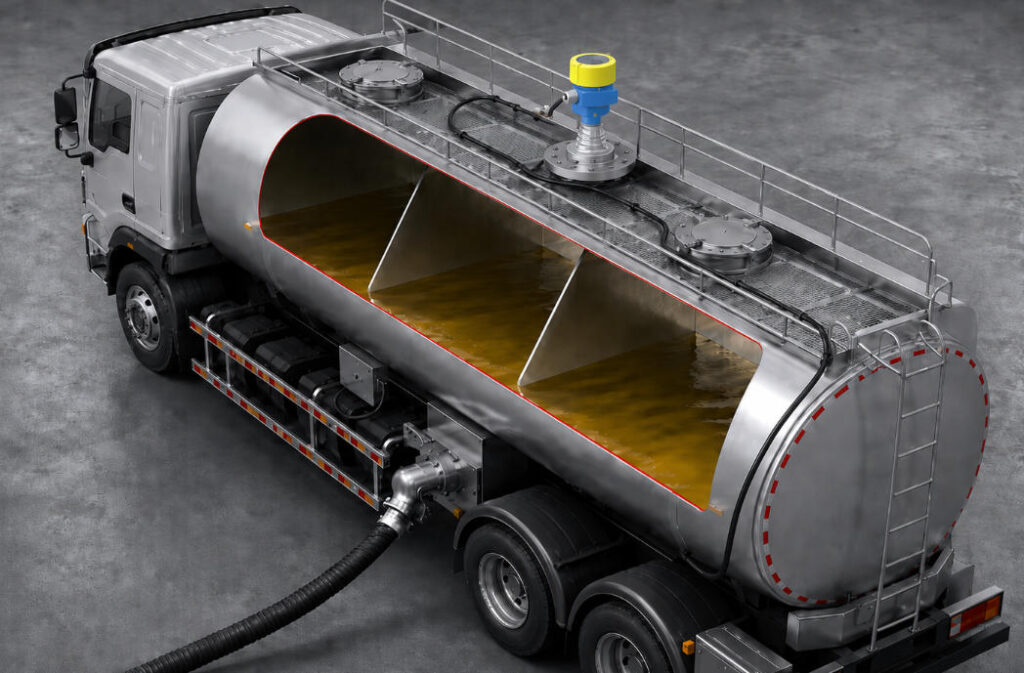
Due to the operating conditions characterized by high vibration, strong liquid sloshing, multi-media switching, confined installation space, and strict safety requirements, traditional mechanical level gauges or float-based measurement systems can no longer meet modern intelligent management demands.
This case is based on a real tanker structure and adopts the Jiwei Automation JWrada® series 80GHz high-frequency radar level transmitter, enabling non-contact, high-precision liquid level measurement. The system provides stable and reliable data support for fuel transportation and can be directly integrated into vehicle control systems to achieve automatic loading/unloading and safety interlock control.
II. Industry Pain Points (Tank Truck Level Measurement Challenges)
In tanker truck applications, liquid level measurement faces several critical challenges:
1. Strong Vibration and Continuous Sloshing
During vehicle movement, the liquid inside the tank is constantly fluctuating, making float or hydrostatic sensors unstable or inaccurate.
2. Complex and Variable Media
The same tanker may transport diesel, gasoline, edible oil, lubricants, or chemical liquids, with significant density variations affecting pressure-based measurement accuracy.
3. High Safety and Explosion-Proof Requirements
Fuel and chemical liquids are flammable and explosive, requiring equipment that meets Ex protection standards (Ex db / Ex ia).
4. Limited Installation Space
The top of the tank includes filling ports, breathing valves, and inspection openings, leaving very limited installation space.
5. No Real-Time Manual Monitoring
Traditional methods rely on manual dipping or estimation, which cannot support digital or remote monitoring.
III. Solution: Jiwei JWrada® 80GHz Radar Level Transmitter
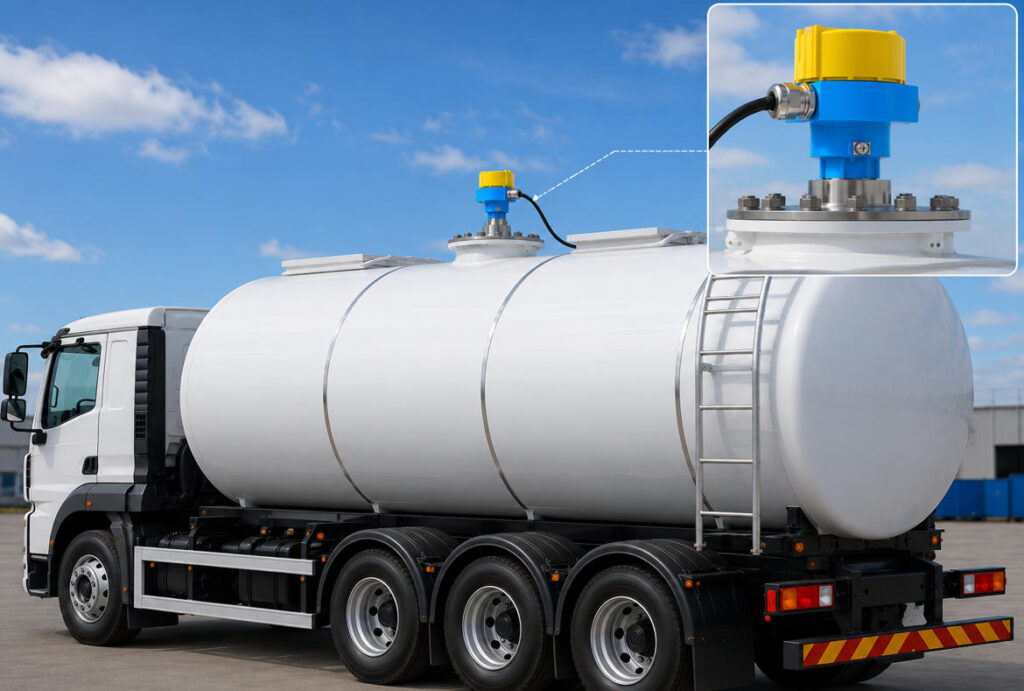
To address the above challenges, the system adopts the Jiwei JWrada® PRO series radar level transmitter, based on FMCW (Frequency Modulated Continuous Wave) technology, achieving non-contact high-precision measurement.
Key Advantages:
1. Non-Contact Measurement with Anti-Vibration Performance
Radar signals are not affected by liquid sloshing, maintaining stable echo even during braking or acceleration.
2. 80GHz Narrow Beam Technology
With an ultra-narrow beam angle, the radar avoids internal structures such as baffles and reinforcements, reducing false echoes.
3. High Accuracy (±1 mm Level)
Ideal for high-value fuel transportation requiring precise loading control.
4. Industrial Explosion-Proof Design
Meets hazardous area requirements for petrochemical and fuel transportation industries.
5. Bluetooth + Mobile App Commissioning (Jiwei Smart Control)
Enables fast on-site configuration via smartphone APP, significantly improving commissioning efficiency.
IV. System Structure and Installation Method
In tanker truck level measurement systems, installation design is critical for long-term stability. Since the tanker is a mobile sealed pressure vessel, the system must consider vibration, shock, sealing, electrical safety, and maintenance convenience.
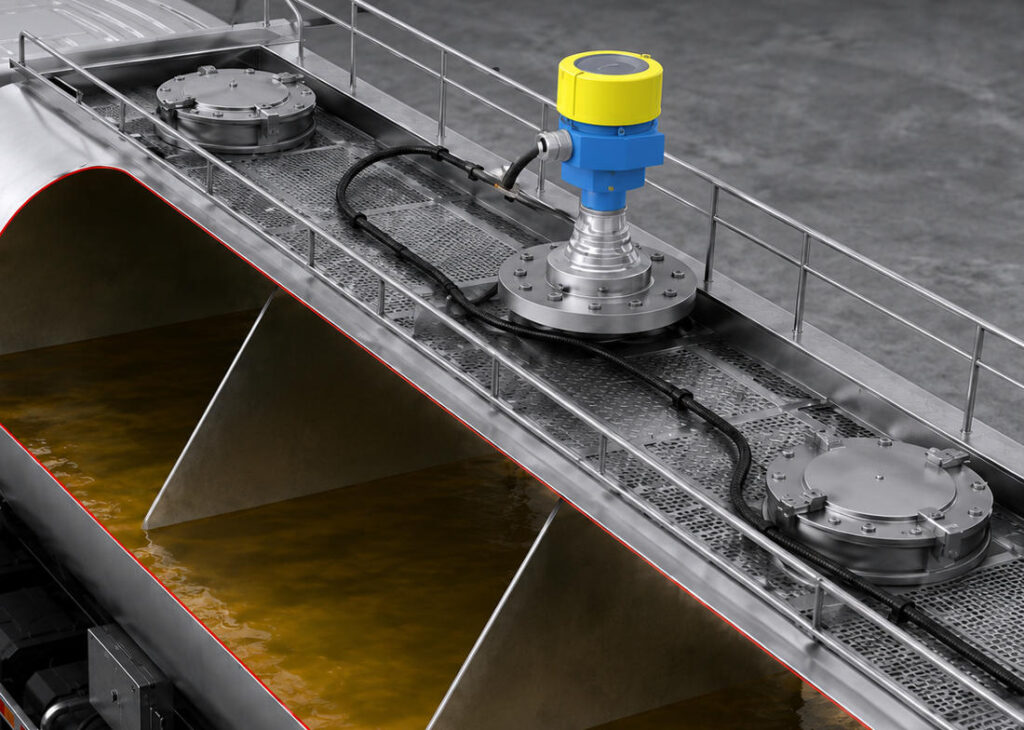
The JWrada® radar level transmitter is installed on the top flange process port of the tank, forming a stable industrial measurement system.
1. Top Flange Installation Design
The radar transmitter is mounted on standard flanges (DN50 / DN80 or ASME 4”), ensuring:
- Radar antenna aligned vertically toward tank center
- Avoidance of inlet turbulence zones
- No obstruction from internal structures
- Stable signal reflection path
High-strength bolts and oil-resistant sealing gaskets ensure mechanical stability under vibration conditions.
2. Explosion-Proof and Sealing Design
The system meets strict safety requirements:
- Ex db / Ex ia explosion-proof design
- Industrial cable glands for sealing
- Oil-resistant, high-temperature shielded cables
- Double-seal housing to prevent vapor ingress
Signal cables are routed through protective conduits along the tank top and fixed with metal clamps to prevent mechanical stress during vehicle movement.
3. Electrical Connection Architecture
Typical system configuration:
Power Supply
- 24V DC vehicle power system
- Over-voltage protection via fuse module
Signal Output
- 4–20mA analog output
- RS485 Modbus-RTU communication
- Optional HART protocol
Integration Targets
- Vehicle PLC system
- Driver cabin display unit
- IoT remote monitoring system (GPS + 4G module)
4. Cable Routing and Vehicle Adaptation
Cable routing must comply with anti-vibration design standards:
- Routed along tank top platform
- Stainless steel clamps every ≤300mm
- Flexible bends at turning points
- Protective sleeves through chassis area
- Avoid parallel installation with fuel pipelines
5. Anti-Vibration Structural Optimization
To ensure stable operation under dynamic conditions:
- Rigid flange mounting design
- Anti-vibration antenna structure
- Dynamic echo filtering algorithm
- Reinforced cable fatigue resistance
The system maintains stable output even under braking, turning, or rough road conditions.
6. Commissioning and Configuration Process
- Verify flange sealing and installation
- Check power polarity and voltage
- Connect via Jiwei Smart Control APP
- Set tank height and measurement range
- Enable echo learning function
- Perform empty and full tank calibration
- Integrate with vehicle control system
Commissioning time: 2–5 minutes per device
7. Long-Term Structural Stability
In long-term operation, the system offers:
- Maintenance-free operation
- Stable flange connection under vibration
- Explosion-proof sealing integrity
- No mechanical wear due to non-contact measurement
- Extended service life
V. Key Technical Features
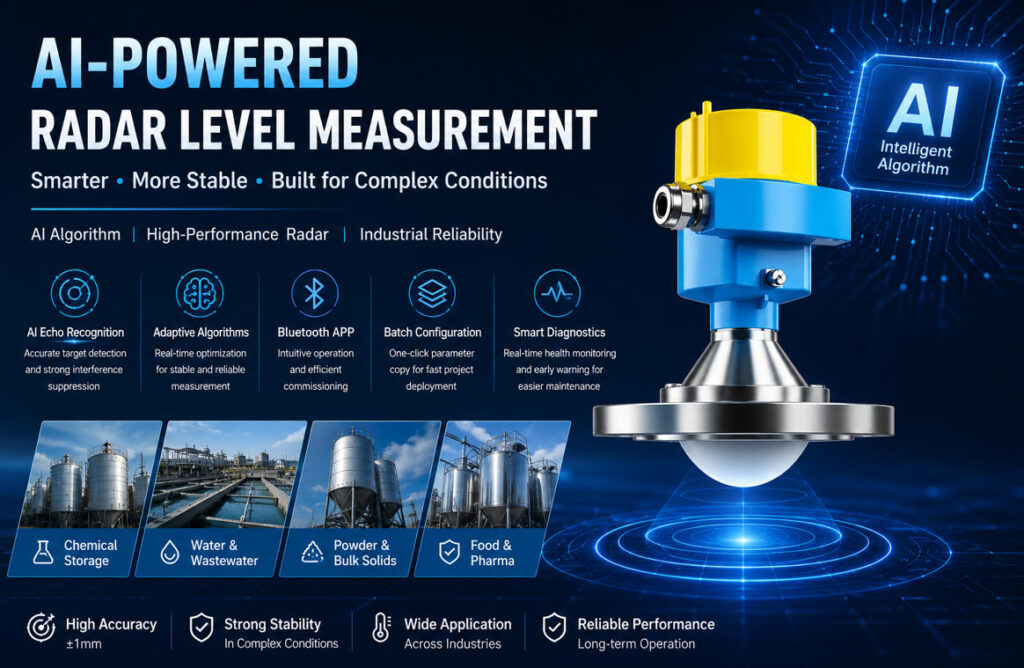
1. Dynamic Echo Tracking Algorithm
Filters liquid sloshing noise and outputs stable average level.
2. False Echo Suppression
Automatically identifies internal tank reflections.
3. Multi-Media Adaptability
Supports switching between different liquids without recalibration.
4. EMC Anti-Interference Design
Resistant to engine and inverter electromagnetic noise.
VI. Application Benefits
After deployment, significant improvements are achieved:
- Improved loading accuracy and efficiency
- Enhanced safety and reduced overflow risk
- Lower maintenance and labor cost
- Full digital data management via cloud platforms
- Faster commissioning via Bluetooth APP
VII. Extended Applications
This solution is also suitable for:
- Chemical liquid tank trucks
- Edible oil transport vehicles
- LNG cryogenic tankers
- Hazardous chemical tankers
- Mobile refueling stations
- Temporary fuel storage systems
VIII. Company Strength – Jiwei Automation
Jiwei Automation specializes in industrial level measurement with applications in:
- Petrochemical industry
- Energy storage systems
- Environmental water treatment
- Food and pharmaceutical industries
Core strengths:
- 80GHz high-frequency radar technology
- Fully independent R&D capability
- Bluetooth wireless commissioning system
- Industrial explosion-proof certification
- Multi-protocol outputs (4–20mA / RS485)
IX. Conclusion
With the rapid development of smart logistics and digital transportation, tanker level measurement is evolving from traditional mechanical methods to high-precision radar measurement combined with IoT management systems.
The Jiwei JWrada® radar level transmitter, with its high stability, strong anti-interference capability, and excellent vehicle adaptability, provides a reliable and intelligent solution for hazardous liquid transportation, ensuring safer, more efficient, and fully visible operations.