Oil Storage Tank Projects: JWrada® 80GHz Radar Level Transmitters for Middle East Refineries
In large refineries, fuel storage terminals, and petrochemical projects across the Middle East, level measurement systems are no longer used only for inventory monitoring. They have become a critical part of plant safety, process stability, and overall automation management.
Due to the region’s extreme ambient temperatures, large storage tanks, continuous production processes, and hazardous area requirements, traditional level measurement technologies are increasingly unable to meet the long-term operational demands of modern refinery projects.
For applications involving VR (Vacuum Residue), HFO (Heavy Fuel Oil), kerosene, and other high-viscosity process liquids, Shenzhen Jiwei Automations Ltd. provides the JWrada® 80GHz Radar Level Transmitter — a stable, intelligent, and refinery-oriented continuous level measurement solution specifically designed for demanding Middle Eastern oil storage applications.
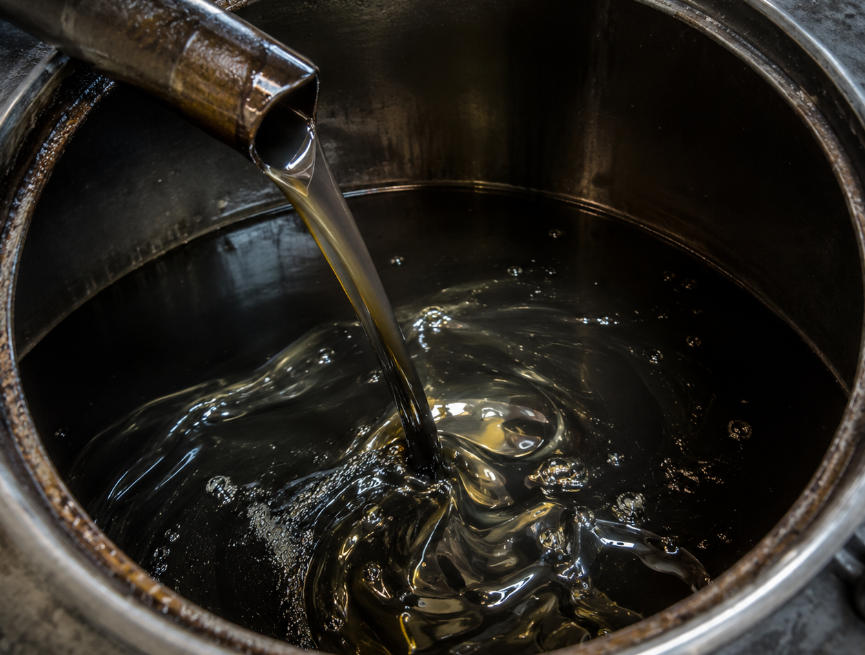
Typical Challenges in Middle East Refinery Tank Applications
According to the customer’s technical requirements, the project includes multiple storage tank measurement points for:
- Vacuum Residue (VR)
- Heavy Fuel Oil (HFO)
- Kerosene
- Process product liquids
Typical process conditions include:
| Medium | Temperature | Pressure | Viscosity |
|---|---|---|---|
| VR | 100°C | 5 barg | 520 cP |
| HFO | 70°C | 5 barg | 450 cP |
| Kerosene | 40°C | 5 barg | 0.6 cP |
These operating conditions represent typical refinery and fuel storage environments in the Middle East, where level measurement systems face several major challenges.
High-Temperature Oil Vapor and Steam Interference
In VR and HFO tanks, high process temperatures generate significant amounts of oil vapor, steam, and condensate inside the tank vapor space. Combined with the already high ambient temperatures common in Middle Eastern environments, complex vapor layers and condensation zones frequently form near the tank roof.
These conditions can directly affect radar wave propagation, causing echo drift, false level readings, and unstable low-level measurements.
Many standard radar transmitters may perform well under laboratory conditions but gradually suffer from echo attenuation and unstable measurements during long-term operation in real refinery tanks.
For refinery customers, the key concern is not simply whether the instrument can measure level, but whether it can continuously maintain stable echo recognition under severe vapor conditions for years of operation.
False Echoes Caused by Complex Internal Tank Structures
Large refinery tanks often contain numerous internal metal structures, including:
- Steam heating coils
- Reinforcement beams
- Ladders
- Spray systems
- Anti-vortex devices
Especially in VR and heavy oil tanks, complex steam tracing systems are commonly used to maintain fluidity, creating extremely complicated reflection environments for radar signals.
Ordinary radar transmitters can easily be affected by false echoes, multi-path reflections, and signal shielding from these structures.
Many radar instruments appear stable during empty tank commissioning but later experience random level fluctuations or signal loss during actual operation.
The real challenge is not simply detecting the liquid surface — it is maintaining stable and accurate level tracking despite continuously existing structural interference.
Fouling and Coke Build-Up on High-Viscosity Applications
High-viscosity media such as VR and HFO tend to generate coke, asphalt deposits, and sludge accumulation on the antenna surface during long-term high-temperature operation.
This issue usually develops gradually after months or years of service rather than during initial commissioning.
As deposits increase, radar transmission and receiving efficiency decrease, resulting in weaker echoes, increased noise, and slower measurement response.
Some conventional level transmitters may initially operate normally but later become unstable or even completely fail.
Therefore, refinery customers in the Middle East place much greater importance on long-term anti-fouling capability and operational reliability rather than only initial measurement accuracy.
Thermal Expansion and Installation Stability
Large storage tanks operating under high temperatures and significant day-night temperature differences often experience thermal expansion.
Steam-heated heavy oil tanks may cause slight flange movement or installation angle deviation over time.
For high-frequency narrow-beam radar transmitters, even minor installation angle changes can affect radar beam direction, reducing echo energy and increasing unwanted reflections.
Some high-frequency radar instruments achieve excellent theoretical accuracy but have low tolerance for real industrial installation variations.
For large refinery tanks, installation tolerance and long-term operational stability are equally important considerations.
Irregular Reflection from Heavy Oil Surfaces
Unlike water or light hydrocarbons, high-viscosity products such as VR and HFO rarely form smooth liquid surfaces.
Foam, wax layers, sludge, and irregular wave patterns often create so-called “soft surfaces,” causing radar signal scattering and unstable echo behavior.
Many standard radar transmitters work well on clean liquids but struggle to maintain stable operation on heavy oil applications.
For refinery storage tanks, the real test of radar performance is not laboratory accuracy specifications, but long-term stable operation under difficult heavy oil surface conditions.
Why Middle East Refineries Prefer 80GHz Radar
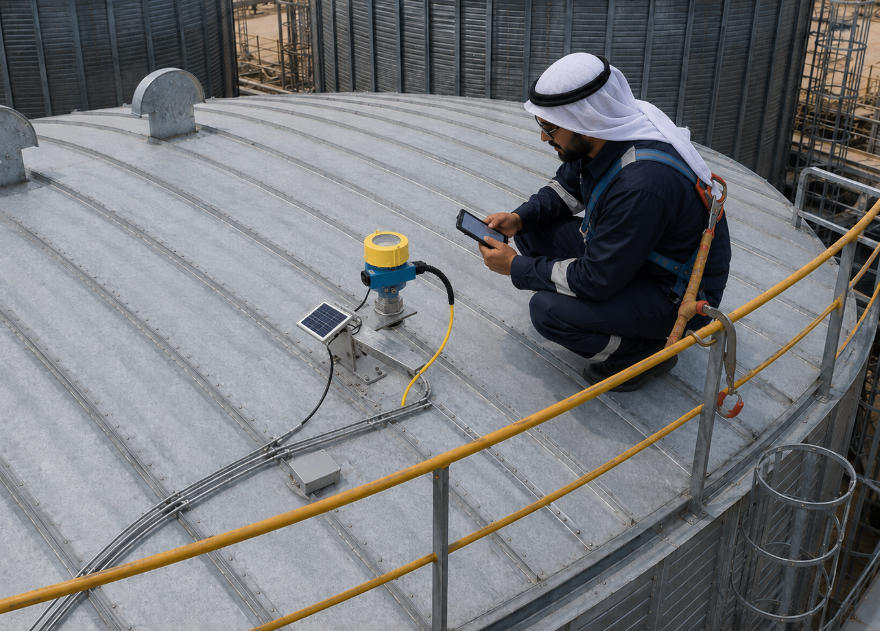
As refinery automation continues to advance, 80GHz radar level transmitters are rapidly becoming the preferred solution for Middle Eastern storage tank projects.
Compared with conventional 26GHz radar technology, 80GHz radar provides:
- Smaller beam angles
- Stronger signal focusing
- Higher measurement precision
- Better obstacle avoidance capability
In tanks with heating coils, condensate, internal structures, and heavy vapor interference, traditional low-frequency radar often suffers from excessive reflections and unstable measurements.
80GHz radar technology can more effectively avoid obstacles and continuously identify the true liquid surface echo, significantly reducing false echo problems.
For low dielectric liquids such as kerosene, where reflected signals are naturally weak, 80GHz radar also offers superior sensitivity and stable echo detection.
As a result, 80GHz radar is increasingly replacing traditional low-frequency radar in refinery, fuel storage, and oil terminal automation projects throughout the Middle East.
How JWrada® Meets Middle East Refinery Requirements
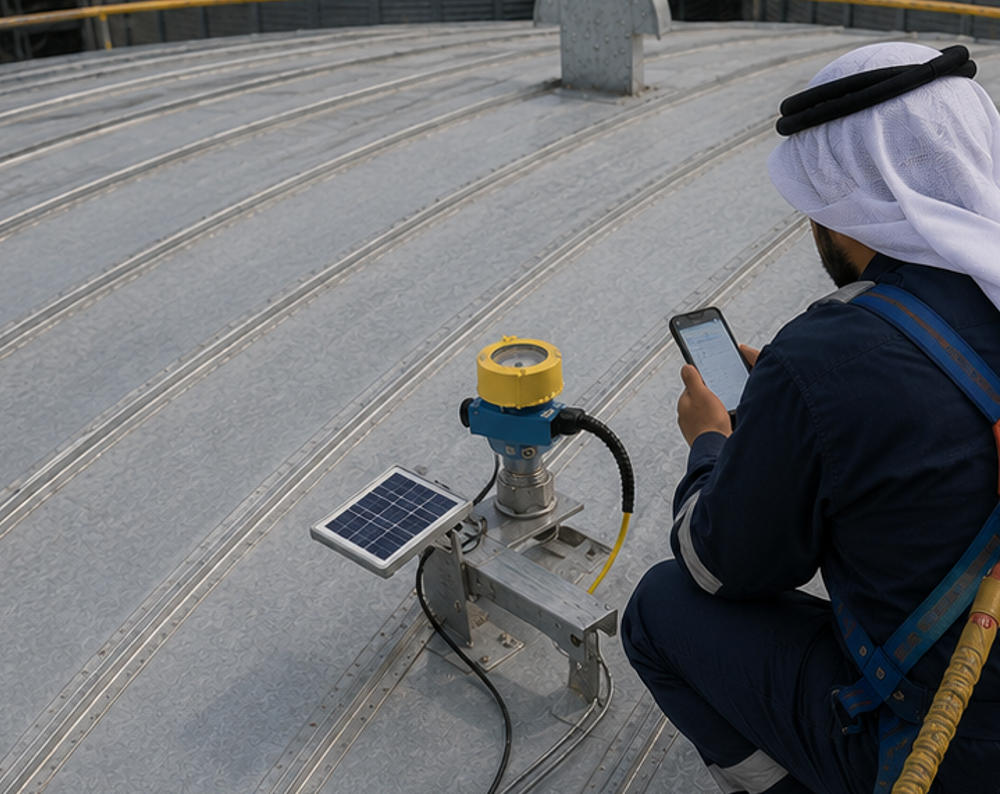
As one of China’s leading industrial radar level transmitter brands, JWrada® has already successfully replaced traditional European and American radar brands in multiple international refinery and storage terminal projects.
The JWrada® 80GHz radar transmitter adopts advanced FMCW technology and maintains stable performance under:
- High temperatures
- Heavy vapor environments
- Volatile hydrocarbons
- High-viscosity liquids
- Long measuring distances
Compared with contact-type instruments, the non-contact radar design eliminates common problems such as build-up, fouling, and heavy maintenance requirements found in VR and HFO applications.
In real refinery projects, customers are not only concerned about whether the level can be measured, but whether the instrument can remain continuously stable during years of operation.
JWrada® provides strong anti-interference capability, stable echo processing, and excellent adaptability to complex vapor and heavy oil environments.
JWrada® Bluetooth Remote Commissioning System
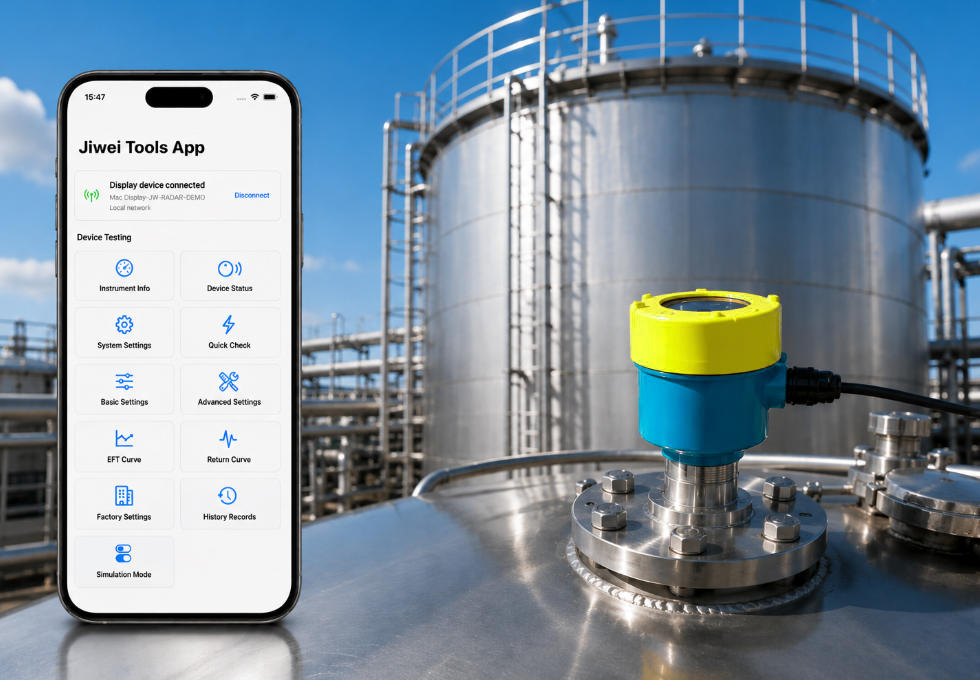
For Middle Eastern projects, commissioning efficiency and long-term maintenance capability are equally important.
Many conventional imported radar systems still suffer from:
- Complex configuration procedures
- Closed software systems
- Difficult parameter duplication
- Low field commissioning efficiency
In large tank farms containing dozens or even hundreds of radar transmitters, individual device configuration can consume significant time and labor.
JWrada® radar transmitters integrate:
- Stable industrial Bluetooth communication
- The intuitive “JW Tools” mobile APP
- LCD display
- Full manual keypad operation
Devices can be pre-configured before shipment or quickly adjusted on site.
Even with liquid already inside the tank, configuration typically requires only 2–5 minutes per device.
Using the Bluetooth APP, engineers can:
- Remotely assist field commissioning
- View live echo curves
- Modify parameters online
- Diagnose faults remotely
- Copy parameters to multiple devices instantly
This significantly reduces commissioning workload for large-scale refinery projects.
Unlike many products that only advertise “Bluetooth capability,” JWrada® uses a true industrial-grade Bluetooth module capable of complete functional control through mobile devices.
Why More Customers Are Replacing VEGA with JWrada®
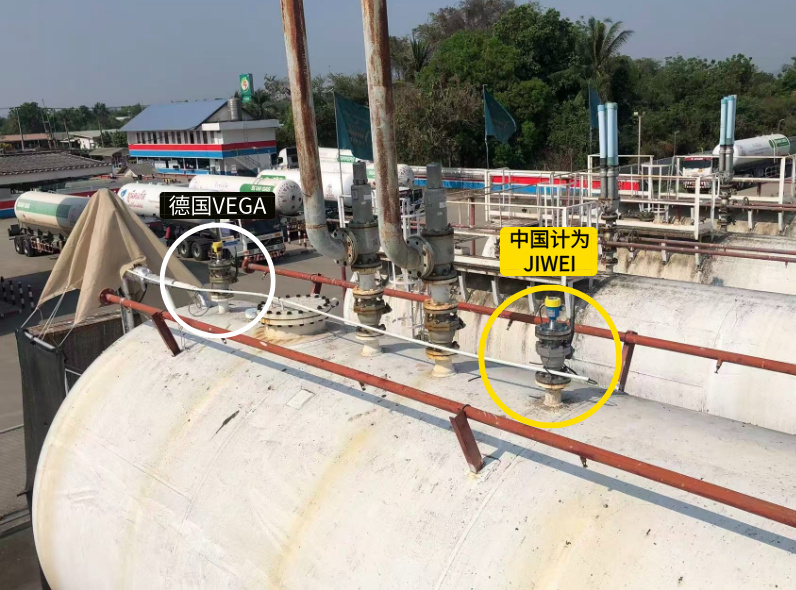
VEGA has long dominated the high-end refinery radar level market and remains widely used in large EPC projects.
However, as competition intensifies and project owners place greater focus on total project cost control, customers are increasingly evaluating additional factors beyond brand recognition, including:
- Better cost-performance ratio
- Faster delivery
- More flexible technical support
- Easier commissioning
- Lower long-term maintenance cost
Under this trend, JWrada® has gained increasing international recognition thanks to:
- Mature 80GHz radar technology
- Advanced Bluetooth remote commissioning
- Extensive refinery application experience
In high-temperature, high-viscosity, and vapor-heavy refinery environments, JWrada® continuously delivers stable and reliable measurement performance.
Its Bluetooth commissioning system greatly simplifies field setup and batch parameter configuration, dramatically improving efficiency for large tank projects.
As a result, JWrada® has already successfully replaced VEGA in multiple international projects and is rapidly becoming one of China’s few radar brands truly capable of competing with global high-end suppliers.
Conclusion
For VR, HFO, kerosene, and fuel storage tank applications in the Middle East, modern level measurement systems must provide:
- High-temperature stability
- Explosion-proof safety
- Steam resistance
- Anti-build-up capability
- Long-term reliability
- Fast commissioning and maintenance
JWrada® 80GHz Radar Level Transmitters not only satisfy these technical requirements, but also significantly improve project implementation efficiency through advanced Bluetooth commissioning and remote diagnostic capabilities.
For refinery operators and EPC companies seeking a reliable alternative to VEGA while balancing performance, delivery, and project cost control, JWrada® is becoming an increasingly trusted choice.