Resin Mixing Tank Level Measurement with Jiwei JWrada® Radar Level Instrument
1. Project Background: Resin Production Requires More Reliable Level Measurement
In the production of coatings, printing inks, adhesives, composite materials, electronic chemicals, and fine chemicals, resin is one of the most important basic raw materials. Resin is commonly stored, mixed, heated, dispersed, and transferred in stainless steel mixing tanks, batching tanks, pre-reaction buffer tanks, or process storage vessels. The accuracy of level data directly affects dosing ratio, batch consistency, pumping efficiency, and production continuity.
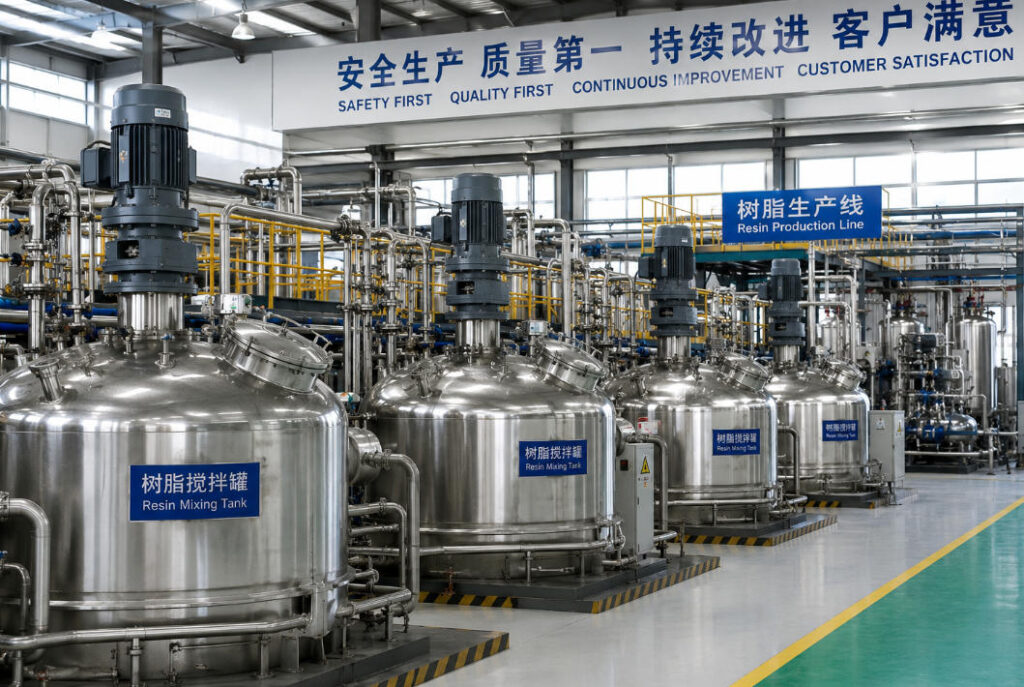
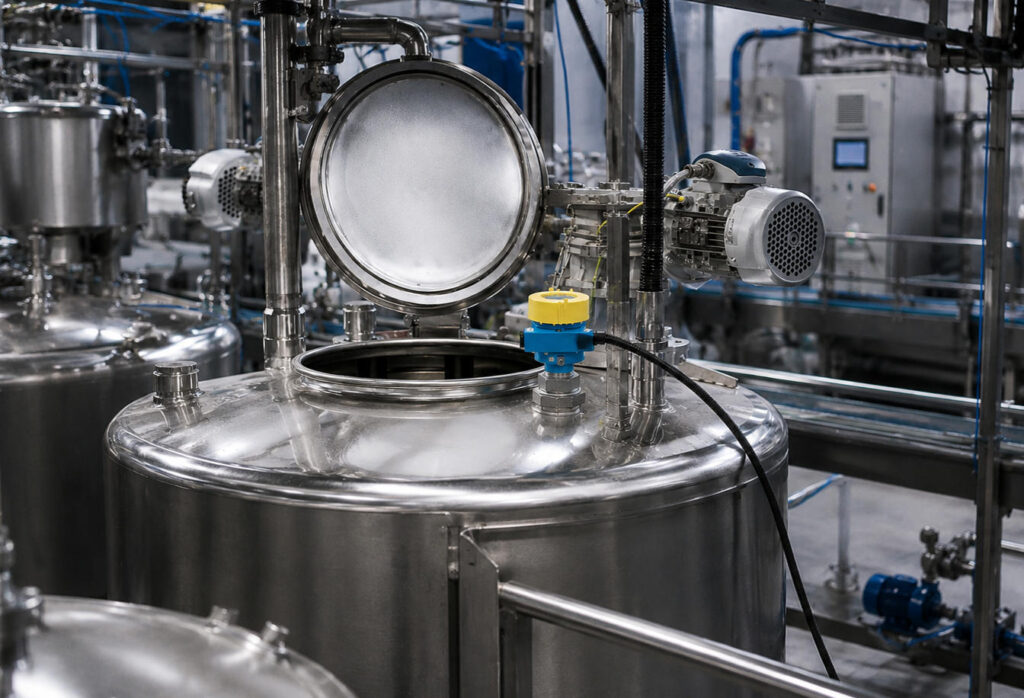
A resin manufacturer in China uses multiple stainless steel mixing tanks to store and blend different types of resin materials. The tanks are closed stainless steel vessels equipped with agitator motors, feeding ports, cleaning ports, vent connections, and inspection manholes on the top. Due to the viscosity of resin, some operating conditions also involve agitation, foam, vapor, condensation, and material buildup on the tank wall. As a result, traditional manual inspection and contact-type level instruments are difficult to keep stable over long-term operation.
To improve the reliability of resin mixing tank level measurement, the company selected Jiwei 3X Series JWrada® radar level instrument to build a non-contact continuous level monitoring solution. The system enables online resin level data acquisition, automatic alarms, and process control integration.
2. On-Site Challenges: Viscous Resin Limits Traditional Level Measurement Methods
Before the upgrade, the site mainly relied on manual inspection, operator experience, and some contact-type level detection devices. As production speed increased, the original methods gradually showed several limitations.
First, manual inspection could not meet the requirements of continuous production. Resin production is usually carried out in batches, and level changes are closely related to feeding, agitation, heating, and discharge processes. Manual checking is inefficient and cannot provide real-time level trends, which may lead to delayed replenishment, pump dry running, or high-level overflow risks.
Second, resin has relatively high viscosity and can easily adhere to the surface of contact-type sensors. Float level meters, submersible pressure transmitters, capacitance probes, and other contact instruments may be affected by material adhesion, skinning, contamination, and cleaning requirements after long-term use. These problems can cause reading drift or increase maintenance frequency.
Third, the internal structure of stainless steel mixing tanks is complex. Agitator blades, feeding pipes, tank walls, foam layers, and liquid surface fluctuations may all interfere with level measurement. If the instrument does not have sufficient anti-interference capability, unstable echoes, level jumps, or false alarms may occur.
Fourth, resin production sites have requirements for sealing, safety, and cleanliness. Frequent opening of the tank or disassembly for maintenance not only affects production efficiency, but may also increase the risks of volatilization, contamination, and operator exposure. Therefore, the company needed a more stable, low-maintenance level measurement solution that could be easily integrated into the automation system.
3. Solution: Jiwei 3X Series JWrada® Radar Level Instrument for Non-Contact Measurement
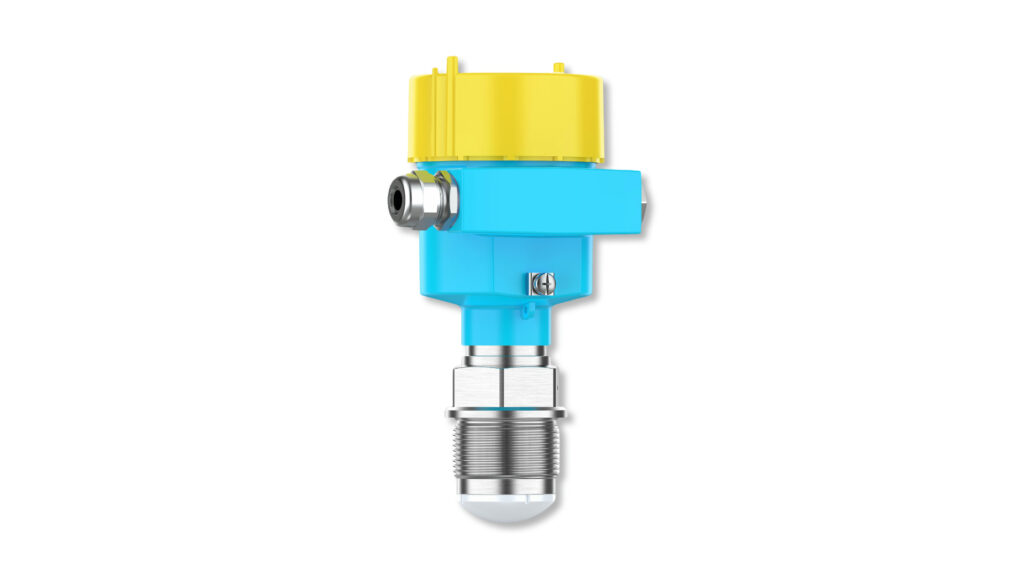
Based on the application characteristics of stainless steel resin mixing tanks, Jiwei recommended the 3X Series JWrada® radar level instrument. This series adopts the non-contact radar measurement principle. Installed on the top of the tank, the instrument emits radar waves toward the liquid surface and receives the reflected echo. It then calculates the distance from the instrument to the liquid surface and converts it into real-time level data according to the tank height.
Unlike contact-type level meters, the JWrada® radar level instrument does not require the probe to be inserted into the resin medium. This avoids measurement problems caused by resin adhesion, corrosion, contamination, and cleaning. For high-viscosity resin, emulsion, solvent-based resin, water-based resin, and various chemical mixtures, this solution helps reduce maintenance workload and improve long-term operational stability.
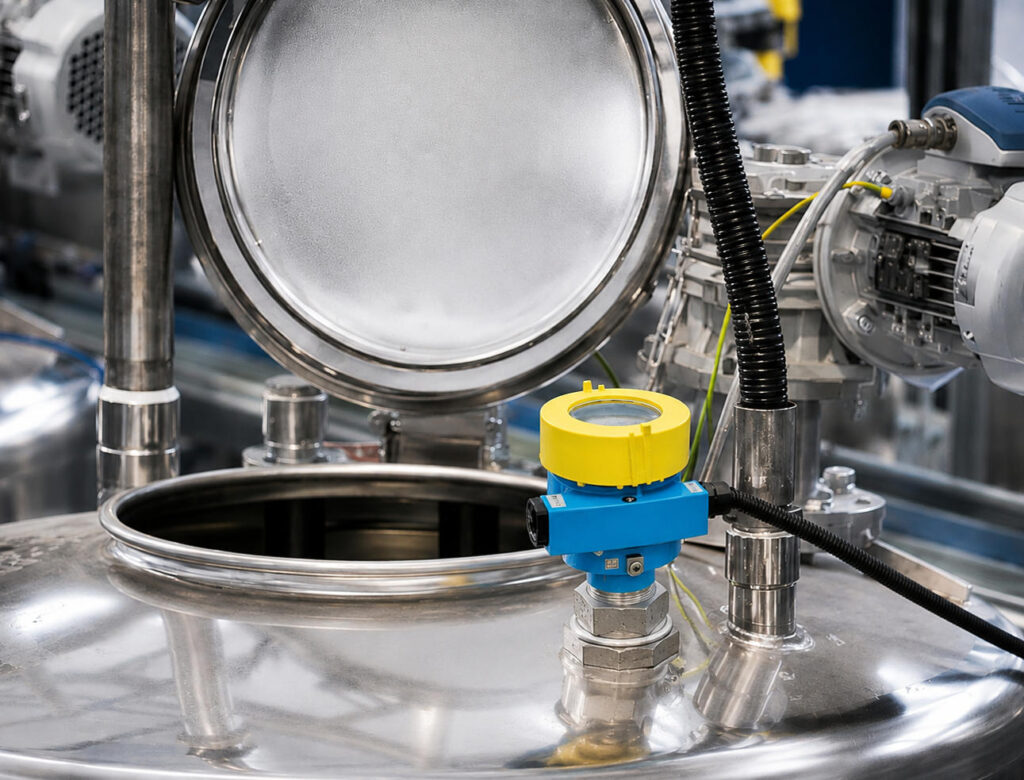
In this application, the instrument was installed at a suitable position on the top of the stainless steel mixing tank, avoiding the agitator motor, feeding port, tank wall edge, and internal structures. During commissioning, the radar beam direction, measuring range, empty tank height, full tank height, and false echo suppression settings were optimized. As a result, the instrument could reliably identify the true liquid surface echo and continuously output level signals, even during agitation and slight surface fluctuations.
The Jiwei 3X Series JWrada® radar level instrument can transmit level data to PLC, DCS, or local display and control systems. The data can be used for real-time display, trend recording, high and low level alarms, pump start-stop interlocking, and batch feeding management. For resin production lines requiring digital management, the instrument can also be connected to SCADA systems or factory data platforms for centralized monitoring of multiple tanks.
4. Application Results: Improved Reliability of Resin Mixing Tank Level Monitoring
First, the level data became more continuous. Operators no longer needed to frequently check the tank level on site. The control room could monitor the resin level in real time, making it easier to arrange feeding, mixing, and discharge operations.
Second, maintenance workload was reduced. Since the instrument does not contact the resin medium, it avoids common problems of contact-type instruments, such as material adhesion, skinning, and frequent cleaning. This is especially suitable for long-term measurement of viscous resin and adhesive media.
Third, production safety was improved. The system can be configured with high-level alarms to prevent overfilling or overflow. It can also provide low-level alarms to avoid pump dry running, protect equipment, and reduce shutdown risks.
Fourth, batch stability was enhanced. Resin production requires strict control of formulas and process parameters. Continuous and reliable level data helps the company better manage feeding quantity, inventory level, and production rhythm, reducing human error and improving product consistency.
Fifth, the solution supports factory automation upgrades. The standard signal output of the JWrada® radar level instrument can be integrated into automation control systems, providing essential data for intelligent, visualized, and digital resin production management.
5. Why Radar Level Instruments Are Suitable for Stainless Steel Resin Mixing Tanks
Resin mixing tanks represent a typical complex level measurement application. The medium is viscous, the tank structure is complicated, the liquid surface may fluctuate, and the site usually requires long-term stable operation. Compared with traditional level meters, radar level instruments offer clear advantages in this type of working condition.
First, radar measurement is not affected by changes in medium density. The density and viscosity of resin may vary with batch, temperature, and formula, while radar level measurement is mainly based on electromagnetic wave echo signals for distance calculation. This makes it more suitable for chemical production sites with multiple products and changing process conditions.
Second, non-contact measurement reduces the risk of medium contamination. For resin, coatings, inks, adhesives, and other materials that require stable product quality, reducing contact between the sensor and the medium helps lower contamination sources and maintenance intervention.
Third, radar instruments are suitable for closed tank applications. Stainless steel mixing tanks usually need to remain sealed. Once the radar level instrument is installed on the top connection, it can operate continuously without frequent tank opening, meeting modern chemical production requirements for safety and environmental protection.
Fourth, radar level instruments offer strong anti-interference capability. With proper installation and parameter settings, interference from agitator blades, tank walls, feeding streams, and internal components can be reduced, improving measurement stability in complex tanks.
6. Installation Recommendations: Key Points for Radar Level Measurement in Resin Mixing Tanks
To ensure the best performance of Jiwei 3X Series JWrada® radar level instrument in stainless steel resin mixing tanks, several installation points should be considered.
The instrument should be installed in a relatively open area on the tank top, avoiding the center of the agitator shaft, the area directly below the feeding port, the tank wall edge, and obvious obstacles. The radar beam should be directed as vertically as possible toward the liquid surface to reduce echo loss caused by tilted installation.
If there are agitator blades, heating coils, or other internal structures inside the tank, false echo suppression should be performed during commissioning to prevent internal obstacles from being mistakenly identified as the liquid surface. For applications with heavy foam, strong vapor, or significant condensation, the installation position should be optimized according to site conditions, and suitable process connections and protective structures should be selected.
For different resin media, it is recommended to observe echo performance during initial operation under full tank, half tank, low level, and agitation conditions. After parameter optimization is completed, the instrument can then be connected to interlock control. This helps improve system safety and stability.
7. Conclusion: JWrada® Radar Level Instrument Provides Reliable Data for Resin Production
In the resin, coatings, printing ink, adhesive, and fine chemical industries, level measurement in stainless steel mixing tanks affects not only the operation of a single vessel, but also the continuity, safety, and product consistency of the entire production process. Facing challenges such as viscous media, agitation interference, vapor condensation, and maintenance difficulties, traditional manual inspection and contact-type level meters often fail to meet the requirements of modern automated production.
Jiwei 3X Series JWrada® radar level instrument provides stable, reliable, and system-integrated level data for resin mixing tanks through non-contact continuous measurement. The solution reduces manual inspection, lowers maintenance frequency, improves level alarm and process control capability, and supports automation, intelligent inventory management, and digital factory development.
For users looking for resin level measurement, stainless steel mixing tank level meters, chemical radar level meters, or non-contact radar level instruments, Jiwei 3X Series JWrada® radar level instrument provides an industrial measurement solution with reliability, adaptability, and automation value.