Level Measurement with Radar: The Software Advantage of JWrada® Radar Level Transmitters
Introduction
In modern industrial process control, radar level measurement technology has become one of the most reliable and widely used methods for continuous level monitoring. Radar level transmitters determine the level by transmitting microwave signals toward the surface of the medium and analyzing the reflected signals. Based on this information, the device calculates the distance between the sensor and the material surface and converts it into real-time level data.
Compared with traditional measurement methods, radar level transmitters offer several advantages, including non-contact measurement, high stability, minimal influence from temperature and pressure, and strong resistance to vapor and dust interference. As a result, they are widely used for continuous level measurement of liquids and bulk solids in industries such as water treatment, chemical processing, energy, power generation, metallurgy, and various industrial storage tanks and silos.
The JWrada® radar level transmitter series, developed by Shenzhen Jiwei Automations Ltd, builds upon the inherent reliability of radar measurement technology while further enhancing adaptability and commissioning efficiency through a proprietary software platform. Today, software capability has become one of the key competitive strengths of the JWrada® radar level transmitter series.
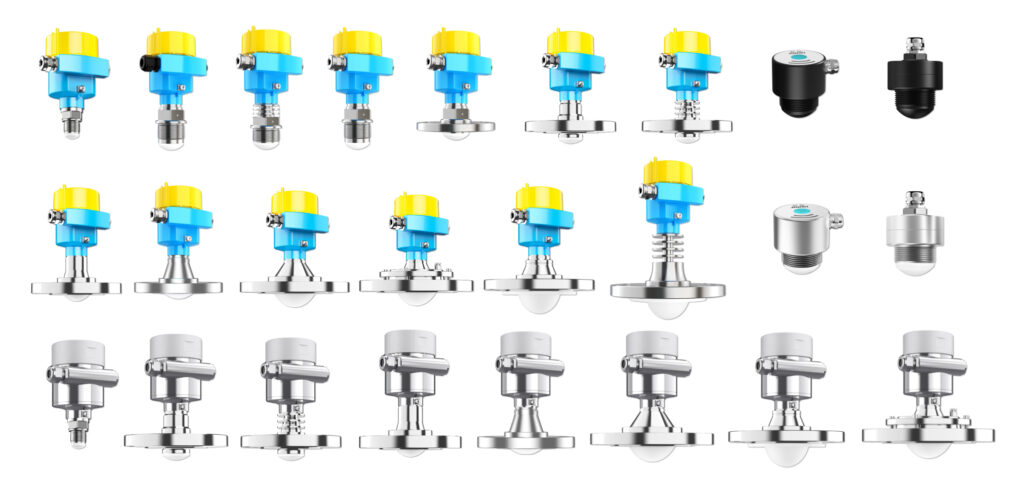
Radar Level Measurement Principle
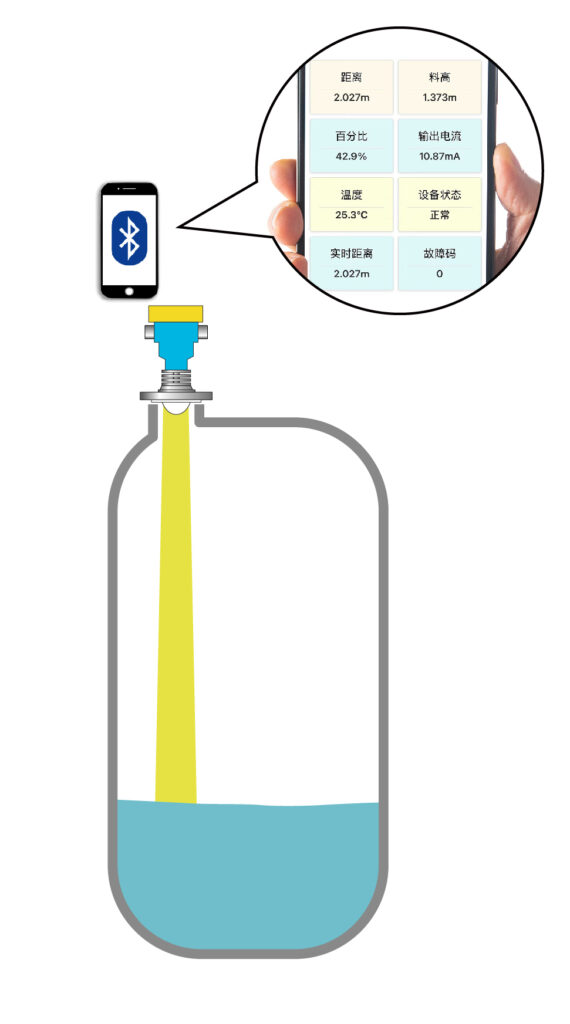
In continuous non-contact radar level measurement, the radar sensor installed at the top of a tank emits microwave signals downward toward the surface of the material. When the microwave signals reach the medium surface, they are reflected back to the antenna of the sensor.
After receiving the reflected signals, the radar transmitter processes them using internal signal-processing algorithms to calculate the distance between the sensor and the material surface. Based on the installation height and tank parameters, the system converts this distance into accurate level data.
Because microwave signals are hardly affected by temperature, pressure, vapor, or dust during propagation, radar level transmitters can maintain reliable performance in many challenging environments, such as:
- Vapor-rich environments
- Dusty conditions
- Applications with significant temperature variations
- Closed or pressurized vessels
For these reasons, radar technology has become an important solution for industrial level measurement.
Core Software Advantages of JWrada® Radar Level Transmitters
In addition to robust hardware design, software capability is one of the key strengths of the JWrada® radar level transmitter.
JWrada® radar instruments are equipped with a proprietary software platform developed in-house, providing engineers with advanced management and diagnostic functions, including:
- Firmware updates
- Field commissioning
- Parameter configuration
- Fault code monitoring and diagnostics
These features allow engineers to clearly understand the operating status of the device and optimize parameters according to actual process conditions, thereby improving measurement stability and overall system reliability.
All these software functions are independently developed by Shenzhen Jiwei Automations Ltd, forming a comprehensive software technology system that provides a clear advantage compared with many domestic alternatives.
Cloud-Based Remote Debugging
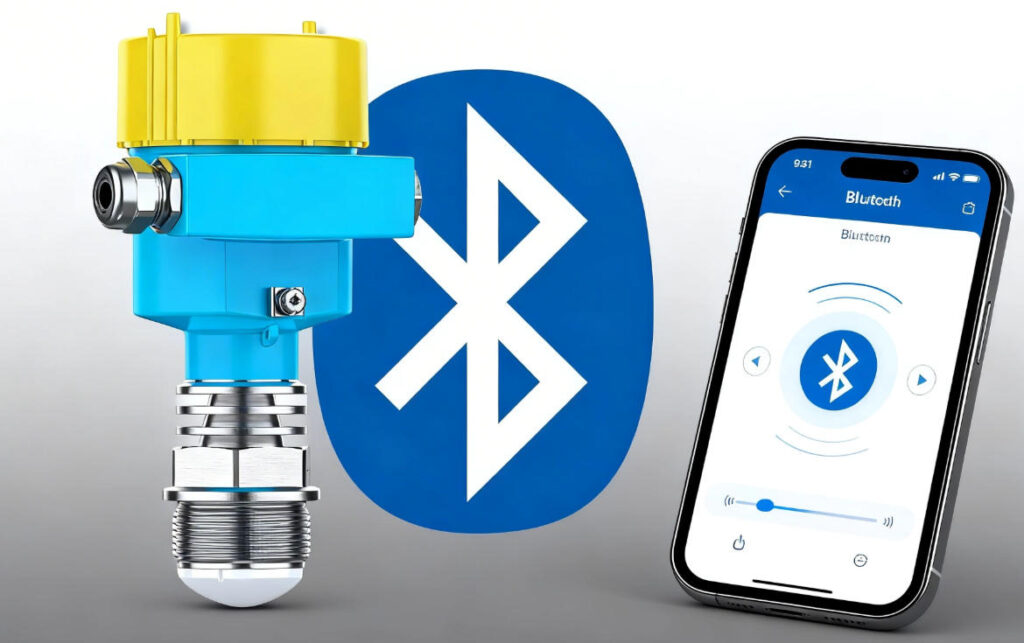
In traditional instrumentation commissioning, engineers usually need to travel to the site to configure parameters and analyze faults. This process can be time-consuming and increases maintenance costs.
The JWrada® radar level transmitter supports a cloud-based remote debugging mechanism. Through a cloud server platform, Jiwei engineers can conduct one-to-one remote collaborative commissioning with on-site personnel. Even without being physically present at the installation site, engineers can access the device status in real time and perform professional analysis.
During remote debugging, engineers can:
- View the Echo Curve in real time
- Analyze the EFT (Echo False Target) Curve
- Identify sources of signal interference
- Detect installation-related issues
- Optimize measurement parameters according to actual process conditions
This remote debugging approach significantly improves commissioning efficiency and greatly reduces troubleshooting time.
Customized Optimization for Different Operating Conditions
In practical industrial applications, level measurement environments are often complex. For example:
- Foam may be present inside the tank
- Agitators may be installed inside the vessel
- Large amounts of vapor or dust may exist
- Tank structures may be irregular
- Installation space may be limited
Standard parameter settings may not always fully adapt to these complex conditions.
With the software platform of JWrada® radar level transmitters, engineers can perform targeted optimization and algorithm adjustments based on the specific application environment. By analyzing the echo curve and EFT curve, interference signals can be effectively identified and measurement algorithms can be optimized to ensure stable operation under different conditions.
This customized commissioning capability based on real operating conditions ensures that each device achieves the best possible measurement performance in its unique environment.
Conclusion
As industrial automation continues to advance, level measurement instruments require not only reliable hardware but also powerful software capabilities.
By integrating advanced radar measurement technology with a proprietary software platform, JWrada® radar level transmitters provide remote debugging, real-time signal analysis, and customized parameter optimization.
This integrated hardware and software architecture enables stable performance even in complex industrial environments, providing reliable and efficient level measurement solutions for a wide range of industries.