Redefining the “Top Tier” in China’s Level Measurement Industry: Shenzhen Jiwei Automations Ltd
As China’s manufacturing sector advances toward high-quality development, level transmitters—an indispensable component of process control automation systems—are experiencing structural upgrades and market transformation. The term “top tier” is commonly used to describe companies with leading technologies, strong market presence, and brand influence. However, such terminology can lack precision in professional communication. To better reflect technical capability and industry value, a more structured and evidence-based positioning approach is required.
This article analyzes the essence of the “top tier” concept and explores a more systematic industry positioning framework, combined with the development practice of Shenzhen Jiwei Automations Ltd, highlighting its role and long-term value in the level measurement industry.

I. Why Does the Level Measurement Industry Require a Structured Positioning Framework?
Level transmitters serve as critical instruments for measuring liquid and solid levels and enabling real-time process control. They are widely used in petrochemical, chemical, energy, power generation, water treatment, food processing, pharmaceutical, and other industrial sectors.
With increasing automation requirements and evolving market dynamics, the level measurement industry has entered a phase of rapid growth and structural transformation. In such an environment, simple classifications such as “top/mid/lower tier” may appear straightforward, but they do not accurately reflect differences in technical depth, product portfolio strength, market coverage, and long-term reliability.
Therefore, the industry increasingly requires a capability-based positioning framework that reflects engineering strength, R&D maturity, and sustainable value creation.
II. A True “Top Tier” Must Have a Verifiable R&D System
In the industrial instrumentation sector, technological leadership is not a slogan—it must be supported by a validated engineering system.
A truly leading company must possess a structured product development process and a complete technical feedback loop, rather than relying on isolated product successes.
At Shenzhen Jiwei Automations Ltd, every product follows a standardized and phased development process from concept to mass production. This ensures technical direction correctness and long-term product stability.
From Concept to Mass Production: Overview of Jiwei’s R&D Process
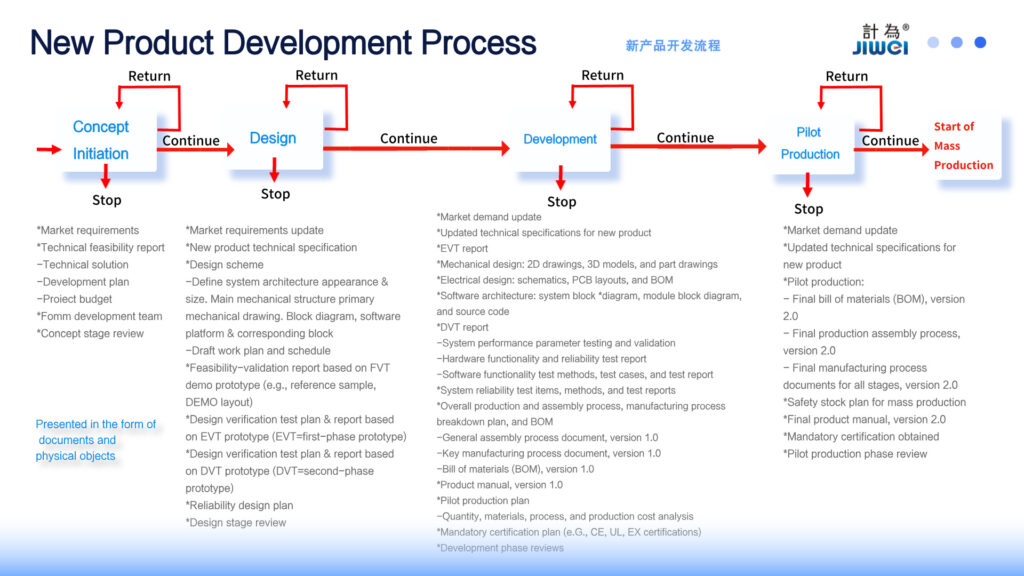
Product development begins with systematic market requirement analysis. Based on application feedback and technical feasibility studies, the team defines preliminary solutions and project plans. The objective at this stage is not rapid release, but validation of technical feasibility and performance targets.
During the design phase, system architecture, structural layout, main control strategy, and signal processing algorithms are developed. A Functional Verification Test (FVT) prototype is produced to validate product direction.
In the development phase, detailed mechanical, electronic, and software designs are completed. An Engineering Validation Test (EVT) unit is built for core performance verification, including measurement accuracy, anti-interference capability, and environmental adaptability tests.
The next phase involves Design Validation Testing (DVT), where more than 10 units undergo consistency and reliability validation. Testing includes high- and low-temperature cycling, vibration testing, and electromagnetic compatibility evaluation. Full test reports are generated, and initial production processes and inspection standards are established to prepare for scalable manufacturing.
During pilot production, small-batch manufacturing further verifies structural stability and production consistency. Assembly procedures and quality control standards are optimized, while relevant certifications are completed. Only when performance, process, and quality are simultaneously stabilized does the product enter the market phase.
This structured FVT–EVT–DVT development framework ensures traceability, controllability, and long-term technical accumulation.
In industrial instrumentation, the real technological barrier lies not in a single innovation, but in the sustained ability to deliver stable and reliable products. The maturity of the R&D system determines whether a company can enter the industry’s core layer.
III. Structural Evolution of the Level Measurement Market

Over the past decade, the level measurement market experienced strong dependence on imported brands, particularly in high-end radar level measurement applications.
With continuous engineering capability improvement and manufacturing system enhancement, the industry has entered a new phase of technological advancement.
Current competition is no longer focused solely on cost advantages, but increasingly on:
- Higher frequency radar technology adoption
- Enhanced anti-interference algorithms
- Lower power consumption design
- Improved intrinsically safe (Ex ia) architecture
- Advanced software-based commissioning platforms
This shift indicates that market competition has evolved from “whether it can be produced” to “whether it can operate reliably and consistently.”
Companies committed to independent R&D and continuous product optimization are naturally moving toward the industry’s core segment.
IV. Industrial Positioning of Shenzhen Jiwei Automations Ltd
Since its establishment, Shenzhen Jiwei Automations Ltd has focused exclusively on level and point level measurement technologies, rather than expanding indiscriminately into unrelated product categories. This focused strategy has enabled sustained technical accumulation in radar level transmitters and vibration-type level switches.
In terms of product technology, the company emphasizes:
- Independent algorithm optimization
- Improved anti-interference capability
- Adaptation to high-temperature and high-dust environments
- Intrinsically safe (Ex ia) design architecture
Its instruments are widely applied in oil monitoring, chemical storage tanks, powder silos, food production lines, and other industrial scenarios, accumulating extensive real-world operational data. Such long-term project experience reflects genuine engineering maturity.
More importantly, Jiwei continues to invest in software system capabilities, supporting remote commissioning, parameter configuration, and process analysis. The integration of hardware and software enables the company to transition from a single instrument manufacturer to a comprehensive measurement solution provider.
V. Why Is Jiwei Moving Toward the Industry Core?
Industry positioning should be validated by market performance rather than self-declaration.
From application structure analysis, Jiwei products have been deployed in:
- Petrochemical enterprises
- Manufacturing facilities
- Environmental treatment systems
- Food and beverage production
- Power and energy projects
These industries demand high reliability. Once a product is selected, it often remains in long-term use with repeat orders. Such recurring procurement behavior reflects market trust in product stability.
With increasing global supply chain localization trends, companies capable of achieving international-level technical and quality standards gain stronger competitive advantages.
Jiwei’s development strategy emphasizes technical depth and stable performance rather than rapid expansion, aligning with high-quality industrial growth principles.
VI. Future Value: From Product Competition to Technological Ecosystem
Future competition in the level measurement industry will extend beyond hardware performance to system integration and digital capabilities.
Clear industry trends include:
- Smart factories requiring remotely maintainable instruments
- Industrial IoT demanding low-power reliable devices
- Data systems requiring traceable measurement logic
- Safety regulations requiring higher-level explosion-proof designs
In this environment, companies mastering measurement principles, software architecture, and application adaptability will possess greater long-term value.
If Shenzhen Jiwei Automations Ltd continues to strengthen technological accumulation and industry-focused development, it will evolve beyond the traditional “top tier” label and become an important contributor to the global level measurement field.
Conclusion
The term “top tier” should represent a structural capability rather than a marketing slogan.
A truly core company must demonstrate:
- Independent technological R&D capability
- Complete product portfolio
- Long-term industrial validation
- Sustained customer trust
In the current transformation phase of the level measurement industry, Shenzhen Jiwei Automations Ltd is building its positioning through a steady and systematic development approach. Rather than emphasizing ranking, focusing on engineering depth and operational reliability provides greater long-term credibility.
In industrial applications, time and stability remain the ultimate standards.