Application of Jiwei Radar Level Transmitters for Sugar Beet Conveyor Belt Level Monitoring
In the sugar industry, sugar beet serves as the primary raw material, and its transportation, washing, and slicing processes typically operate continuously. Conveyor belts, connecting the unloading area to subsequent processing equipment, play a critical role in production rhythm, energy consumption, and equipment stability. Therefore, real-time and reliable monitoring of sugar beet loading height on the conveyor belt is a fundamental prerequisite for maintaining stable feed and optimizing process control.
Application Background and Measurement Requirements
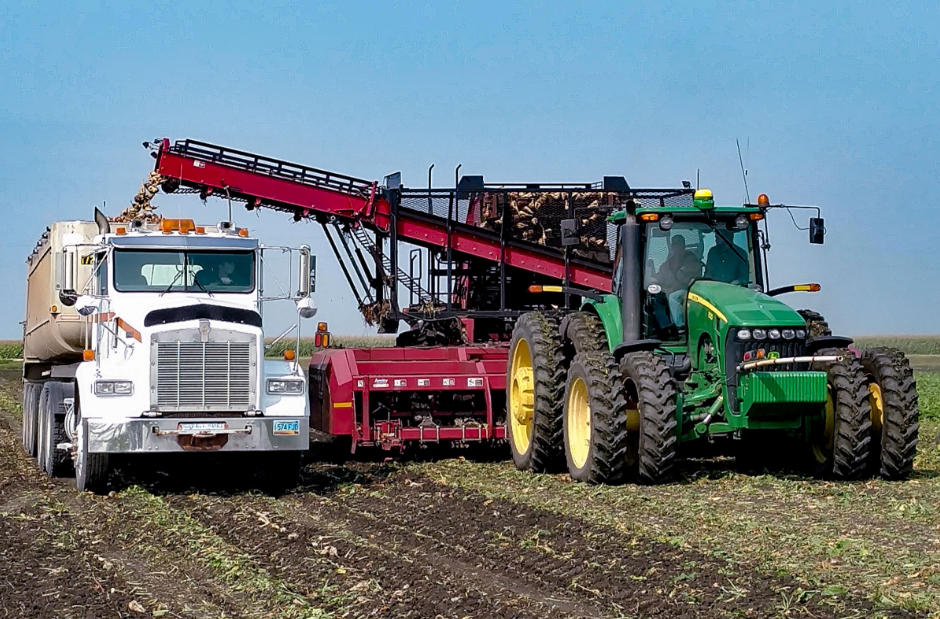
In practice, sugar beets are usually dumped directly from transport vehicles onto conveyor belts, then conveyed to washing and crushing systems. The unloading process is intermittent and random, resulting in uneven material distribution and continuously changing loading heights. Without effective monitoring, underfeeding or localized overloading may occur, affecting downstream process stability while increasing mechanical load and energy consumption of the conveyor system.
This application imposes clear engineering requirements for level measurement:
- Short measurement distance, typically within 2 m
- Irregularly shaped sugar beets with significant surface variation
- Continuous conveyor operation with mechanical vibration
- Process temperature range from -40 to +50 °C
- Potential presence of dust, moisture, and material splashing
Under these conditions, contact-type or mechanical measurement solutions are prone to wear, clogging, and frequent maintenance, reducing long-term reliability. Non-contact measurement methods are therefore better suited for continuous processes.

Technical Adaptation of Radar Level Transmitters
Jiwei radar level transmitters are based on microwave radar measurement principles. High-frequency electromagnetic waves are emitted towards the material surface, and reflected signals are received to calculate the round-trip time, thereby determining the real-time material surface position. This measurement method does not depend on material color, shape, or surface cleanliness, and is insensitive to dust, moisture, or ambient light, making it suitable for open, dynamic conveyor belt applications.
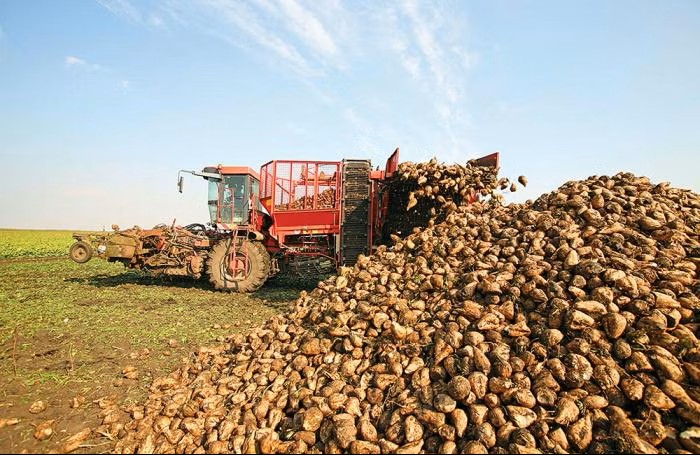
For sugar beet conveyor belt applications, radar level transmitters are typically installed above the belt to continuously monitor the material surface. Even when sugar beets are unevenly distributed with pronounced surface fluctuations, the radar consistently identifies valid echoes, ensuring reliable monitoring of overall loading height.
Measurement Optimization for Short-Range Applications
Unlike silos or large bins, conveyor belt level monitoring is characterized by short measurement distances. This places higher requirements on near-field echo detection and signal processing stability.
Jiwei radar level transmitters are specifically optimized for short-range applications through antenna design and echo processing strategies. This effectively suppresses near-field interference and enhances resolution and stability within the 1–2 m measurement range. In practical use, measurement signals remain smooth and continuous, providing stable input for control systems and avoiding frequent adjustments due to signal fluctuations.
Stability Under Dynamic Conditions
During conveyor operation, vibration is unavoidable, and movement or accumulation of sugar beets further causes fluctuating material levels. Jiwei radar level transmitters use internal signal filtering and echo analysis to mitigate short-term random fluctuations, maintaining responsiveness while preventing meaningless signal spikes.
Furthermore, as a non-contact measurement method, radar is not affected by soil, water, or debris on beet surfaces, nor by conveyor belt wear or material residues, significantly reducing maintenance frequency.
Digital Commissioning and On-Site Adaptability
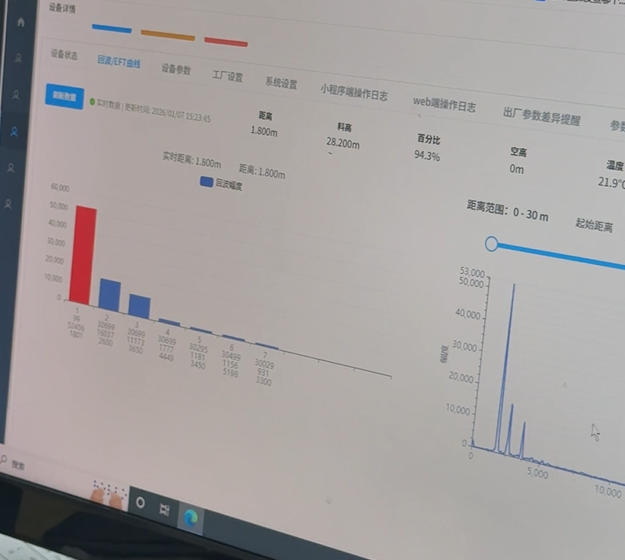
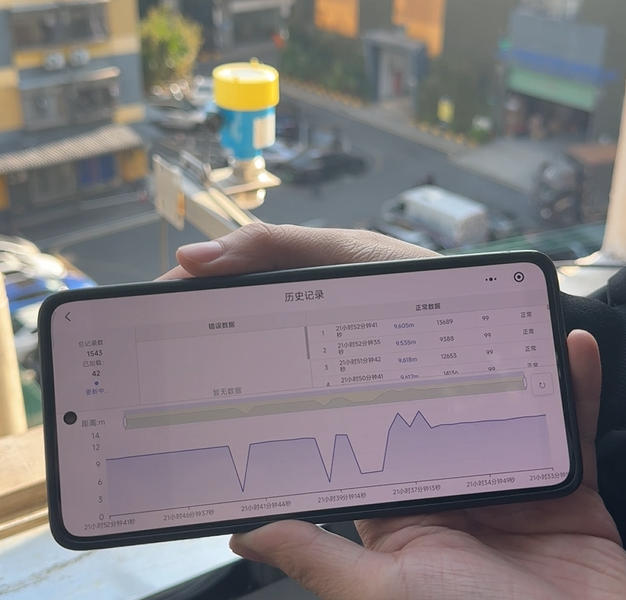
Conveyor installations often occur at height with limited space, making traditional wired commissioning inconvenient. Jiwei radar level transmitters, paired with the Jiwei SmartControl® WeChat mini-program and mobile APP, support Bluetooth communication for direct interaction with the instrument. On-site personnel can configure parameters and perform process commissioning without opening the device or connecting a dedicated programmer.
Through a visual interface, engineers can adjust measurement range, echo processing parameters, and output settings while observing real-time measurement feedback. This approach reduces reliance on personal experience and enhances commissioning efficiency in non-standard or dynamic conditions.
Operational Diagnostics and Remote Engineering Support
Once in operation, if measurement anomalies or process changes occur, Jiwei radar level transmitters can provide direct access to operational status and fault information through the SmartControl® platform, giving maintenance personnel clear diagnostic data without halting production or disassembling devices.
For advanced technical support, Jiwei engineers can establish one-to-one remote debugging sessions via the cloud. With proper authorization, engineers analyze real-time data, optimize parameters, and provide guidance, shortening issue resolution time and avoiding delays associated with on-site visits.
Process Control and System Integration Value
Deploying Jiwei radar level transmitters at critical points on the conveyor allows the control system to continuously track sugar beet loading height and dynamically adjust material feed based on belt speed. When loading is low, feed rate can be increased; when near the upper limit, unloading can be moderated to prevent overload.
This continuous monitoring and adjustment approach helps maintain stable conveyor operation, reduces unnecessary energy fluctuations, and provides more uniform material supply for downstream washing and crushing processes.
Application Summary
In sugar beet conveyor belt monitoring, Jiwei radar level transmitters not only solve the challenges of dynamic level measurement through non-contact technology but also enhance field usability and maintainability through digital commissioning and remote engineering support.
By integrating measurement performance with engineering support capabilities, the radar transmitter becomes a key component in stabilizing conveyor operation and optimizing process control. This approach is equally valuable for similar conveyor systems, open material transport, and short-range level monitoring applications.