Are Narrow and Long Pipelines Difficult for Level Measurement? Jiwei’s Radar Level Transmitter Provides the Answer
In the field of industrial automation, level measurement is generally considered a mature application. However, once it is applied to narrow and long pipelines, the complexity increases significantly. Especially when the pipeline diameter is very small and the length extends to over ten meters or even longer, traditional measurement methods often struggle to maintain both stability and reliability, leading to frequent issues such as false readings, drift, or even complete failure in real applications.
In such scenarios, conventional measurement technologies are no longer sufficient. The radar level transmitter, with its non-contact measurement and strong resistance to environmental interference, has gradually become a more promising solution. However, standard radar level transmitters still face significant challenges in narrow pipelines and cannot achieve stable performance through simple installation alone.
To address this typical industry challenge, Shenzhen Jiwei Automations Ltd has carried out dedicated R&D on level measurement in narrow pipelines. By optimizing the transmitting structure, signal processing, and algorithm logic of the radar level transmitter, a measurement solution suitable for complex structures has been developed and validated through systematic testing under different ranges and interference conditions.
This article analyzes why this radar level transmitter solution can achieve stable measurement in narrow pipelines from three aspects: application challenges, technical approach, and validation results.
1. Why Is Level Measurement in Narrow Pipelines So Difficult?
Compared to conventional tanks or open vessels, narrow pipelines present inherent structural disadvantages that significantly increase the difficulty of radar level measurement:
Limited Space and Signal Distortion
A small diameter means that the electromagnetic waves emitted by the radar level transmitter have very limited propagation space. Signals frequently reflect off the pipe walls, generating multiple spurious echoes that distort or mask the true level signal.
Long Distance and Signal Attenuation
When the measurement distance exceeds 10 meters or approaches 20 meters, signal energy continuously decreases during propagation. The weakened echo from the far end becomes more difficult to detect and identify.
Severe Multipath Reflection
In narrow structures, radar signals do not only travel in a straight path but also reflect multiple times between pipe walls, creating multipath echoes that can lead to false level readings.
Internal Structural Interference
In real-world applications, weld seams, supports, deposits, or foreign objects inside the pipeline can interfere with the echo signal. Without effective filtering, measurement reliability will be compromised.
These combined factors make narrow pipelines one of the most challenging application scenarios for radar level transmitters.
2. Core Approach of Jiwei’s Radar Level Transmitter Solution
To overcome these challenges, Jiwei’s R&D team focused on system-level optimization of the radar level transmitter, rather than relying solely on hardware improvements. The solution is built on three key principles: controllable signal, identifiable echoes, and correctable results.
Directional Signal Control Design
By optimizing the antenna structure and emission angle, electromagnetic waves are guided to propagate along the pipe axis as much as possible, minimizing unnecessary reflections from the pipe walls.
Multi-Echo Identification Mechanism
Unlike conventional radar level transmitters that simply detect the strongest echo, this solution applies advanced signal processing:
- Main echo identification
- Intermediate reflection filtering
- Multipath suppression
- Abnormal signal rejection
This ensures that the radar level transmitter locks onto the true liquid level instead of false reflections.
Dynamic Compensation Algorithm
The system dynamically compensates for various influencing factors, including:
- Signal attenuation correction
- Distance error compensation
- Installation deviation adjustment
This guarantees stable output under different operating conditions.
3. Validation from Medium to Long Distance
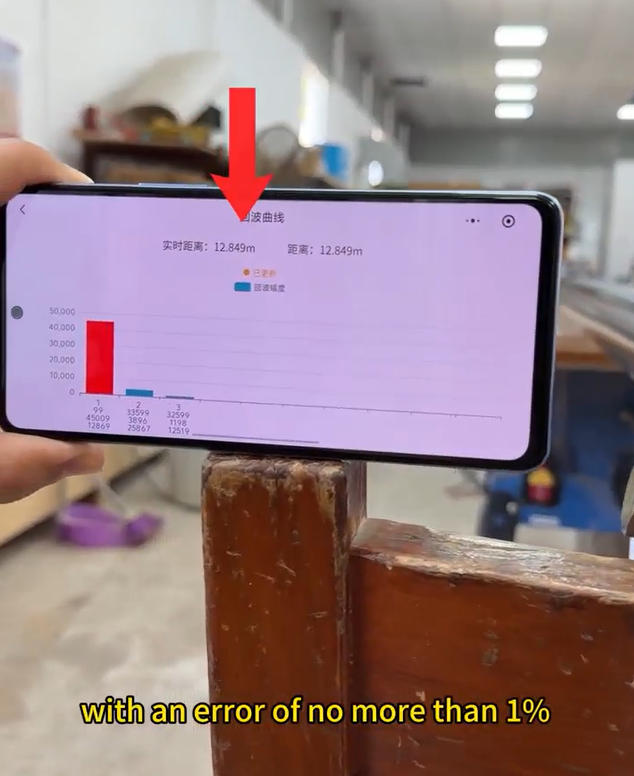
To verify the feasibility of the solution, systematic tests were conducted under different pipeline lengths and complex conditions.
Medium-Length Pipeline Test
In a φ57 mm narrow pipeline with a length of approximately 12 meters:
- Stable measurement output was achieved
- Clear level identification was observed
- Measurement error remained within a low range
This confirms the system’s solid baseline performance.
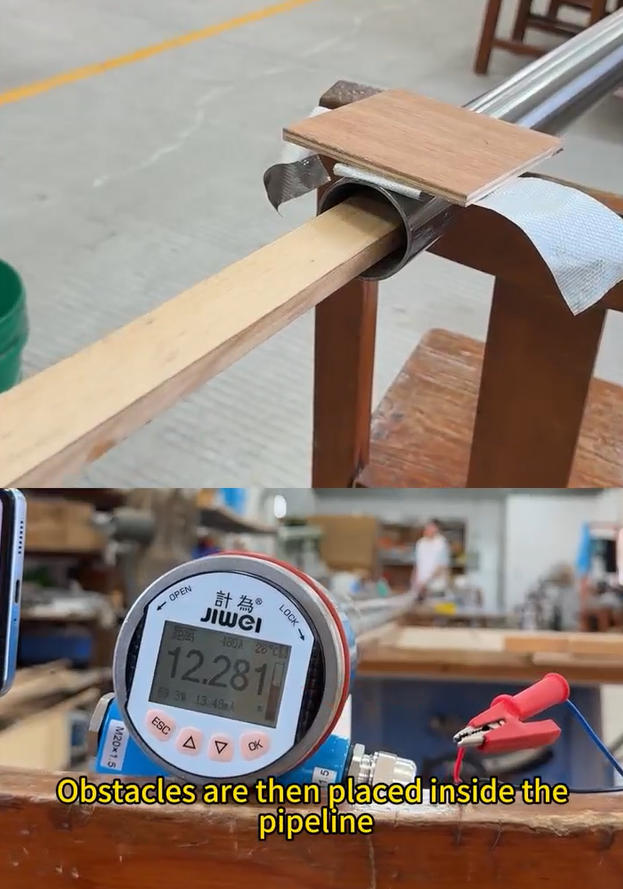
Performance Under Interference
Obstacles were introduced inside the pipeline to simulate real conditions.
Results showed:
- The radar level transmitter could distinguish intermediate reflections
- Measurement results remained stable
- Continuous and reliable output was maintained
This demonstrates strong anti-interference capability.
Long-Distance Validation
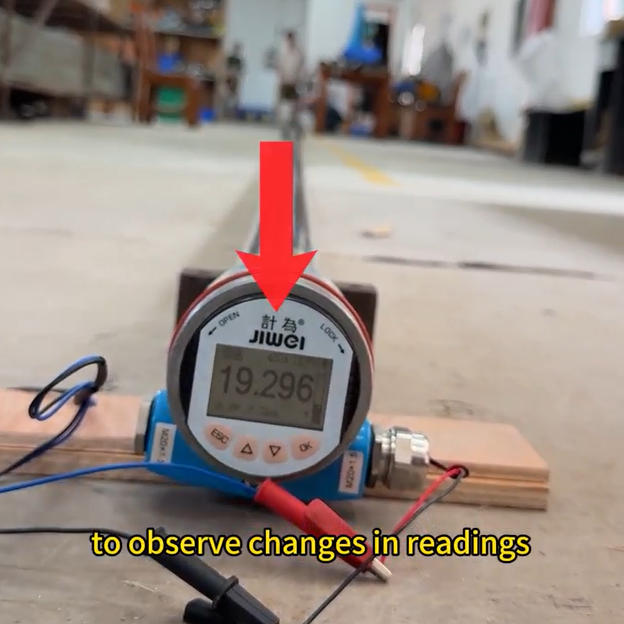
The pipeline length was extended to approximately 19 meters, introducing greater challenges:
- Increased signal attenuation
- More complex echo environment
- Higher noise influence
Despite these factors, the system maintained stable level detection, proving its scalability.
Combined Long Distance and Interference Test
Obstacles were again introduced in the long pipeline scenario.
Results confirmed:
- No false readings occurred
- Measurement logic remained stable
- Output consistency was maintained
This validates the system’s robustness in real industrial conditions.
4. Engineering Value of the Solution
Based on validation results, this radar level transmitter solution offers clear practical advantages:
- Optimized for narrow pipeline structures (φ57 mm)
- Reliable performance over long distances
- Strong resistance to internal interference
- Reduced commissioning and maintenance effort
5. From “Measurable” to “Reliably Measurable”
In industrial measurement, achieving measurement is not enough—reliable measurement under complex conditions is the real challenge.
The difficulty of narrow pipeline measurement lies in the combination of spatial limitation, signal interference, and structural complexity. Only when a radar level transmitter can handle all these factors simultaneously can it deliver real engineering value.
Jiwei’s R&D work represents a key transition from “functional capability” to “reliable performance.”
Conclusion
Level measurement in narrow pipelines has long been considered a difficult task. However, with continuous optimization of radar level transmitter technology, this challenge is gradually being overcome.
When a solution can consistently deliver stable results across different lengths and interference conditions, complex scenarios are no longer limitations—they become standardized applications.
For industrial automation, this is where true technological progress lies.