Jiwei Radar Level Meter Communication Solution White Paper— Technical Analysis of 4–20 mA/HART Two-Wire and RS485/Modbus Four-Wire Systems
1. Overview
In industrial process automation systems, level measurement is not only critical to production safety, but also directly affects control accuracy and overall system efficiency. With the advancement of intelligent manufacturing, field instruments are evolving from “single measurement devices” into “data nodes.”
Based on this trend, Jiwei JWrada® radar level meters provide two mainstream signal output options:
- 4–20 mA/HART two-wire output
- RS485/Modbus four-wire output
These two approaches represent traditional industrial control and modern digital communication technologies respectively, and are suitable for different application scenarios. This white paper provides a systematic analysis from the perspectives of technical principles, system architecture, and applications.
2. 4–20 mA/HART Two-Wire Communication Solution
2.1 Technical Principle
The 4–20 mA current signal reflects the measured level through linear variation:
- 4 mA: corresponds to the lower range limit
- 20 mA: corresponds to the upper range limit
The HART protocol (Highway Addressable Remote Transducer) superimposes Frequency Shift Keying (FSK) digital signals onto the current loop, enabling simultaneous transmission of analog and digital information.
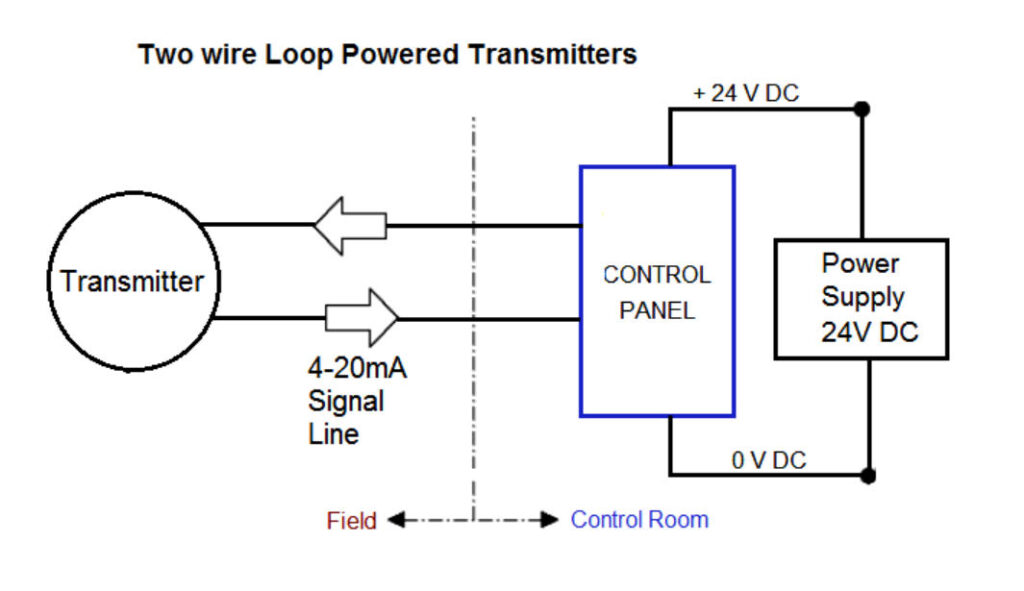
2.2 Two-Wire Structure
The two-wire system features:
- Power supply and signal share the same two wires
- No additional power wiring required
- Simple system structure and low wiring cost
2.3 Functional Features (Jiwei Radar Level Meter)
Under 4–20 mA/HART mode, the device provides:
- Continuous level analog output
- HART remote parameter configuration
- Device diagnostics (echo quality, fault information)
- Online range adjustment
2.4 Technical Advantages
The 4–20 mA current signal is widely used in industrial environments primarily due to its strong anti-interference capability. Compared with voltage signals, current signals are less affected by electromagnetic interference, line voltage drops, and ground potential differences. Even in harsh environments with variable frequency drives and motors, stable measurement performance can be maintained, making it highly suitable for continuous measurement in complex conditions.
At the same time, 4–20 mA offers excellent long-distance transmission capability. Under proper power supply conditions, signals can be transmitted stably over hundreds of meters with minimal attenuation, without requiring complex compensation. This makes it ideal for distributed measurement scenarios such as tank farms and plant pipelines.
From a system integration perspective, 4–20 mA has high compatibility. Most PLCs, DCS systems, and controllers support standard 4–20 mA analog inputs, enabling easy integration and simple engineering implementation. When combined with HART, additional capabilities such as parameter reading, remote debugging, and diagnostics can be achieved without altering the existing control system.
In addition, 4–20 mA provides strong fault detection capability. Since 4 mA represents the lower limit of normal operation, 0 mA typically indicates loop failure, power loss, or device malfunction. This allows fast alarm triggering and maintenance response. Some systems also use out-of-range currents to represent different fault conditions, enhancing safety and maintainability.
2.5 Application Scenarios
- Petrochemical storage tanks
- Water treatment level monitoring
- Legacy system upgrades
- High-reliability industrial environments
3. RS485/Modbus Four-Wire Communication Solution
3.1 Technical Architecture
RS485 is an industrial differential communication interface standard with the following characteristics:
- Differential signal (A/B lines)
- Strong anti-interference capability
- Long-distance communication support (≤1200 m)
The Modbus protocol defines communication rules, including:
- Master/slave structure
- Register-based data access
- Standard function codes
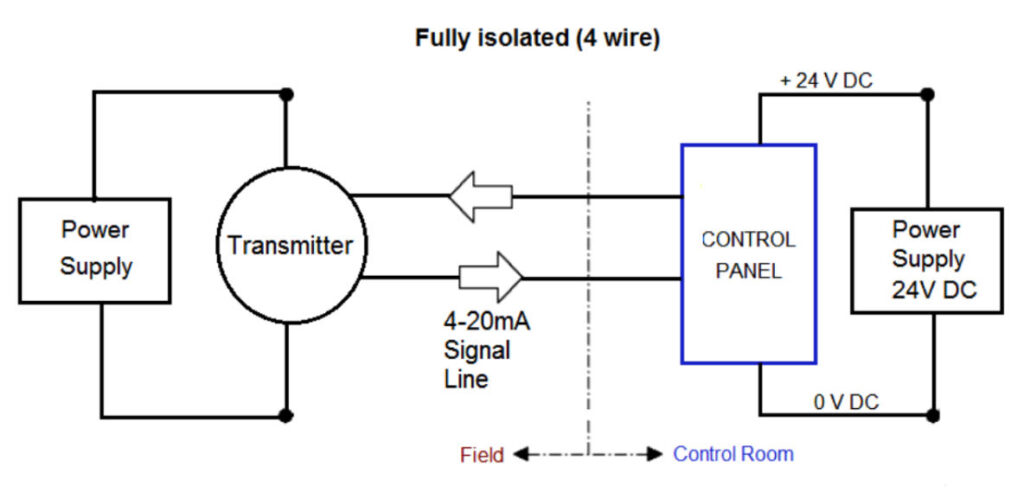
3.2 Four-Wire Structure
A typical four-wire system includes:
- Two power supply wires (L/N or DC+/DC−)
- Two communication wires (RS485 A/B)
This design separates power and communication, improving system stability.
3.3 Functional Features (Jiwei Radar Level Meter)
Through RS485/Modbus communication, the device enables:
- Multi-variable output (level, distance, signal strength, etc.)
- Multi-device networking (multiple instruments on one bus)
- Remote centralized monitoring (SCADA/PLC)
- Batch configuration and management
3.4 Technical Advantages
The core advantage of RS485/Modbus lies in its strong data communication capability. Unlike single-variable 4–20 mA output, Modbus supports transmission of multiple data types, including level, distance, echo status, and fault information, meeting advanced requirements for monitoring, diagnostics, and configuration.
RS485 supports multi-node network structures, allowing multiple Jiwei radar level meters to connect to a single communication bus for centralized data acquisition and management. This significantly reduces wiring costs and improves system integration efficiency, especially in large-scale installations such as tank farms and silos.
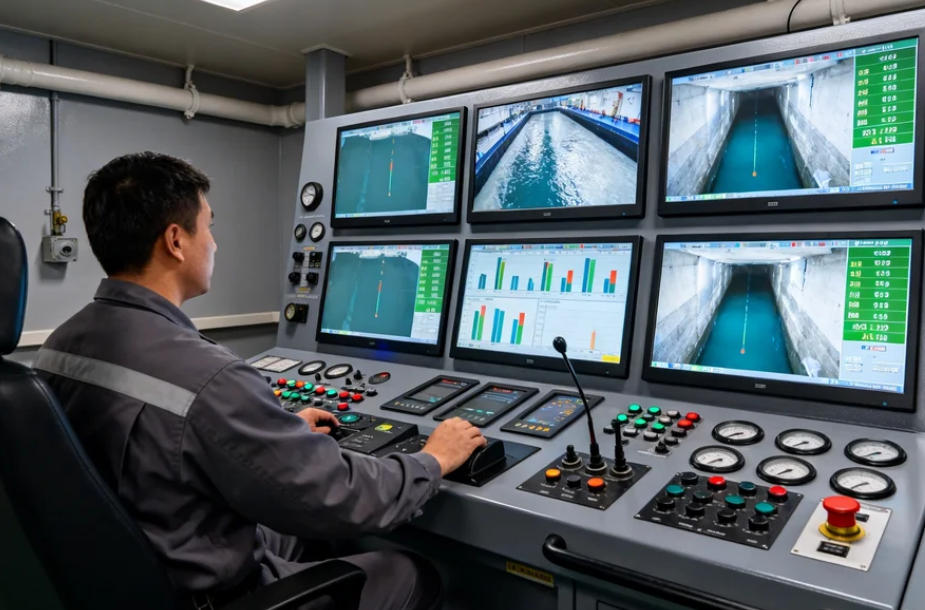
In terms of digitalization, RS485/Modbus is well suited for industrial IoT systems. By connecting to PLCs, RTUs, SCADA systems, or host computers, real-time data transmission, remote monitoring, and centralized maintenance can be achieved, supporting smart factory development.
Additionally, this solution offers strong scalability. As project requirements grow, new devices can be added without major system restructuring, making it highly flexible for expansion and future upgrades.
3.5 Application Scenarios
- Smart factory systems
- Tank farm centralized monitoring
- Digital water management systems
- Industrial data acquisition platforms
4. Comparison of Communication Methods
| Technical Aspect | 4–20 mA/HART Two-Wire | RS485/Modbus Four-Wire |
|---|---|---|
| Signal Type | Analog + Digital | Pure Digital |
| Power Supply | Loop-powered | Independent |
| Anti-interference | Very strong | Strong |
| Communication Speed | Low | Medium–High |
| Data Capacity | Single variable | Multi-variable |
| Networking | Not supported | Supported |
| System Complexity | Low | Medium |
| Application Stage | Traditional control | Digital systems |
5. Selection Recommendations for Jiwei Radar Level Meters
5.1 Stability-Oriented Scenarios
Recommended: 4–20 mA/HART
Applicable for:
- Single-point measurement
- Closed-loop control systems
- High-reliability environments
5.2 Digital-Oriented Scenarios
Recommended: RS485/Modbus
Applicable for:
- Multi-point centralized monitoring
- Industrial IoT systems
- Data-driven production management
5.3 Dual Output Trend
In modern industrial environments, a single output method is often insufficient. Therefore, combined solutions are increasingly adopted.
4–20 mA is typically connected to PLC/DCS systems for real-time level measurement and control, while RS485 connects to SCADA or remote platforms for data acquisition, diagnostics, and remote maintenance.
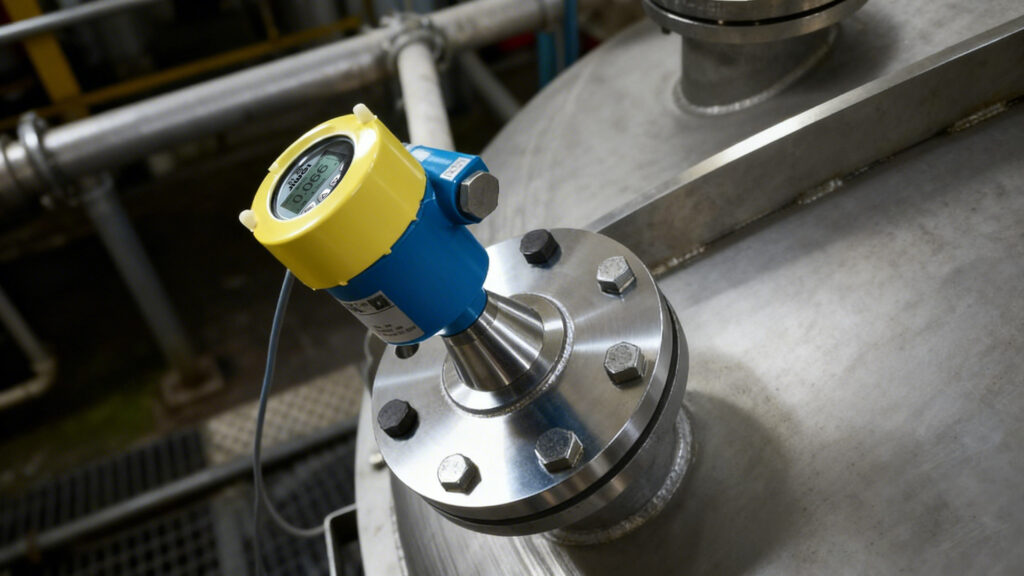
For Jiwei JWrada® radar level meters, multiple output configurations enable both reliable control and advanced data management. The instrument functions not only as a measurement unit but also as a data node, enabling seamless integration between control systems and information systems, and enhancing overall automation and digitalization.
6. Conclusion
As industrial automation evolves toward digitalization and networking, communication method selection becomes increasingly critical.
- 4–20 mA/HART ensures stable and reliable process control
- RS485/Modbus enables device connectivity and data utilization
Jiwei radar level meters integrate multiple communication methods to provide flexible and efficient level measurement solutions, helping industrial users upgrade from simple measurement to intelligent sensing.