Best Radar Level Transmitters for Harsh Conditions – 80GHz Technical Analysis
In modern industrial automation systems, level measurement instruments not only determine the stability of production processes, but also directly affect operational safety, efficiency, and long-term maintenance costs. Especially in industries such as oil & gas, chemical processing, power generation, metallurgy, cement, and environmental protection, field conditions are often associated with high temperature, high pressure, steam, dust, foam, and strong acid or alkali corrosion, creating significant challenges for traditional level measurement technologies.
Many industrial facilities continuously face problems such as:
- Steam causing unstable measurement for ultrasonic level transmitters;
- Dust and airborne particles generating false echoes in conventional radar devices;
- Strong corrosive media leading to probe aging and failure;
- High-temperature environments reducing electronic stability;
- Agitators, foam, and complex tank structures causing severe level fluctuations;
- Hazardous explosive environments requiring extremely high explosion-proof standards.
Against this background, 80GHz high-frequency radar level transmitters have gradually become a key development direction for level measurement in harsh industrial environments. Among them, the JWrada®-35 80GHz radar level transmitter has been widely applied in demanding industrial applications due to its millimeter-wave technology, intelligent echo learning algorithms, high-temperature resistance, and corrosion-resistant structural design.
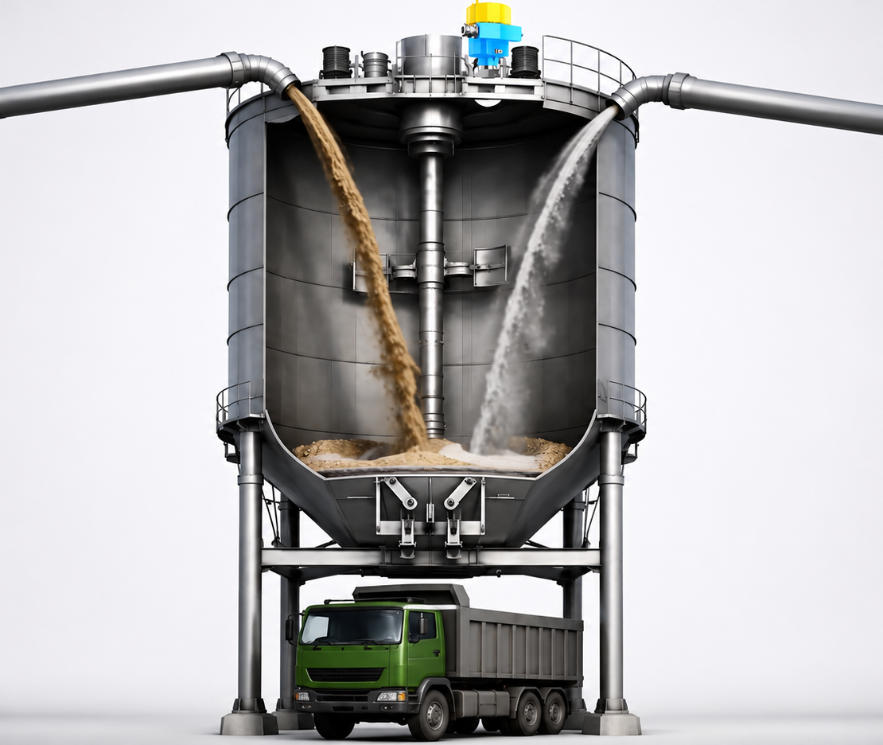
Why Are 80GHz Radar Level Transmitters More Suitable for Harsh Conditions?
Traditional level measurement technologies often show significant limitations in complex industrial environments.
For example, ultrasonic level transmitters rely on acoustic wave propagation and are easily affected by steam, temperature changes, and pressure fluctuations. Guided wave radar devices provide relatively strong anti-interference capability, but in adhesive media, crystallizing materials, or highly corrosive environments, the probe rods may suffer from buildup, fouling, or corrosion damage.
In contrast, 80GHz FMCW radar level transmitters use millimeter-wave electromagnetic measurement technology, which is largely unaffected by media density, temperature, pressure, or most steam conditions. At the same time, they provide narrower beam angles, higher focusing capability, and stronger anti-interference performance, making them particularly suitable for harsh industrial applications.
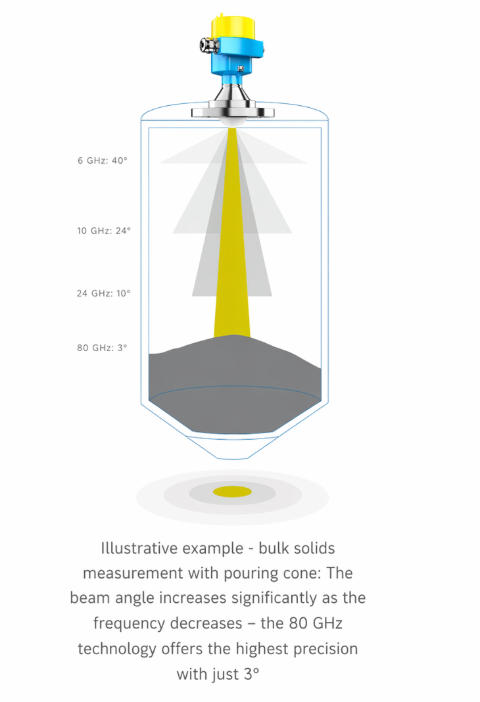
JWrada®-35 adopts 80GHz millimeter-wave FMCW continuous frequency modulation technology. The device transmits high-frequency electromagnetic waves with linearly increasing frequencies and receives reflected echoes from the material surface. The system analyzes the intermediate-frequency signal spectrum through FFT algorithms and calculates the distance between the antenna and the material surface based on electromagnetic wave travel time, achieving highly accurate non-contact level measurement.
Thanks to the high-frequency millimeter-wave design, JWrada®-35 features a smaller beam angle and more concentrated energy. Even inside tanks with complex internal structures, it can effectively avoid ladders, coils, agitators, and other obstacles, significantly reducing false echo interference.
150m Long Measuring Range for Large Tanks and Silos
In large chemical storage tanks, cement silos, mineral powder silos, and bulk material storage systems at ports, measuring distances are often extremely long, making stable measurement difficult for ordinary radar transmitters.
JWrada®-35 is equipped with a 76mm lens antenna and provides a maximum measuring range of up to 150 meters, meeting the requirements of large industrial tanks, ultra-high silos, and long-distance level monitoring applications.
Meanwhile, 80GHz high-frequency technology offers a higher signal-to-noise ratio. Even when measuring low dielectric constant materials such as plastic pellets, fly ash, cement powder, grain, and chemical powders, the transmitter can still obtain stable echo signals.
For bulk solids measurement, field environments are usually filled with airborne dust and floating particles. Conventional low-frequency radar devices often experience signal attenuation, while JWrada®-35 improves measurement stability in dusty conditions through high-energy focusing and intelligent echo processing technology.
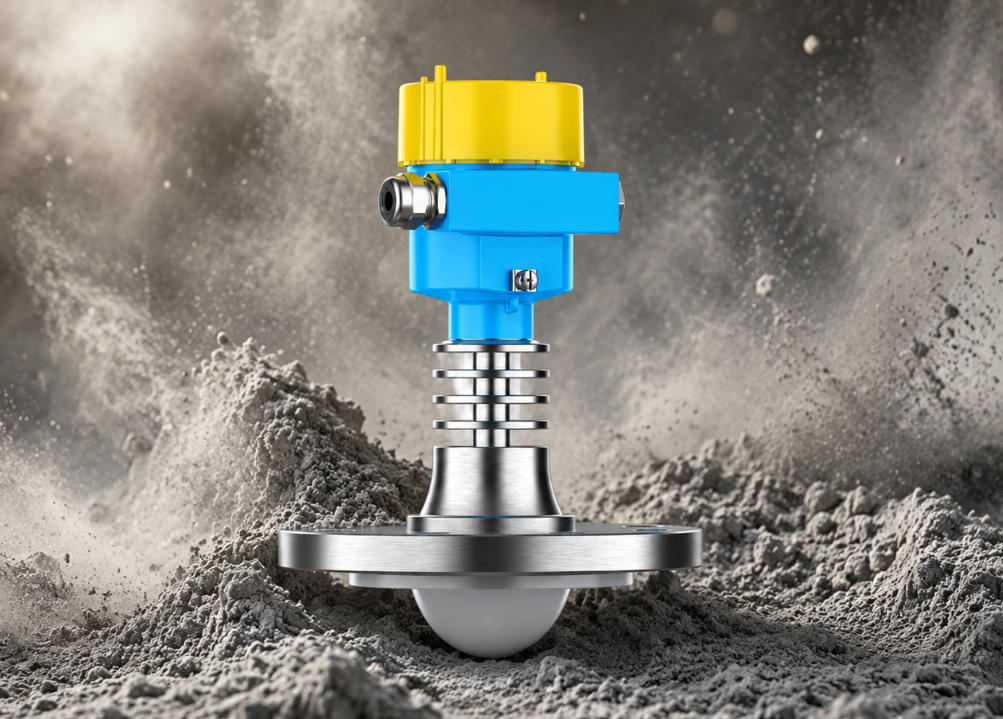
Stable Operation in High-Temperature Steam Environments
High-temperature applications have always been one of the major challenges in industrial level measurement.
Applications such as steam boilers, chemical reactors, hot oil tanks, flue gas desulfurization systems, and high-temperature slurry tanks are commonly associated with steam, condensation, and severe temperature fluctuations. These environments can easily cause measurement drift or even equipment failure in conventional level instruments.
JWrada®-35 adopts an industrial-grade high-temperature structural design and can operate continuously in environments up to 220°C.
Its high-frequency millimeter-wave signals provide strong penetration capability. Even in environments with heavy steam and condensation, the transmitter maintains stable measurement performance. In addition, the device incorporates highly reliable high-temperature-resistant electronic components and professional sealing structures to minimize the influence of high-temperature environments on the electronic modules.
For the chemical industry, high-temperature applications require not only measurement accuracy but also long-term operational reliability. JWrada®-35 has been specifically engineered to ensure long-term stability under high-temperature conditions, reducing maintenance frequency and minimizing downtime risks.
Why Corrosion-Resistant Radar Level Transmitters Are Essential in Corrosive Applications
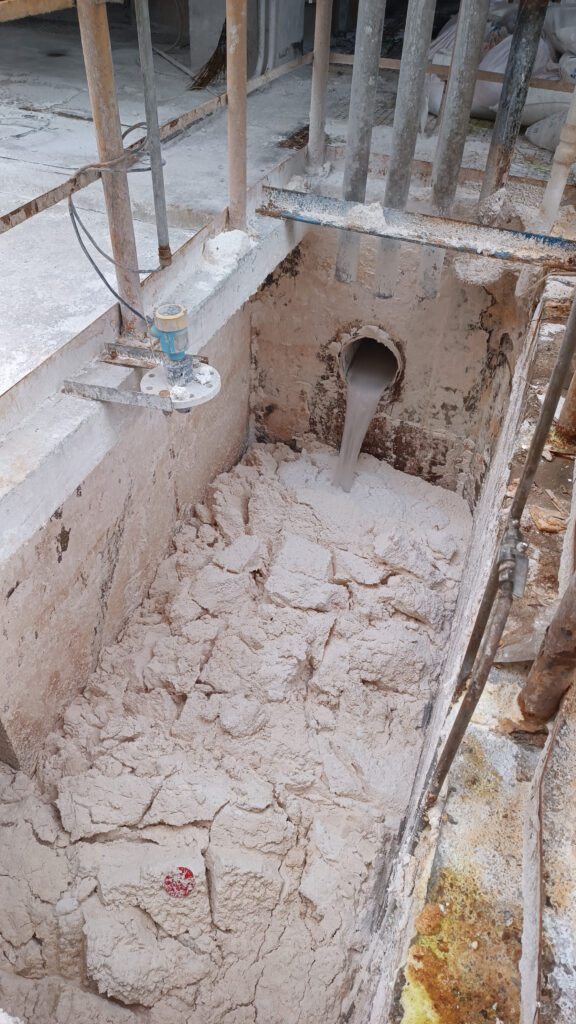
In acid and alkali storage tanks, chemical reactors, and corrosive liquid processes, the media often exhibit extremely aggressive chemical properties.
Conventional metal antennas or sealing structures may suffer from corrosion, sealing degradation, or leakage after prolonged exposure to strong acids and alkalis, affecting measurement accuracy and potentially creating safety risks.
JWrada®-35 adopts a professional corrosion-resistant structural design, equipped with a PTFE anti-corrosion diaphragm and highly reliable corrosion-resistant sealing structures, enabling long-term stable operation in highly corrosive environments. For common chemical media such as hydrochloric acid, sulfuric acid, nitric acid, caustic soda, various organic solvents, and corrosive slurries, the device maintains excellent sealing performance and stable measurement capability.
Its non-contact measurement principle is another major advantage. Since the radar waves do not directly contact the medium, problems such as probe wear, material buildup, and fouling are effectively eliminated, significantly extending service life while reducing maintenance costs.
Dual Explosion-Proof Certification for Hazardous Areas
The oil & gas, chemical, and energy industries require extremely high explosion-proof standards.
Especially in environments containing flammable liquids, combustible gases, or explosive dust, level instruments must comply with strict hazardous-area certifications.
JWrada®-35 is equipped with both gas and dust explosion-proof certifications, including:
- Ex db llC T6 Gb
- Ex ia llC T6 Ga
- Ex tb lllC T80℃ Db
- Ex ia lllC T200 80℃ Da
The product series has been certified by the National Explosion-Proof Certification Center and provides comprehensive protection for both gas and dust hazardous environments. It is widely used in oil storage tanks, LNG storage and transportation systems, chemical hazardous areas, dusty workshops, oil & gas transportation facilities, and explosive reactor vessels.
In petrochemical, energy, and chemical industries, harsh operating environments are often associated with combustible gases, volatile media, and dust explosion risks, placing extremely high demands on instrumentation safety. Through its flameproof and intrinsically safe dual explosion-proof design, JWrada®-35 not only improves operational safety and long-term reliability, but also meets the requirements of large industrial projects for internationally standardized and highly reliable automation equipment.
How Intelligent Echo Learning Algorithms Solve Complex Interference Problems
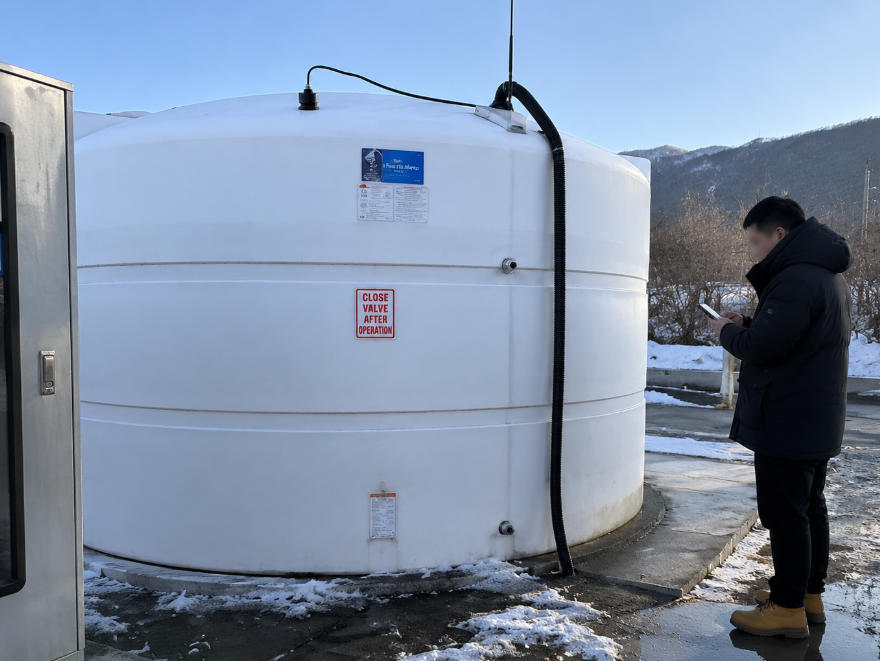
In complex industrial environments, the true factor determining radar measurement stability is not only hardware performance, but also echo processing capability.
Particularly in large storage tanks, chemical reactors, powder silos, and high-temperature steam environments, field conditions are often accompanied by various interference sources, including agitator blades, steam fluctuations, multi-layer foam, internal tank structures, and floating dust particles.
Conventional radar level transmitters frequently encounter false measurement, signal drift, false level indications, or signal loss under such conditions, affecting process stability and automation accuracy.
To address these complex interference problems, JWrada®-35 integrates a self-developed intelligent echo learning adaptive algorithm. The system can automatically learn field environmental characteristics and dynamically optimize measurement models according to process changes.
The algorithm enables:
- False echo identification
- Multi-layer echo separation
- Dynamic target tracking
- Adaptive process compensation
- Interference signal filtering
Even under steam, dust, foam, and complicated tank structures, the transmitter maintains high-quality signal output and long-term stable measurement performance. Compared with conventional radar transmitters that require frequent manual parameter adjustment and repeated field commissioning, JWrada®-35 operates much closer to a truly maintenance-free solution, significantly reducing long-term maintenance costs and downtime risks.
| Harsh Condition Interference | Common Problems with Conventional Radar | JWrada®-35 Solution |
|---|---|---|
| Agitator blade reflection | False level readings, echo confusion | Intelligent false echo identification |
| Steam fluctuation | Signal attenuation, measurement drift | High-frequency millimeter-wave + dynamic compensation |
| Multi-layer foam | Incorrect level detection | Multi-layer echo separation algorithm |
| Internal tank structures | Strong interference echoes | Narrow beam precise obstacle avoidance |
| Floating dust | Signal loss, unstable measurement | High signal-to-noise anti-interference design |
| Continuous process changes | Frequent re-commissioning required | Adaptive learning algorithm optimization |
Bluetooth Wireless Commissioning Greatly Improves Field Efficiency
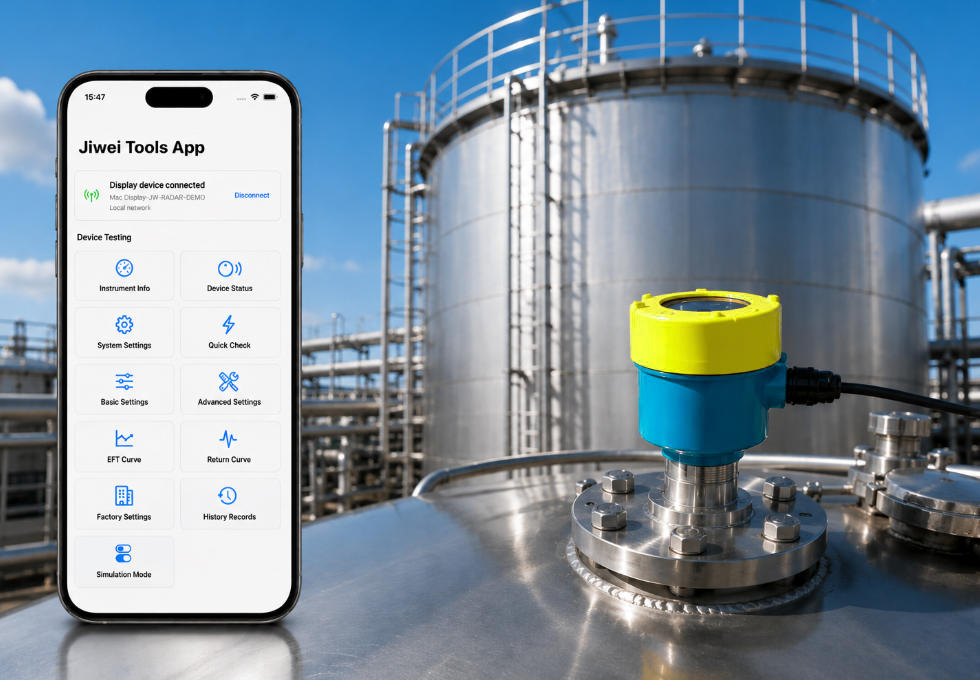
Traditional field commissioning of level instruments usually requires engineers to carry HART communicators and configure parameters on high storage tanks or in hazardous areas, which is inefficient and potentially unsafe.
JWrada®-35 comes standard with a Bluetooth 5.0 module and supports the international APP “JW TOOLS”.
Engineers can use smartphones or tablets to perform:
- Wireless parameter configuration
- Real-time echo curve monitoring
- Remote commissioning
- Fault diagnosis
- Parameter duplication
- Software upgrades
Field commissioning typically requires only around 2 minutes. Through cloud-based data connectivity, remote technical support and remote monitoring can also be achieved, significantly reducing maintenance costs for overseas projects and large industrial plants.
JWrada®-35 Is Widely Used Across Multiple Industries
Thanks to its outstanding high-temperature resistance, corrosion-resistant construction, explosion-proof certification, and strong anti-interference capability, JWrada®-35 has been widely applied in harsh industrial environments worldwide. The product not only withstands extreme operating conditions through its hardware design, but also ensures long-term stable measurement through intelligent echo learning algorithms, earning trust from industrial users globally.
Oil & Gas and Petrochemical Industry
In oil storage and chemical processing applications, storage tanks and reactors are often exposed to high-temperature steam, corrosive liquids, and explosive environments.
For example, a Middle Eastern refinery installed JWrada®-35 on crude oil tanks and chemical storage vessels to continuously monitor crude oil, benzene-based products, and highly acidic liquids. The radar level transmitters operated stably under 220°C conditions and successfully minimized safety risks through flameproof and intrinsically safe protection. According to customer feedback, measurement stability improved by approximately 30% compared with previously used guided wave radar devices, while maintenance costs were significantly reduced.
Power Generation and Environmental Protection Industry
In applications such as desulfurization towers, fly ash silos, and lime slurry storage systems, heavy dust, high temperatures, and steam are common interference sources.
A large thermal power plant in South China installed JWrada®-35 in fly ash silos and wastewater treatment tanks. Through high signal-to-noise ratio design and intelligent echo algorithms, the transmitter effectively eliminated steam and dust interference, maintaining measurement accuracy within ±3mm. Plant engineers reported that the devices have operated without frequent manual adjustments since installation, achieving truly maintenance-free performance while significantly improving operational safety and efficiency.
Metallurgy and Building Materials Industry
In cement, mineral powder, and metallurgical silos, high dust concentration, uneven material flow, and irregular material surfaces often cause false echoes and signal drift in conventional level instruments.
A major cement group in Jiangsu deployed JWrada®-35 in cement powder silos and mineral powder silos. Through narrow beam technology and multi-layer echo separation algorithms, the system achieved highly accurate bulk solids measurement. Field data demonstrated stable measurement performance even under severe dust conditions, effectively preventing equipment shutdowns and overflow incidents caused by incorrect level readings.
Food and Pharmaceutical Industry
The food and pharmaceutical industries require extremely high hygiene standards for liquid and slurry storage tanks, while also demanding low maintenance frequency and non-contact measurement methods.
For example, a large fermentation pharmaceutical plant adopted JWrada®-35 for syrup tanks and fermentation vessels, achieving highly accurate non-contact level measurement while preventing contamination and buildup issues. Through Bluetooth connectivity and the “JW TOOLS” system, operators can remotely monitor level data and echo curves, enabling rapid commissioning and parameter duplication while significantly improving production management efficiency.
These application cases clearly demonstrate that JWrada®-35 provides stable, accurate, and maintenance-free level measurement solutions under high temperature, high pressure, severe corrosion, heavy dust, complex foam, and explosive conditions. Whether in petrochemical, power generation, metallurgy, building materials, food processing, or pharmaceutical industries, JWrada®-35 has become a preferred solution for harsh industrial level measurement applications.
Why More Industrial Companies Are Choosing 80GHz Radar Level Transmitters
80GHz radar level transmitters are gradually replacing traditional ultrasonic level instruments, mechanical level gauges, and even some guided wave radar systems.
With features including:
- Measuring range up to 150 meters
- High-temperature resistance up to 220°C
- PTFE corrosion-resistant structure
- Dual explosion-proof certification
- Intelligent echo learning algorithms
- Bluetooth wireless commissioning
JWrada®-35 has become an important level measurement solution for complex industrial applications.
For harsh operating conditions involving high temperature, steam, dust, strong corrosion, and explosive atmospheres, choosing a stable and reliable 80GHz radar level transmitter not only improves operational stability, but also significantly reduces long-term maintenance costs and unplanned downtime risks.