Why Are 80GHz Radar Level Transmitters Better Suited for Complex Conditions? A Full Analysis from Measurement Principle to Digital Operation and Maintenance
As industrial process control continues to demand higher accuracy, stability, and remote management capability, 80GHz high-frequency radar level transmitters are becoming an important measurement solution for medium and large storage tanks, complex vessels, and harsh operating conditions. Compared with traditional contact-type or guided-wave measurement technologies, 80GHz high-frequency radar level transmitters offer stronger overall adaptability in industries such as chemical processing, petroleum, energy, water treatment, mining, and new materials, thanks to non-contact measurement, narrow beam angle, high resolution, and intelligent operation and maintenance capabilities.
Especially under conditions involving high temperature and high pressure, strong vapor, heavy dust, material buildup, long measuring ranges, and complex internal structures, 80GHz high-frequency radar level transmitters are not only capable of measuring, but more importantly, can maintain stable output over longer operating cycles. This is why more enterprises are prioritizing 80GHz high-frequency radar level transmitter solutions in level instrument upgrades and new construction projects.
I. What Is the Technical Basis of 80GHz High-Frequency Radar Level Transmitters?
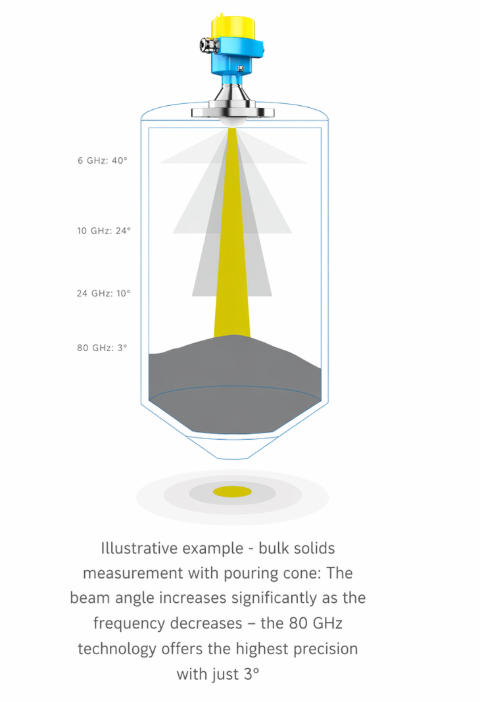
An 80GHz high-frequency radar level transmitter is essentially a free-space, non-contact measuring device. The instrument emits high-frequency microwaves toward the liquid surface through a lens antenna or horn antenna, receives the echo signal reflected from the surface, and calculates the level height through measurement methods such as FMCW. Because the operating frequency is higher and the wavelength is shorter, the beam angle is narrower, the spatial resolution is higher, and the ability to identify the true liquid surface in complex environments is stronger.
From an engineering application perspective, the technical advantage of an 80GHz high-frequency radar level transmitter is not simply higher frequency, but the stronger beam focusing capability brought by higher frequency. The narrower the beam, the easier it is to avoid obstacles such as coils, agitators, baffles, and supports inside the tank, thereby reducing the interference of false echoes on measurement results.
II. Why Are Complex Conditions More Suitable for 80GHz High-Frequency Radar Level Transmitters?
The core difficulty of level measurement under complex conditions is not only the level change itself, but also the presence of multiple interference factors, restricted installation conditions, and high maintenance requirements. In this context, the advantages of 80GHz high-frequency radar level transmitters mainly come from the following aspects.
1. Non-contact measurement structure, more suitable for high-risk media
Traditional contact-type instruments or guided-wave structures must remain in long-term contact with the medium. In high-viscosity, corrosive, crystallizing, or highly contaminated media, adhesion, blockage, and wear can easily occur.
In contrast, an 80GHz radar level transmitter measures downward from the tank top, and the antenna does not directly enter the medium. This avoids contamination and loss caused by long-term contact between the instrument and the medium. Therefore, under high-risk operating conditions, it is easier to maintain long-term stable operation while reducing later maintenance frequency.
2. Narrow beam design, stronger anti-interference capability
In large storage tanks, reactors, or complex process vessels, internal structures such as baffles, agitators, coils, and supports are often present. Ordinary measurement methods are easily affected by reflections from these structures, resulting in chaotic echoes, level fluctuations, or signal loss.
Because 80GHz high-frequency radar level transmitters have a more concentrated beam and more focused energy, they can more easily avoid interference areas through proper installation, reduce the influence of tank walls, internal components, and stray echoes, and improve the ability to identify liquid surface echoes.
3. Better suited for medium and large vessels and long-range applications
For applications such as crude oil tanks, chemical storage tanks, silos, and reservoir shafts, the measuring distance is long, the site space is large, and maintenance conditions are complex. Compared with inserted solutions, non-contact free-space radar is usually easier to install and maintain.
80GHz high-frequency radar level transmitters can meet long-range measurement requirements while maintaining strong echo focusing capability, making them more suitable for medium and large vessels and long-term continuous monitoring applications. In actual applications, they can reduce installation modification and maintenance costs while ensuring measurement stability.
III. Which Typical Industries Are Suitable for 80GHz High-Frequency Radar Level Transmitters?
From the perspective of industry applications, 80GHz high-frequency radar level transmitters are especially suitable for the following types of projects.
In the petrochemical industry, large storage tanks, reactors, solvent tanks, and intermediate tanks are often accompanied by vapor, temperature and pressure fluctuations, and complex internal components. Non-contact radar can more easily demonstrate its advantages in these scenarios.
In the mining and building materials industries, silos, powder bins, and high-dust conditions place high demands on anti-contamination capability and long-range measurement performance. 80GHz high-frequency radar level transmitters are usually more suitable for continuous monitoring tasks.
In the water treatment and environmental protection industries, open basins, chemical dosing tanks, and sludge-related applications require non-contact measurement and convenient later maintenance, making 80GHz solutions highly attractive.
In the food, pharmaceutical, and new materials industries, due to high process hygiene requirements, diverse media, and complex vessel structures, non-contact measurement also offers clear advantages.
IV. Taking JWrada®-35 as an Example, Where Is the Value of an 80GHz High-Frequency Radar Level Transmitter Reflected?
The value of 80GHz high-frequency radar level transmitters represented by JWrada®-35 is no longer limited to hardware measurement accuracy. It is reflected in the comprehensive capability of measurement, commissioning, operation and maintenance, and system integration. Especially in complex industrial scenarios, this comprehensive capability often directly determines project success.
1️⃣ Hardware performance: the basic guarantee for high-accuracy measurement
At the hardware level, JWrada®-35 relies on 80GHz high-frequency radar technology and has the following core advantages:
- Narrow beam design of approximately 3°: highly concentrated signal energy that can effectively avoid obstacles such as agitators and coils inside the tank
- High-resolution echo recognition capability: able to distinguish the true liquid surface from false reflection signals
- Strong anti-interference capability: stable measurement under complex conditions such as vapor, dust, and foam
- Long-distance measurement capability: suitable for medium and large storage tanks and long-range applications
Under proper installation conditions, these characteristics can significantly improve the accuracy of level identification and reduce false alarms and data fluctuations.
2️⃣ Installation adaptability: from installable to optimally installed
Compared with traditional instruments that highly depend on installation conditions, the value of JWrada®-35 in actual engineering is also reflected in stronger adaptability:
- Can be used with a universal flange for flexible angle adjustment
- Supports measurement path optimization for off-center installation positions
- Can avoid interference areas such as feed inlets and agitation zones
- Suitable for retrofit projects without large-scale hot work construction
This allows the device not only to be installed, but to be installed at the best measurement position, improving measurement quality from the source.
3️⃣ Commissioning efficiency: from experience-based to data-driven
In traditional projects, level transmitter commissioning often depends on the experience of engineers and requires repeated disassembly, observation, and adjustment. JWrada®-35 significantly changes this mode through intelligent functions:
- Supports Bluetooth communication, allowing device connection without opening the cover
- Provides real-time echo curve display for intuitive signal quality evaluation
- Can quickly identify sources of false echoes, such as tank walls or structural components
- Supports online parameter adjustment and immediate verification
Engineers can complete commissioning through data analysis rather than experience-based judgment, greatly shortening the project delivery cycle.
4️⃣ Operation and maintenance capability: reducing full lifecycle cost
During long-term operation, the operation and maintenance advantages of JWrada®-35 are especially obvious:
- Non-contact measurement: avoids loss caused by material adhesion and corrosion
- Reduces on-site inspection and repeated commissioning frequency
- Lowers manual troubleshooting costs caused by false alarms
- Extends equipment service life
Compared with the frequent maintenance mode of traditional instruments, its overall operation and maintenance cost is significantly reduced, especially in continuous production scenarios.
5️⃣ Intelligent operation and maintenance: mobile terminal and remote collaboration
If the device supports mobile terminal and cloud capabilities, its project value will be further amplified:
- Complete parameter configuration and status viewing via mobile phone
- Assist on-site personnel with remote commissioning
- Share echo data in real time for expert diagnosis
- Reduce high-altitude and hazardous-area operations
This remote plus on-site collaborative mode makes commissioning safer and more efficient, while also reducing reliance on highly skilled personnel being stationed on site.

6️⃣ System integration capability: from single-point measurement to data asset
In modern industry, level data is not only used for display, but is also an important basis for production decision-making. The system-level value of JWrada®-35 is reflected in:
- Can be connected to DCS, PLC, and SCADA systems
- Supports data remote transmission and centralized monitoring
- Provides real-time data for inventory management and production scheduling
- Supports digital factory and smart operation and maintenance development
Level measurement is upgraded from instrument data to production data asset.
V. Why Will Digital Operation and Maintenance Become the Core Competitiveness of 80GHz High-Frequency Radar Level Transmitters?
In the past, enterprises mainly focused on measurement accuracy and price when selecting level instruments. Today, more and more companies are paying attention to whether devices support remote commissioning, centralized monitoring, and future expansion. This means that a level transmitter is no longer just a single-point device that outputs a 4-20mA signal, but is becoming a sensing node in the industrial digital system.
80GHz high-frequency radar level transmitters that support APP management, Bluetooth commissioning, and remote collaboration usually bring several direct values. First, they shorten the commissioning cycle. Second, they improve the efficiency of abnormal issue location. Third, they reduce travel service costs for overseas projects and distributed projects. Fourth, they facilitate batch parameter replication and later expansion. For modern plants, this integrated capability of hardware, software, and service often has more long-term value than simple parameter advantages.
VI. What Should Be Considered When Selecting an 80GHz High-Frequency Radar Level Transmitter?
Even though 80GHz high-frequency radar level transmitters have broader adaptability, this does not mean that site conditions can be ignored during selection. A truly scientific approach is still to comprehensively evaluate process conditions, vessel structure, and operation and maintenance requirements.
It is necessary to check whether the medium involves vapor, dust, foam, buildup, or corrosion; whether the vessel measuring range is large, whether the top opening position is reasonable, and whether the internal structure is complex; and whether the project emphasizes remote commissioning, rapid deployment, and later digital integration.
In other words, the reason 80GHz high-frequency radar level transmitters are more suitable for complex conditions is not only their higher frequency, but also because they are better aligned with the comprehensive needs of modern industrial projects in terms of structure, signal processing, and digital operation and maintenance.
VII. Conclusion
In the field of complex-condition level measurement, 80GHz high-frequency radar level transmitters are receiving increasing attention because they better meet modern industry’s comprehensive requirements for stability, non-contact measurement, low maintenance, and digital management. For medium and large storage tanks, high-interference vessels, high-temperature and high-pressure environments, and projects requiring remote operation and maintenance support, such products usually demonstrate stronger engineering adaptability.
Represented by JWrada®-35, 80GHz high-frequency radar level transmitters are no longer merely level sensors, but important components for enterprises building efficient, stable, and manageable level monitoring systems. In the future, the development direction of level measurement technology will increasingly emphasize the transition from single-point measurement to systematic sensing and intelligent operation and maintenance.
SEO Keywords:80GHz high-frequency radar level transmitter, complex-condition level measurement, non-contact radar level transmitter, JWrada-35, intelligent level monitoring system