
Chinese-Made Industrial Instruments vs. Established Global Brands: Key Advantages
In the past, when selecting industrial instruments such as pressure transmitters, flow meters, and temperature instruments, many industrial projects prioritized products from established international brands. In continuously operating production facilities, measurement accuracy and operational stability are particularly important because instrument performance directly affects process monitoring and control.
In recent years, Chinese-made industrial instruments have made considerable progress in sensor manufacturing, digital signal processing, and structural design. Some Chinese products now offer technical specifications comparable to those of established global brands. They can also provide advantages in specialized media measurement, installation configurations, and system integration.
For engineers and technical personnel working in industrial environments, comparing Chinese-made instruments with products from established international brands ultimately comes down to measurable performance, response speed, and long-term operating results.
1. Improved Measurement Accuracy
Pressure transmitters are widely used in industrial applications and provide a representative example when comparing the performance of Chinese-made instruments with products from established global brands.
In the past, some Chinese pressure transmitters primarily offered accuracy classes of 0.5 or 0.25. Today, certain high-accuracy products have achieved accuracy classes of 0.075, 0.05, or better, placing them within a range comparable to that of some internationally recognized products.
These improvements are closely related to sensor design, signal conversion, and digital compensation technology.
A pressure transmitter detects pressure changes through a sensing element and converts them into corresponding pressure readings. Factors such as sensor linearity, hysteresis, repeatability, and temperature effects all contribute to measurement error.
Modern Chinese smart pressure transmitters can use multipoint calibration and temperature compensation to correct certain linearity errors and deviations caused by changes in ambient temperature.
During field calibration, technicians should check not only the indication error at each calibration point but also the hysteresis during increasing and decreasing pressure. If the instrument shows a significant difference at the same pressure point during pressurization and depressurization, its measurement performance requires further evaluation.
Range selection also affects actual measurement performance. For instruments whose errors are specified as a percentage of full scale, selecting a range that is too large can result in a relatively high allowable error at the actual operating pressure, even when the instrument has a high accuracy class.
Therefore, when comparing Chinese-made instruments with products from established global brands, measurement range, basic error, and temperature effects should all be considered together.
2. Faster Dynamic Response

In industrial processes where pressure fluctuates frequently, an instrument must do more than measure accurately. It must also respond promptly to changing process conditions.
For example, in compressor discharge pressure control, a pressure transmitter needs to detect pressure changes and update its output signal promptly so that the control system can adjust the relevant actuator.
Some modern Chinese smart pressure transmitters offer response times in the order of hundreds of milliseconds, making them suitable for various rapid-response measurement applications.
Actual response speed also depends on the damping settings.
A higher damping setting produces a smoother output signal but introduces additional measurement delay. A lower setting allows the instrument to reflect pressure changes more quickly, while also retaining more of the pressure fluctuations present in the process.
Modern Chinese smart instruments offer damping adjustment and digital filtering functions that allow parameters to be configured according to control loop requirements. If pressure readings on a DCS display appear to lag behind actual process changes, engineers should check not only the transmitter but also the control system’s filtering settings and signal acquisition cycle.
Therefore, dynamic performance comparisons should be conducted under consistent test conditions, taking into account both the instrument’s own response time and its signal behavior within the actual control loop.
3. Chinese-Made Industrial Instruments:More Flexible Material and Structural Configurations
Process media and installation conditions have a direct impact on industrial instrument performance.
Take electromagnetic flow meters as an example. When measuring corrosive liquids, suitable electrode and liner materials must be selected to withstand the medium. When measuring fluids containing solid particles, the wear resistance of the liner must also be considered.
Chinese-made electromagnetic flow meters are available with different electrode materials, including stainless steel, titanium, Hastelloy, and tantalum, depending on the application. Liner options may include PTFE and polyurethane.
Selecting appropriate materials helps reduce the effects of corrosion and abrasion on measurement equipment. In addition to process media, engineers must consider installation space, pipe connection dimensions, and protection requirements.
Some existing industrial plants use non-standard instrument connections. Replacing these instruments with standard configurations may require modifications to the piping or mounting brackets. Chinese-made instruments can offer flexibility in non-standard connections, sensor dimensions, and structural configurations, allowing equipment to be adapted to site conditions and potentially reducing installation modifications.
In environments with numerous variable-frequency drives and high-power electrical devices, instruments must also provide appropriate electromagnetic interference immunity.
Some Chinese-made instruments improve signal quality through signal isolation, shielding, and digital filtering. However, actual interference immunity must still be evaluated in relation to grounding conditions, cable routing, and electromagnetic compatibility test results.
4. Chinese-Made Industrial Instruments:Better Long-Term Stability
After prolonged operation, an instrument may develop zero-point or span deviations even when no fault alarm is triggered.
For example, a level switch exposed to repeated pressure cycles, temperature changes, and mechanical stress may experience changes in the characteristics of its sensing element or signal-processing circuitry. Over time, these changes can lead to measurement drift.
In continuous production facilities, measurement drift can affect the data received by the control system and, in severe cases, lead to incorrect assessments of process conditions.
Chinese instrument manufacturers have improved sensor encapsulation, temperature compensation, and electronic circuit design to reduce drift caused by certain environmental factors. Some high-performance Chinese-made level switches offer low long-term drift under specified operating conditions, helping maintain consistent performance over time.

However, long-term stability is different from basic accuracy. Basic accuracy describes measurement error under specified conditions, whereas long-term stability describes how instrument performance changes over a period of use.
To compare the long-term stability of Chinese-made instruments with products from established global brands, engineers can review periodic calibration results and track changes in zero-point and span errors over time.
For measurement points exposed to significant temperature variations or frequent pressure shocks, additional operating inspections may also be necessary.
5. Better Communication and Interface Compatibility
When replacing instruments in existing industrial facilities, engineers often need to consider compatibility with existing signal wiring, power supplies, and control systems.
For example, if an existing radar level meter uses a 4–20 mA output, replacing it with a Chinese-made instrument that meets the original power supply, output signal, and process connection requirements can reduce the need for wiring changes and installation modifications.
Some modern Chinese smart instruments support 4–20 mA, HART, Modbus, PROFIBUS, and other signal or communication options, enabling integration with different types of PLC and DCS systems, depending on the model and configuration.
For digital communication applications, engineers should also verify device description files, parameter configuration, and diagnostic information. This helps prevent situations in which measurement values can be read but other device functions do not operate correctly.
Chinese-made instruments can offer flexibility in interface options and functional configurations, allowing them to be adapted to the requirements of existing control systems.
Some smart instruments also provide fault alarms, status monitoring, and remote parameter adjustment, helping maintenance personnel check operating conditions and simplify commissioning.
These capabilities are valuable when upgrading existing plants or installing new measurement points.
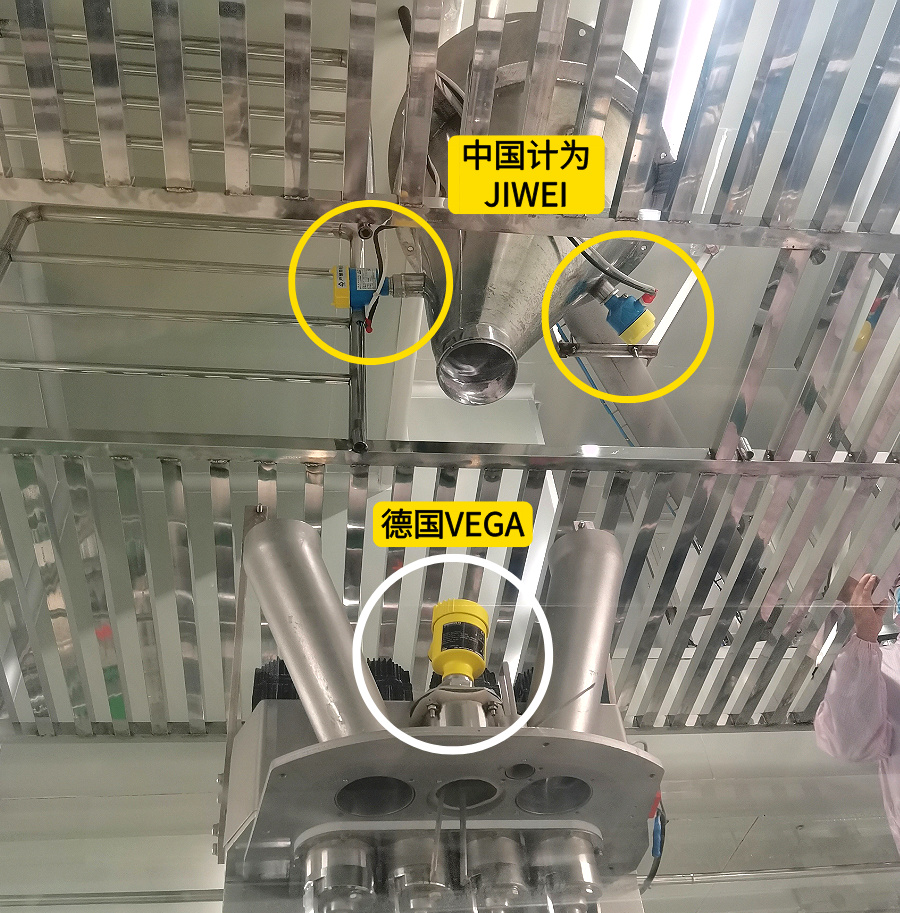
Image caption: Jiwei JWrada radar level meter replacing a VEGA level meter in a petrochemical storage tank application.
6. Performance Comparisons Must Be Based on Actual Data

Replacing products from established global instrumentation brands with Chinese-made alternatives should ultimately be supported by testing under comparable conditions.
For pressure transmitters, relevant parameters include basic error, hysteresis, repeatability, and temperature effects. For level meters, engineers can evaluate indication error and repeatability at different measurement points.
For instruments used in long-term operation, drift records, dynamic response, and environmental performance should also be considered when assessing overall performance.
Pressure transmitters can undergo relevant metrological performance verification in accordance with JJG 882-2019, the Chinese verification regulation for pressure transmitters. Electromagnetic compatibility can be evaluated against the applicable standards in the GB/T 18268 series.
During instrument selection, engineers should also verify the measurement range, ingress protection rating, wetted materials, and communication options to ensure that the instrument matches the actual operating conditions.
A reliable comparison should consider the complete application rather than relying on a single specification. Depending on the process, this may include installation constraints, maintenance requirements, signal integration, and performance over the intended service life.
Conclusion
Chinese-made industrial instruments have made significant progress in measurement accuracy, dynamic response, and long-term stability. Some products now offer technical performance comparable to that of established global brands.
For applications involving specialized process media, non-standard installations, and control system upgrades, Chinese-made instruments can also offer flexibility in material selection, structural design, and interface configuration.
In industrial applications, instrument performance should not be judged by nominal accuracy alone. Actual measurement error, environmental effects, and long-term operating performance must all be considered.
As sensor technology and intelligent measurement systems continue to advance, Chinese-made instruments are expected to play an increasingly important role in industrial automation.
For companies evaluating alternatives to established global instrumentation brands, Jiwei Automations provides radar level meters and level switches for industrial applications. Models such as the JWrada radar level meters, Ring-11 tuning fork level switches, and Tube-11 vibrating rod level switches can be evaluated according to process conditions, installation requirements, and control system compatibility.
The most suitable replacement is the one whose verified specifications and actual performance meet the requirements of the application.