How Does a 4G Wireless Radar Level Meter Enable Cloud-Based Inventory Management?
Cloud-based inventory management with a wireless level meter is not simply about sending a level value to a mobile phone. The real challenge is to connect the entire chain—from accurate level measurement and wireless communication to tank-volume conversion, cloud data processing, alarms, and inventory applications.
If the level measurement is inaccurate, the inventory data will not be reliable. If wireless communication is unstable, cloud data will be interrupted. If tank-volume parameters are incorrect, even highly accurate level measurement can result in inaccurate inventory calculations.
For this reason, the success of a 4G wireless level measurement system depends not on a single instrument, but on whether the entire data chain can provide stable, continuous, and trustworthy information.
1. Accurate Level Measurement Comes First
A 4G wireless level meter is first and foremost a level measurement instrument. Its primary task is to accurately measure the liquid level or solid material level inside a storage tank, silo, or other container.
Different measurement technologies, including radar, ultrasonic, and hydrostatic level measurement, have different application ranges. Instrument selection should not be based only on measuring range and accuracy. The actual process conditions also need to be considered, including the medium, temperature, pressure, steam, dust, foam, tank structure, and installation position.
In real industrial applications, many level measurement problems are not caused by instrument failure. They are caused by insufficient understanding of the process conditions.
For example, if a radar level meter is installed too close to the inlet, the incoming material may interfere with the radar signal. Agitators, reinforcing structures, ladders, and other internal obstacles can generate false echoes. An excessively long nozzle or an unsuitable nozzle diameter can also affect measurement, particularly in the near-field area.
Therefore, for a wireless inventory management project, measurement reliability comes before wireless communication.
If the measured level is unreliable, subsequent inventory calculations, alarms, and replenishment decisions will also be affected.
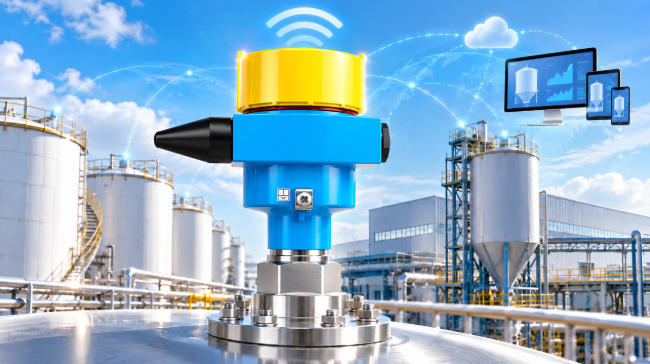
4G Wireless Radar Level Meter for Industrial Inventory Management
A 4G JWrada radar level meter from Jiwei Automations can be used for remote tank level monitoring and industrial inventory management, helping transmit field measurement data to a cloud-based management system.
2. Then Transmit the Data to the Cloud
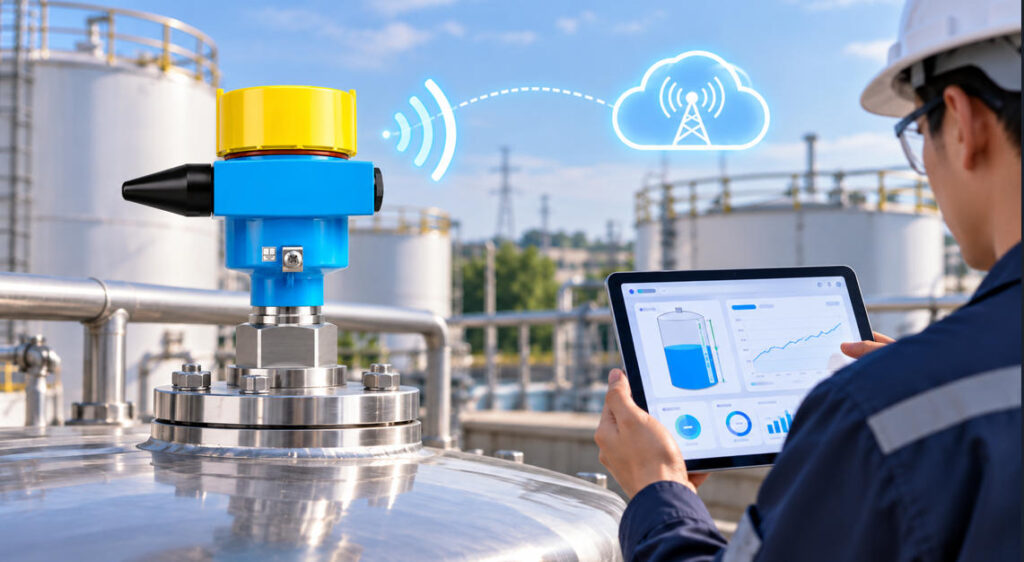
Once the level has been accurately measured, the next step is to transmit the data to the cloud.
Common wireless communication technologies for level monitoring include 4G, LTE Cat.1, NB-IoT, and LoRaWAN. The best communication method should not be selected simply because a technology is newer. The decision should be based on the actual application environment.
Important factors include:
- Wireless network coverage
- Number of measurement points
- Power supply conditions
- Data transmission frequency
- Installation location
- Required communication distance
- Expected device operating time
For storage tanks distributed across different areas, cellular communication such as 4G can allow each wireless level meter to transmit data independently to a cloud platform.
For a large number of measurement points within a plant, another approach is to collect data through a wireless network and gateway before uploading the data to the cloud.
Wireless Signal Stability Matters
One of the most common problems in wireless level monitoring is unstable communication after installation.
Metal storage tanks, underground areas, enclosed workshops, and equipment-dense industrial environments can affect wireless signal quality. Therefore, antenna location, equipment installation height, and local network coverage should be evaluated before the project is implemented.
Power consumption is another important consideration, especially for battery-powered wireless level meters.
A shorter measurement interval and more frequent data transmission will increase power consumption. Poor wireless coverage can also cause repeated reconnection attempts, further reducing battery life.
Therefore, the data acquisition interval should not simply be set as short as possible. It should be determined according to the actual rate of inventory change.
Cloud inventory management requires continuous and reliable data—not simply a level value refreshed every second.
Remote Parameter Configuration
For wireless level monitoring applications, convenient commissioning is also important. A 4G JWrada radar level meter can support Bluetooth communication for remote parameter configuration and commissioning, helping reduce the need for frequent on-site adjustments.
3. Level Is Not the Same as Inventory
This is one of the most important points in cloud-based inventory management.
A level meter measures height. Inventory management normally requires volume, weight, or inventory percentage.
There is an additional step between level measurement and inventory calculation: tank-volume conversion.
For a regular vertical cylindrical tank, the relationship between liquid level and volume is relatively straightforward.
However, for horizontal tanks, conical-bottom tanks, tanks with elliptical heads, or irregularly shaped vessels, the relationship between level and volume is not simply proportional.
In these applications, accurate tank dimensions or a calibrated tank strapping table may be required.
A cloud inventory management system may need to include parameters such as:
- Tank height
- Tank diameter
- Tank shape
- Effective tank volume
- Measurement reference point
- Tank-volume relationship
- Medium density
- Material characteristics
If inventory is calculated by weight, the density of the medium must also be considered.
For materials whose density changes significantly with temperature, additional compensation may be required depending on the measurement requirements.
Solid and granular materials can be even more complicated. Their surface is often uneven, and the actual inventory can be affected by the angle of repose and bulk density.
Therefore, the calculation method for a liquid storage tank cannot simply be applied to a powder or bulk-solid silo.
Accurate Inventory Requires More Than Accurate Level Measurement
The accuracy of cloud inventory management depends on several factors:
Level measurement accuracy + tank-volume data + material parameters + correct calculation logic
In other words, instrument accuracy is only one part of the overall inventory management system.
4. Cloud Inventory Management Goes Beyond Level Data

Once measurement data reaches the cloud platform, its management value becomes much greater.
A single level value does not provide enough information for effective inventory management.
A cloud-based inventory management system should collect data from different sites and storage tanks and convert it into continuous, usable inventory information.
In practice, plant managers are usually concerned with several key questions:
- How much material is currently available?
- How quickly is inventory being consumed?
- When will the inventory reach the replenishment level?
- Which measurement point is experiencing abnormal data?
- Which storage tank needs material replenishment?
- Is the current inventory sufficient for upcoming production?
Continuous data makes these functions possible.
Inventory Trends
Historical trends can show how quickly inventory is increasing or decreasing. They can also help identify abnormal changes.
For example, a sudden level change may indicate:
- Material loading or unloading
- Unexpected consumption
- Measurement interference
- Communication problems
- Incorrect configuration
Remote Inventory Monitoring
With multiple wireless level meters connected to the cloud, users can monitor multiple storage tanks from a centralized platform instead of manually checking each tank.
This is particularly useful for:
- Factory storage tanks
- Chemical storage
- Water treatment facilities
- Oil and fuel storage
- Food and beverage production
- Agricultural storage
- Bulk material silos
- Remote storage facilities
The key is not simply to display data, but to ensure that the data is continuous, traceable, and reliable enough to support inventory decisions.
5. Inventory Alarms Should Be More Than High and Low Limits
Many inventory monitoring systems only configure high-level and low-level alarms.
In real applications, this is often not enough.
Inventory alarms should be considered together with the data acquisition interval, material consumption rate, transportation time, and replenishment cycle.
If the low-level alarm is set too low, the warning may arrive after there is no longer enough time to arrange replenishment.
If the alarm is set too high, the system may generate excessive warnings, eventually causing users to ignore them.
Different Types of Alarms
A practical cloud inventory management system should distinguish between inventory alarms and equipment alarms.
Inventory-related alarms may include:
- High inventory
- Low inventory
- Critical low inventory
- Abnormal inventory change
- Rapid consumption
Equipment-related alarms may include:
- Communication failure
- Low battery voltage
- Abnormal measurement
- Sudden data fluctuation
- Long-term unchanged measurement data
These two categories serve different users.
Inventory alarms are primarily intended for production, warehouse, and purchasing personnel.
Equipment alarms are more relevant to instrumentation, maintenance, and automation engineers.
Separating these alarm types makes the cloud inventory management system easier to operate and maintain.
6. Common Problems in Wireless Level Monitoring Projects
Several problems occur repeatedly when implementing wireless level monitoring and cloud inventory management systems.
1. Incorrect Instrument Selection
The medium, process conditions, tank structure, and installation environment must be understood before selecting the instrument.
Choosing a level meter simply according to measuring range can result in unstable measurement after installation.
2. Improper Installation
Installation location has a direct impact on measurement performance.
Problems may occur when the instrument is:
- Installed too close to the material inlet
- Installed at an unsuitable angle
- Mounted on an excessively long nozzle
- Installed too close to internal tank structures
- Installed where there are strong interference sources
3. Wireless Coverage Is Not Tested in Advance
If wireless network coverage is only checked after installation, additional antenna work or equipment relocation may be required.
A wireless communication survey should therefore be performed before large-scale deployment.
4. Incorrect Tank-Volume Parameters
Even accurate level measurement cannot produce accurate inventory data if the tank dimensions or tank-volume table are incorrect.
Differences between actual tanks and engineering drawings can also introduce errors.
5. Incorrect Data Acquisition Interval
A measurement interval that is too short can increase power consumption.
A measurement interval that is too long may fail to reflect rapid inventory changes.
The appropriate interval should therefore be determined according to the actual application.
Any of these problems can reduce user confidence in the system.
Once users no longer trust the inventory data, alarms, reports, replenishment planning, and other cloud-based functions become difficult to use effectively.
7. Wireless vs. Wired Level Measurement
Wired and wireless level measurement systems are not necessarily alternatives to each other. Their suitability depends on the application.
A wired level instrument can be connected to a PLC, DCS, or local control system and is generally suitable for process monitoring and control within a plant.
Wireless level measurement is particularly suitable for:
- Distributed storage tanks
- Remote measurement points
- Difficult-to-wire locations
- Long-distance monitoring
- Cloud-based inventory management
- Low-power remote monitoring applications
For an internal plant control loop, a wired solution may be preferable when stable real-time control is required.
For geographically distributed storage tanks and remote inventory monitoring, a wireless solution can significantly simplify deployment.
The key principle is:
Do not choose wireless technology simply because the application is “wireless.” Choose the communication method that provides reliable data for the actual operating environment.
8. The Complete Wireless Inventory Management Chain
From an instrumentation and automation perspective, a cloud-based wireless inventory management system can be divided into several layers:
Level Sensor → Communication Terminal → Wireless Network → Cloud Platform → Tank-Volume Model → Inventory Management Application
Each layer has a different responsibility.
Level Measurement
The level sensor measures the actual liquid or solid level in the storage tank or silo.
Wireless Communication
The communication module transmits the measurement data from the field to the cloud platform.
Cloud Platform
The cloud platform receives, stores, and processes the measurement data.
Tank-Volume Model
The system converts the measured level into volume, weight, or inventory percentage based on tank geometry and material parameters.
Inventory Application
The final application provides:
- Real-time inventory monitoring
- Historical trends
- Inventory reports
- High/low inventory alarms
- Equipment status monitoring
- Replenishment reminders
- Multi-tank management
- Remote access
For an industrial project, measurement, installation, power supply, wireless communication, tank-volume parameters, and cloud-platform logic should be considered together.
During commissioning, the field level, cloud-platform data, calculated inventory, and actual material quantity should be checked against each other.
Only after these values are verified can the system provide reliable support for actual inventory management.
9. Conclusion
The technical concept behind using a 4G wireless level meter for cloud-based inventory management is not complicated. The challenge is making sure every part of the system works correctly.
The level must be measured accurately.
The wireless data must be transmitted reliably.
The tank-volume parameters must be correct.
The cloud platform must use appropriate calculation logic.
The data acquisition interval and alarm strategy must match the actual operating conditions.
For end users, the effectiveness of a wireless inventory management system can ultimately be judged by three questions:
Is the data accurate?
Is the data transmission stable?
Can operators trust the system when making inventory decisions?
When these three requirements are met, a 4G wireless level meter becomes more than a remote measurement instrument. It becomes an important field device connecting industrial level measurement with cloud-based inventory management and smart factory operations.
If your factory is looking for a 4G wireless level monitoring and cloud inventory management solution, contact Jiwei Automations to discuss your application and level measurement requirements with our engineering team.