
Why aren’t all tuning fork level switches suitable for foam pellets?
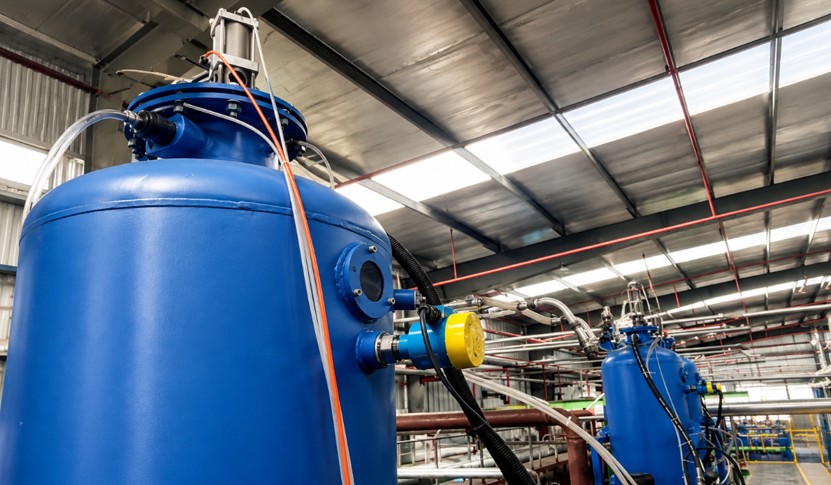
The reason why the Fork-11 tuning fork level switches are suitable for ultra-low-density foam beads is not simply because it has “high sensitivity.” More importantly, the fork area, vibration frequency, vibration amplitude, piezoelectric detection, and precision tuning work together, allowing extremely light particles to produce an identifiable damping change on the fork.
Quick Overview
| On-Site Issue | Impact on the Level Switch | Fork-11 Response Approach |
| Foam bead density is extremely low | The damping acting on the probe is very small, and ordinary switches may fail to operate. | Increase the fork contact area to improve the ability to identify very small damping changes. |
| Airflow, steam, and agitation inside the pre-expander | The material surface fluctuates and is easily disturbed, which may cause false triggering. | The vibrating level switch only detects contact/non-contact, making it more suitable for point-level control. |
| Static electricity and particle adhesion | May cause false alarms or incomplete reset. | A suitable fork structure and installation angle can reduce the impact of material buildup. |
| Fast molding machine cycle time | Timely operation and stable reset are required. | The switching output is suitable for high- and low-level interlocks and automatic material replenishment. |
| Need for domestic replacement | Users are concerned about cost, delivery time, and maintenance response. | Within the scope of publicly available information, it can be used as a domestic selection option for lightweight particle applications. |
1.Ultra-Low-Density Foam Beads Are Difficult to Measure Not Because the Particles Are Small, but Because the Damping Is Too Weak
In ordinary powder or granular material silos, as long as a level switch comes into contact with a certain amount of material, the mechanical resistance, capacitance change, or vibration attenuation is usually relatively obvious. However, EPS, EPP, and other foam beads have very low density after pre-expansion. The material is fluffy and contains a high amount of air. The material surface is also affected by pneumatic conveying, steam, exhaust air, and equipment vibration. The pre-expanded density of EPS can be as low as 0.008 g/cm³, and the material surface is easily disturbed by airflow and steam.
This type of operating condition places three practical requirements on a level switch:
First, the probe must be able to identify very small changes caused by contact with the medium. Foam beads do not create obvious damping when contacting the fork, unlike sand, cement, or salt particles, which have significant weight.
Second, the switch should not rely excessively on dielectric constant or mechanical torque. The difference between foam beads and air is relatively small, and the particles are loose. Under extremely low-density conditions, some capacitance-type or mechanical solutions may be prone to false operation, failure to operate, or an overly narrow adjustment range.
Third, the equipment must be suitable for continuous production cycles. Pre-expanders and molding machines are usually not used for one-time static measurement. Instead, they continuously feed, discharge, and replenish material. Once the level signal is delayed, it may affect density consistency and production rhythm.
2. The Core Logic of the Fork-11: Making Lightweight Particles Able to “Affect” Tuning Fork Vibration
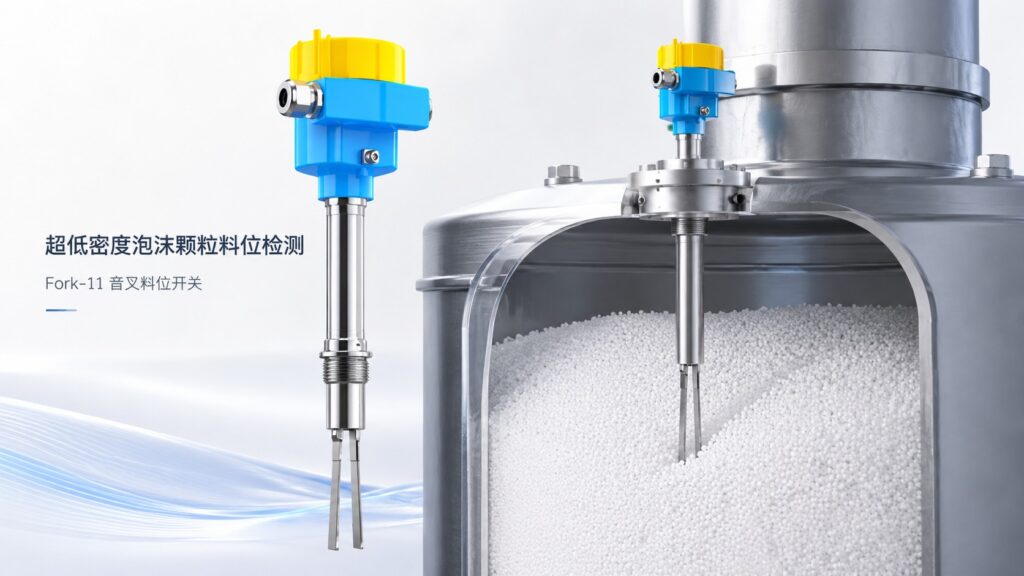
The operating principle of tuning fork level switches is not complicated: the tuning fork vibrates in air under a fixed condition; when material contacts the fork, the vibration amplitude or vibration characteristics change; the electronic circuit detects the change and outputs a switching signal. Jiwei Automation’s product page also states that the Fork-11 is based on a tuning fork probe and uses piezoelectric components for vibration drive and detection. When the fork comes into contact with material, the vibration amplitude decreases, and the intelligent circuit outputs a switching signal accordingly.
The real difficulty is that foam beads with a density of 0.008 g/cm³ are too light. If the fork area is small, the frequency is too high, or the vibration amplitude is too low, the damping generated after material contact may be insufficient, and the circuit may not be able to stably determine that material is present.
Therefore, the design approach of the Fork-11 is not simply to increase electronic sensitivity. Instead, it first makes the fork structure easier for lightweight particles to affect mechanically.
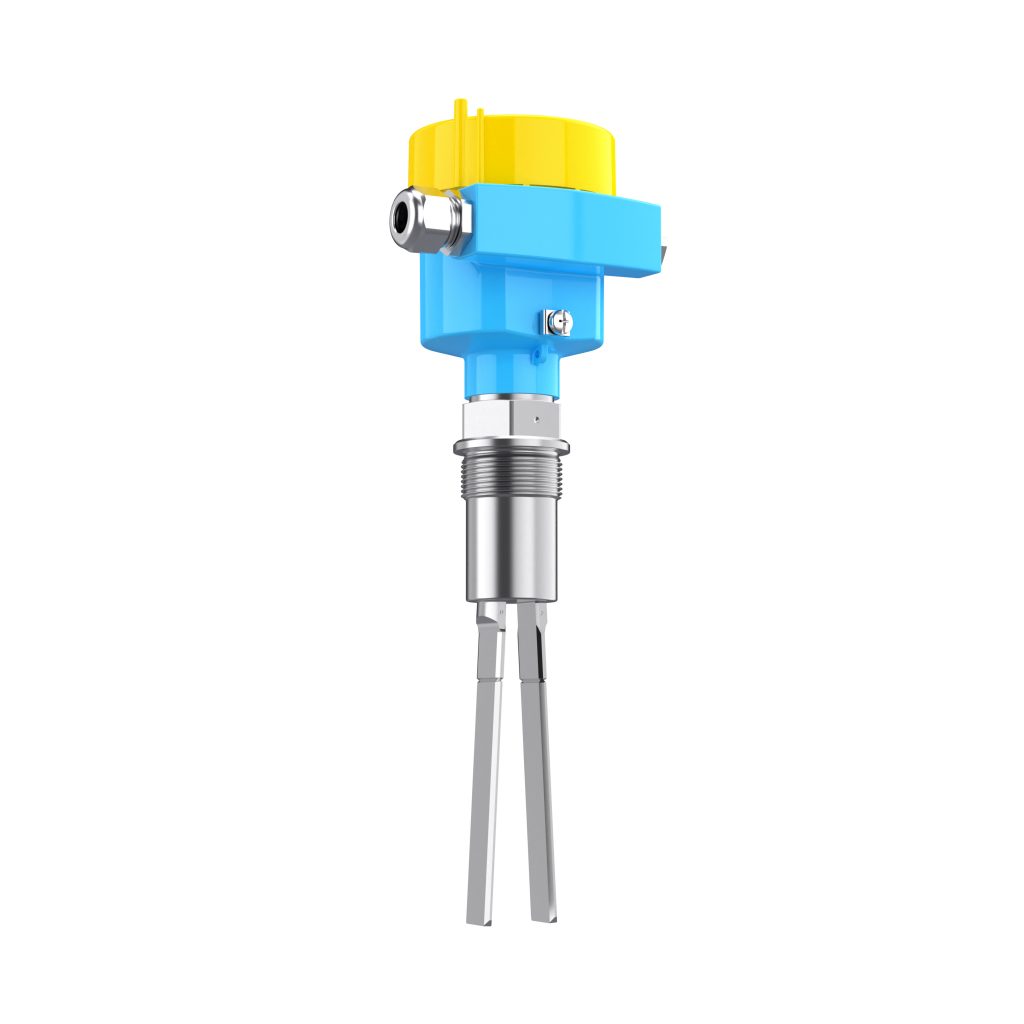
The Fork-11 appropriately increases fork vibration amplitude, reduces vibration frequency, and increases the fork wing area to improve the contact surface with the medium. This design direction of low frequency and large contact area is consistent with the general understanding in the vibrating level-switch industry that longer forks provide higher sensitivity and lower vibration frequency, making them more suitable for low-density media.
3. Why Are Not All Tuning Fork Level Switches Suitable for Foam Beads?
A common misunderstanding in field selection is that any product called a “tuning fork level switch” can measure lightweight foam beads. In reality, this is not the case.
Some tuning fork products are designed to accommodate liquids, solids, slurries, or stronger self-cleaning performance. They may use shorter, stiffer, or higher-frequency fork structures. These designs may perform stably in higher-density powders, granules, or liquids. However, in low-damping conditions such as foam beads, material contact may not be sufficient to significantly change the vibration state of the fork, resulting in unstable operation.
Therefore, foam bead level detection should focus on the following three indicators:
| Selection Focus | Why It Matters | Key Points to Confirm |
| Minimum measurable density | Determines whether ultra-light particles can be detected | Whether it clearly supports low-density ranges such as 0.008 g/cm³ |
| Fork structure | Determines whether lightweight materials can produce sufficient damping | Fork length, area, thickness, and tuning method |
| Process suitability | Determines long-term stability | Temperature, humidity, dust, static electricity, installation angle, and inlet impact |
4. Typical Application Scenarios in Pre-Expanders and Molding Machines
4.1 Pre-Expanders: The Focus Is on Preventing False Full-Level Signals and Delayed Empty-Level Signals
The condition of foam beads inside a pre-expander is not stable. The material is affected by steam, hot air, agitation, suction, and exhaust. The material surface may be loose, turbulent, or locally accumulated. For high-level detection, if the switch falsely indicates that the hopper is full, feeding may stop too early. If the switch does not operate, overfilling may occur or subsequent production cycles may be affected.
The Fork-11 is more suitable for point-level control in this position, such as high-level alarms, full-level shutdown, and material replenishment interlocks. It does not need to continuously display the material level. Instead, it answers the most important on-site question: is there material at this height?
4.2 Molding Machines: The Focus Is on Switching Consistency and Reset Reliability
Molding machines usually operate at a faster cycle rate and have higher requirements for level-signal consistency. If the level switch operates slowly, it may affect mold cavity filling. If it does not reset properly, it may affect the next material replenishment judgment. For foam beads that are easily disturbed by airflow, stable switching signals are often easier to use for interlock control than complex continuous measurement signals.
4.3 Foam Bead Transfer Hoppers: The Focus Is on Low Density and Static Adhesion
In intermediate silos or transfer bins, foam beads may adhere to the silo wall or probe surface due to static electricity. In this case, the installation method is more important than product parameters alone. The installation should avoid the material inlet impact area as much as possible, prevent the fork from being directly buried or subjected to long-term material buildup, and, for horizontal installation, use an inclined angle and protective structure according to the manufacturer’s installation recommendations.
5. Selection Recommendations: For Low-Density Foam Beads, Do Not Only Ask “Can It Measure?” but Also “How Can It Measure Reliably?”
For EPS, EPP, EPE, and other foam beads, it is recommended to confirm the following in sequence:
- First, confirm the density range.
If the minimum density is close to 0.008 g/cm³, priority should be given to models that clearly specify low-density capability, rather than general-purpose tuning forks or liquid-solid dual-purpose models. - Then, confirm the particle condition.
Are the particles wet? Is there static electricity? Is there dust? Are they affected by steam or hot air? All these factors can affect switching and reset performance. - Confirm the installation position.
High-level, low-level, and intermediate-level applications have different operating conditions. High-level detection focuses more on preventing false full-level alarms. Low-level detection focuses more on timely empty-level indication. Locations near material inlets require particular attention to impact protection. - Confirm output and interlock logic.
Pre-expanders and molding machines usually need to be linked with PLCs, feed valves, vacuum loaders, or alarm systems. During selection, relay output, two-wire output, power supply, and fail-safe mode should be confirmed at the same time. - Confirm maintenance requirements.
For sites prone to material buildup, moisture, or heavy dust, cleaning cycles and installation angles should be planned in advance rather than adjusted only after false alarms occur.
6. The Value of the Jiwei Solution: Turning “Ultra-Light Particles Can Trigger” into “Usable in Real Applications”
The advantage of the Fork-11 should not be understood as a single-parameter advantage. It should be understood as a systematic design for lightweight powders and granular materials: a larger fork contact area, lower vibration frequency, vibration detection suitable for low-damping media, precision-tuned fork structure, and material options such as 316L stainless steel all work together to support level detection of ultra-low-density particles.
The Fork-11 fork body is manufactured through dedicated mold precision casting and is subsequently tuned to improve vibration characteristics.
For foam-equipment manufacturers and users, what is truly needed is not an instrument with attractive specifications, but a level-control solution that can reduce false alarms, reduce commissioning difficulty, and adapt to batch equipment supply requirements. If the on-site material density is extremely low, the material surface disturbance is significant, and simple and reliable high-level or low-level switching signals are required, the Fork-11 tuning fork level switch can be considered as a priority model for evaluation.
7. Industry Issues That Still Require Attention
Even when using a tuning fork level switch suitable for low-density materials, foam bead level detection is still not a matter of simply installing the instrument and expecting everything to work perfectly. Several issues in the industry still need continuous improvement:
- Insufficient installation standards. The performance of the same instrument may vary greatly depending on whether it is installed near the material inlet, on the side wall, or in a silo dead zone.
- Incomplete operating-condition information. Many selection inquiries provide only the material name, without providing density, temperature, humidity, conveying method, or silo structure.
- Ignoring interface details when replacing imported products. Process connections, insertion depth, output type, and installation space all need to be checked.
- A balance is required between low-density sensitivity and material buildup. The higher the fork sensitivity, the more attention should be paid to the long-term effects of static electricity, dust, and installation angle.
8. Conclusion
The key to ultra-low-density foam bead level detection is not simply increasing circuit sensitivity. It is to create sufficient, stable, and repeatable vibration changes between the lightweight material and the probe.
The Fork-11 tuning fork level switch is designed around the structural and vibration characteristics required for low-density powders and fine particles. It is suitable for high-level, low-level, and interlock-control applications in pre-expanders, molding machines, and foam bead storage hoppers.
If the application involves ultra-light particles with a density of around 0.008 g/cm³, strong airflow disturbance, static adhesion, or imported-product replacement requirements, it is recommended to provide Jiwei Automation with the material density, particle size, temperature, silo structure, installation position, and output type so that technical personnel can assist in confirming the specific Fork-11 configuration and installation solution.
9. FAQ
Q1: How difficult is it to detect foam beads with a density of 0.008 g/cm³?
A density of 0.008 g/cm³ is equivalent to 8 kg/m³, which is an extremely lightweight granular-material condition. The damping generated when the material contacts the probe is very small. Ordinary mechanical switches, general-purpose tuning forks, or some capacitance-type solutions may have difficulty operating stably.
Q2: Is the Fork-11 tuning fork level switch suitable for liquid measurement?
The public positioning of the Fork-11 is mainly for powder and fine granular-solid level measurement. For liquid level detection, dedicated tuning fork liquid level switches or other suitable products should be selected. It is not recommended to use the same product simply because both structures are referred to as “tuning forks.”
Q3: Will static electricity in foam beads affect a tuning fork level switch?
Static electricity may cause particles to adhere to the fork or silo wall, which may affect reset performance or cause false alarms. Installation angle should be optimized according to site conditions, the direct material inlet impact area should be avoided, and inspection and maintenance methods should be established according to material adhesion conditions.
Q4: Is a continuous level meter or a level switch more suitable for high-level detection in a pre-expander?
If the application only needs to determine whether the material is full, empty, or present at a certain control point, a level switch is more direct and the interlock logic is simpler. If continuous display of material height is required, radar, weighing, or other continuous-measurement solutions should be evaluated separately.
Q5: What should be considered when replacing an imported tuning fork level switch?
In addition to the minimum measurable density, the process connection, insertion length, power supply, output type, explosion-proof requirements, installation space, and fail-safe logic should also be checked. Avoid replacing a product only based on appearance while overlooking control-system compatibility.