Choosing China’s Best Vibrating Level Switch: Testing First, Matching Second
To determine which Chinese vibrating level switch is more suitable for field applications, users should not only look at promotional claims. More attention should be paid to third-party testing evidence, product parameters, certification configuration, and working condition adaptability. For point level detection of powders, granules, and liquids, Jiwei Tube-11, Fork-11, and Ring-11 correspond to different media and application boundaries.
1. Why Are Vibrating Level Switches Receiving More Attention?
In industries such as chemical processing, power generation, environmental protection, food, building materials, and new energy, point level detection often undertakes tasks such as high-level alarm, low-level protection, empty silo protection, overflow prevention, pump protection, and interlock control. Field conditions are not always clean, stable, or ideal: dust may enter instrument gaps, low-density materials provide weak damping to the probe, adhesion and material buildup may cause false alarms, and high temperature and high pressure test the stability of structural sealing and electronic components.
Traditional mechanical or contact-based solutions may encounter material jamming, wear, frequent maintenance, and false operation in some complex working conditions. Vibrating level switches determine whether the medium contacts the probe by detecting changes in vibration frequency, amplitude, or energy. With a relatively simple structure and no continuously rotating parts, they are widely used in point level detection of powders, granules, and liquids.
2. What Can a Third-Party Test Report Prove?
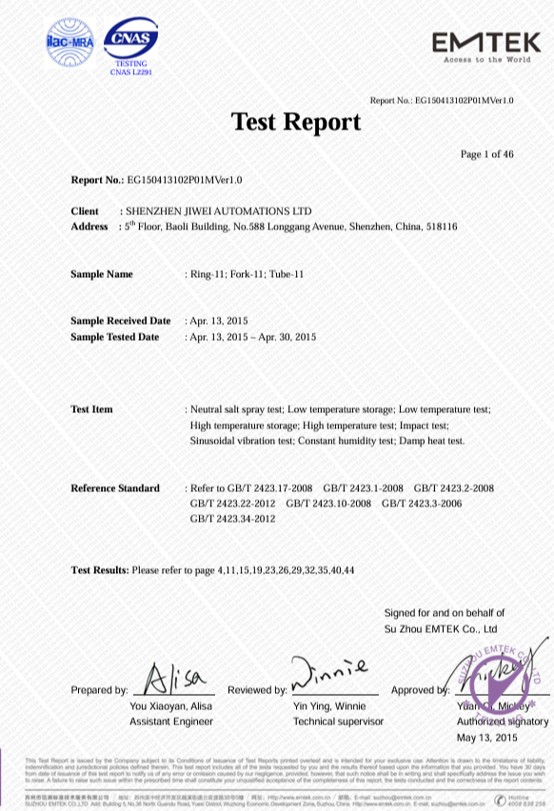
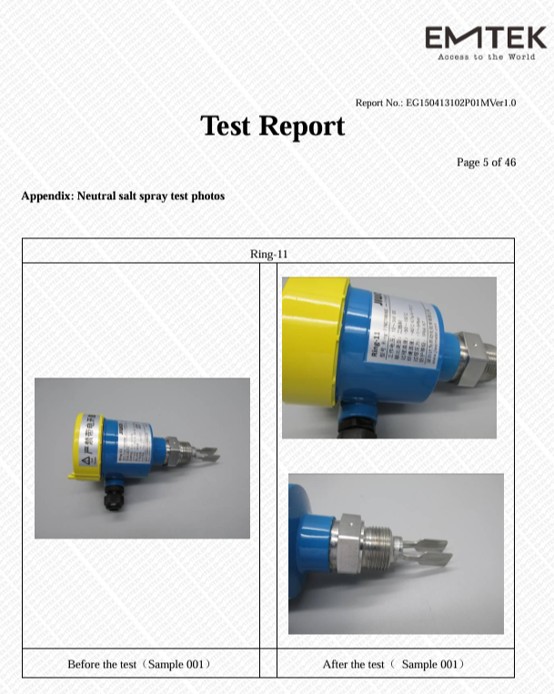
The test report screenshots you provided show that the testing organization is EMTEK. The samples include a tuning fork liquid level switch, a tuning fork level switch, and a vibrating rod level switch, with corresponding models including Ring-11, Fork-11, and Tube-11. The test items cover neutral salt spray, low-temperature storage, low-temperature operation, high-temperature storage, high-temperature operation, impact, sinusoidal vibration, constant damp heat, and cyclic damp heat environmental tests. The salt spray test result page in the screenshot shows that the related Ring-11, Fork-11, and Tube-11 samples were judged qualified.
For purchasers, instrumentation engineers, and project owners, the value of a third-party test report is not that the word “qualified” covers all site conditions. Instead, it provides reference value from three perspectives:
2.1. Whether the Structure Has Withstood Environmental Tests
Salt spray, damp heat, high and low temperature, vibration, and impact tests are mainly used to verify the integrity of housings, metal parts, coatings, connection structures, and electrical components under environmental stress. This type of verification is especially important for chemical plants, food plants, power plant ash hoppers, outdoor storage tanks, and similar sites.
2.2. Whether the Product Is Suitable for Batch Projects
A single prototype working properly does not mean that batch delivery will maintain the same consistency. Third-party testing combined with factory testing can help project owners judge whether a product has the foundation for engineering delivery.
2.3. Whether Parameters Match the Working Conditions
A test report cannot replace product selection. Even if the product passes environmental tests, factors such as medium density, temperature and pressure, corrosiveness, explosion-proof area, installation angle, and output signal still need to be confirmed.
3. Working Logic of Vibrating Level Switches
The basic principle of a vibrating level switch is to keep the probe, tuning fork, or vibrating rod vibrating steadily. When material or liquid contacts the vibrating body, the vibration state changes, and the electronic circuit identifies this change and outputs a switching signal.
For solid powders and granular materials, the detection focus is usually whether the material contacts the probe and whether low-density material can generate sufficient damping. For liquids, the detection focus is more on whether the vibration frequency changes steadily after the fork body is immersed in liquid.
Therefore, a vibrating level switch is not a “one model for all media” product. Selection should be based on solid or liquid media, density, temperature, and installation conditions.
4. How to Choose Jiwei’s Three Types of Vibrating Level Switches?
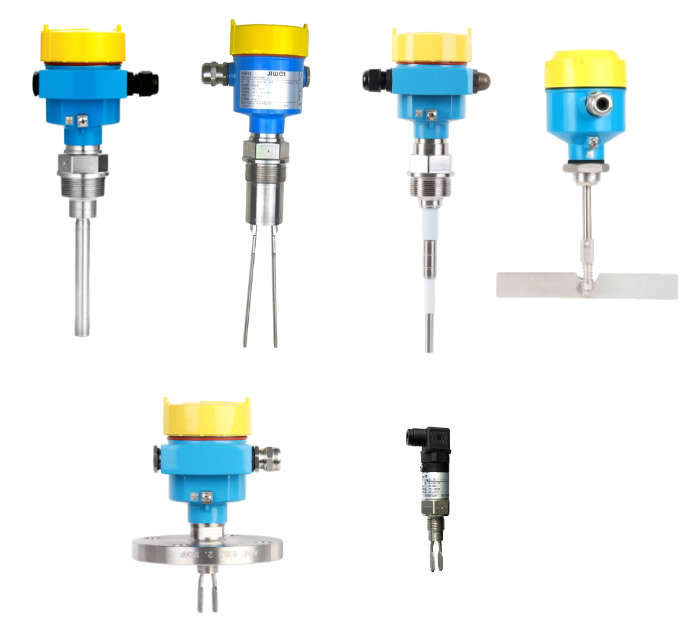
4.1. Tube-11 Vibrating Rod Level Switch: For Powders and Granular Solids
Tube-11 is mainly used for level measurement of granular or powdery solid materials. It adopts an inner and outer nested dual-tube vibrating probe design. Public product information lists the detectable medium density as low as 0.02 g/cm³. The process temperature covers normal temperature from -50 to 150°C, high temperature from -50 to 250°C, and ultra-high temperature from -50 to 400°C. Relay and two-wire outputs are also available.
Suitable applications:
High and low level alarms for powder or granular materials such as fly ash, lime, PVC granules, coal powder, food powder, chemical powder, and building material powder.
Selection focus:
Check whether the medium density is ≥0.02 g/cm³, whether the particle size is suitable, whether the probe may be impacted by large particles for a long time, and whether the site has high temperature, material buildup, or dust explosion-proof requirements.
4.2. Fork-11 Tuning Fork Level Switch: For Low-Density Powders and Fine Granules
Fork-11 is a tuning fork product used for level detection of powders and fine granular solids. Public product information lists the detectable medium density as low as 0.008 g/cm³. Applicable materials include powders and fine granular materials. The process temperature covers normal temperature from -50 to 150°C, high temperature from -50 to 250°C, and ultra-high temperature from -50 to 400°C.
Suitable applications:
Level alarms for flour, salt, fine sand, chemical raw materials, low-density powders, lightweight particles, and small granular solids.
Selection focus:
If the material density is very low, Fork-11 should be prioritized. If the particles are large or the impact is strong, the installation position, protective baffle, and probe stress should be carefully confirmed.
4.3. Ring-11 Tuning Fork Liquid Level Switch: For Liquid Point Level Detection
Ring-11 is used for liquid point level detection. It has a fork length of 40 mm, is suitable for liquids with a density of ≥0.5 g/cm³, and has a viscosity range of 0.1–10000 mPa·s. The maximum flow velocity is 6 m/s, the process pressure is -1 to 64 bar, and the process temperature covers normal temperature from -50 to 150°C, high temperature from -50 to 280°C, and ultra-high temperature from -50 to 400°C. Relay, two-wire, NAMUR, and transistor outputs are supported.
Suitable applications:
Liquid point level detection in storage tanks, process tanks, pipelines, pump protection, high and low liquid level alarms, overflow protection, and dry-run protection.
Selection focus:
Confirm liquid density, viscosity, temperature, pressure, corrosiveness, whether foam or bubbles are present, and whether explosion-proof or SIL-related configurations are required.
5. Advantages of Jiwei Vibrating Level Switches
5.1. Supported by Third-Party Testing
The test report screenshots can be used as article images to show that the products have undergone tests such as salt spray, high and low temperature, impact, vibration, and damp heat. For official publication, it is recommended to display only the report cover, key test item pages, and result pages to avoid excessive page information affecting readability.
5.2. Clear Product Boundaries
Tube-11 is intended for powder and granular solids, Fork-11 is intended for low-density powders and fine granules, and Ring-11 is intended for liquid point level detection. Clearly explaining application boundaries is more credible than broadly claiming that one product is “suitable for all working conditions.”
5.3. Traceable Parameters
Medium density, temperature and pressure, output mode, protection rating, explosion-proof rating, and material configuration are what engineers truly care about during selection. The public certificate list also includes gas and dust intrinsically safe/flameproof certification entries for Tube-11 and Fork-11, as well as 3C certificate entries related to Ring-11.
5.4. Installation and Maintenance Logic
Although vibrating level switches are relatively simple to install, they still need to avoid material inlet impact, and attention should be paid to horizontal installation angle, fork direction, material buildup risk, cable moisture protection, and explosion-proof wiring requirements. Even a good product needs correct installation to achieve stable performance.
6. Conclusion
To judge which Chinese vibrating level switch manufacturer is stronger, users should not only look at slogans. They should check whether the product has reliable test evidence, whether the parameters are transparent, whether the model classification is clear, and whether the selection boundary is well defined. For powders and granular solids, Tube-11 and Fork-11 can be evaluated. For liquid point level detection, Ring-11 can be evaluated. If the site involves low density, material buildup, high temperature, corrosion, explosion-proof requirements, or limited installation space, it is recommended to provide the medium name, density, temperature and pressure, installation method, control logic, and explosion-proof requirements before selection, so that Jiwei Automation can help confirm a more suitable product configuration.