In-Depth Comparison Between Guided Wave Radar and 80 GHz High-Frequency Radar Level Transmitters: Principles, Process Conditions, and Selection Logic
In the field of industrial level measurement, radar level transmitters have become an important measurement solution in industries such as petrochemicals, water treatment, electric power, metallurgy, food, and pharmaceuticals due to their continuous measurement capability, high stability, strong adaptability, and low maintenance requirements. As application scenarios become increasingly specialized, users often encounter a typical question during instrument selection: which should be chosen, a guided wave radar level transmitter or an 80 GHz high-frequency radar level transmitter?
From a surface perspective, both belong to radar measurement technology and both use the principle of microwave reflection to obtain level information. However, from the standpoint of practical engineering applications, they differ significantly in signal propagation mode, installation conditions, applicable media, anti-interference capability, and maintenance model. Especially under complex operating conditions such as high temperature and high pressure, heavy vapor, buildup, agitation, and ultra-long measuring ranges, the choice of device type will directly affect measurement stability and project implementation cost.
This article will provide a systematic comparison between guided wave radar and 80 GHz high-frequency radar level transmitters from the perspectives of measurement principles, application boundaries, performance under complex conditions, engineering selection recommendations, and intelligent operation and maintenance capabilities. Combined with the application characteristics of the JWrada®-35 80 GHz radar level transmitter, it aims to help users establish a clearer selection logic.
I. What Is the Essential Difference Between Guided Wave Radar and 80 GHz High-Frequency Radar?
Although both belong to radar level transmitters, the way in which their “waves propagate” is not the same. This is also the fundamental reason for the subsequent differences in process adaptability.
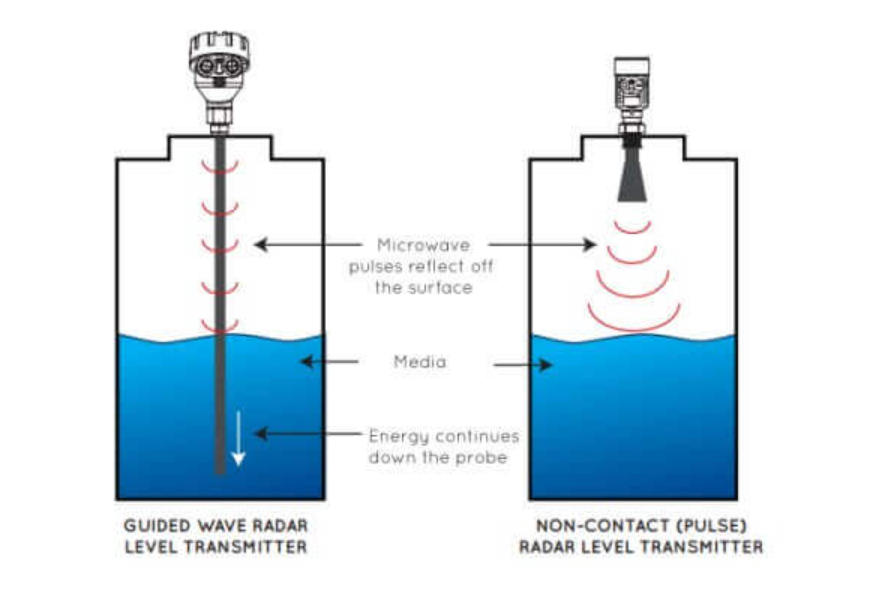
1. Guided Wave Radar Level Transmitter: Microwave Signal Transmission Through a Guided Structure
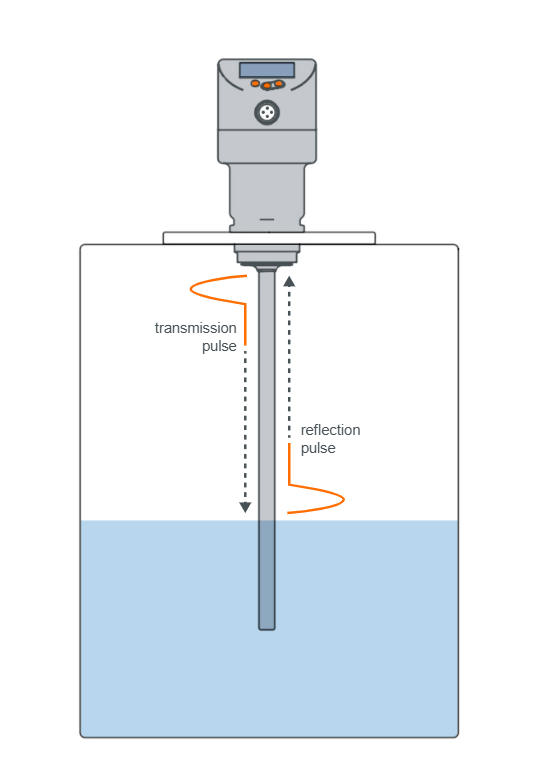
The core structure of a guided wave radar level transmitter is a wave guide rod or wave guide cable. The microwave signal emitted by the instrument propagates downward along the metal rod or cable. When the signal reaches the surface of the measured medium, part of the energy is reflected back to the instrument due to the change in dielectric constant, and the system then calculates the level height according to the propagation time.
The characteristic of this structure is that the microwave energy is confined to propagation around the guided structure and does not easily spread widely throughout the vessel. Therefore, under certain conditions involving narrow spaces or media with relatively low dielectric constants, it can obtain a relatively stable echo signal. Because the signal path is relatively fixed, guided wave radar has certain advantages in applications such as small tanks, bypass tubes, and interface measurement.
However, it should be noted that guided wave radar is essentially still a near-contact measurement method. Although the electronic unit is not directly immersed in the medium, the guide rod or cable must extend into the container and remain in the same process environment as the medium for a long time. Therefore, factors such as buildup, corrosion, crystallization, entanglement, and impact loads affect measurement performance more directly than they do in free-space radar.
2. 80 GHz High-Frequency Radar Level Transmitter: Non-Contact Measurement Through Free-Space Propagation
The 80 GHz high-frequency radar level transmitter uses a free-space emission method. The instrument emits high-frequency microwaves toward the surface of the measured medium through a lens antenna or horn antenna, then receives the reflected signal from the liquid surface for calculation. The JWrada®-35 adopts precisely this type of high-frequency FMCW radar technology.
Compared with guided wave radar, 80 GHz radar does not rely on rods, cables, or other guiding structures. Instead, through the shorter wavelength enabled by a higher frequency, it achieves a narrower beam angle and higher spatial resolution. From an engineering perspective, it can be understood as follows: the higher the frequency, the more concentrated the beam, and the easier it is to “see” the true liquid surface in a complex vessel.
The advantages of this technology are mainly reflected in two aspects:
First, it realizes true top-mounted non-contact measurement, avoiding long-term contact between the guiding structure and the medium.
Second, under conditions involving complex internal structures, long measuring ranges, and strong interference, it can reduce the impact of false echoes through a narrow beam and stronger signal processing capability.
II. What Practical Application Differences Result From the Difference in Measurement Principle?
Many users focus only on whether a device “can measure,” but the more critical questions are whether it can measure stably over the long term and whether it can continue to measure reliably in complex field conditions.
1. Different Installation Methods Determine the Difficulty of Later Maintenance
Guided wave radar requires the guide rod or cable to be inserted into the vessel, so installation must take the following into account:
- Whether the insertion length meets the measuring range requirement
- Whether there are mechanical interferences inside the vessel such as agitators, coils, or support members
- Whether the medium may cause buildup, corrosion, or vibration of the guiding structure
- Whether disassembly and maintenance are convenient
By contrast, 80 GHz high-frequency radar is usually installed from the top, and the antenna does not contact the medium. Once installation is completed, it is generally easier to maintain stable long-term operation. For media that are high-temperature, high-pressure, corrosive, or highly adhesive, this non-contact structure often has greater advantages from a maintenance perspective.
2. Different Signal Propagation Paths Determine Different Anti-Interference Mechanisms
The advantage of guided wave radar is that the signal propagates along a fixed path and is not sensitive to scattered echoes in the vessel space. However, it is more sensitive to the condition of the guide structure itself. Once there is obvious buildup, crystallization, or mechanical deformation on the guide rod surface, additional reflection points may be introduced, affecting measurement results.
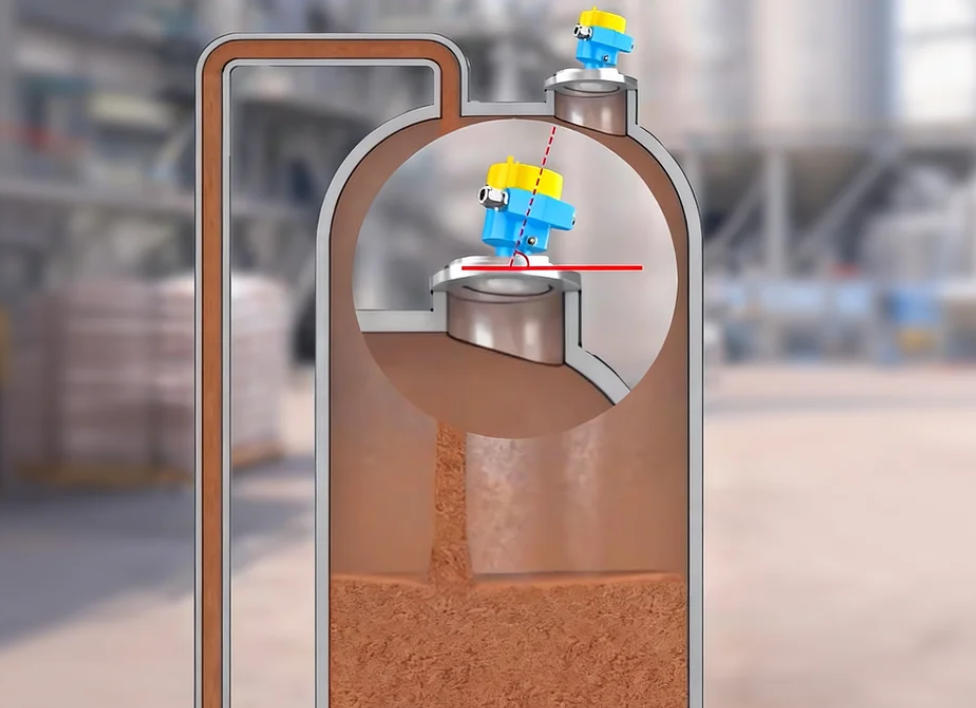
80 GHz high-frequency radar is different. It propagates in free space by means of a narrow beam, and its core capability lies in avoiding obstacles and filtering false echoes through beam control and algorithm processing. Therefore, in large storage tanks, vessels with agitators, and containers with complex internal structures, stable measurement is often easier to achieve as long as the installation position and angle are appropriate.
III. Under Complex Process Conditions, What Scenarios Are Guided Wave Radar and 80 GHz Radar Respectively Suitable For?
This section is the most critical part of actual instrument selection. Rather than vaguely comparing which technology is “more advanced,” it is better to return to engineering reality and clarify the application boundaries to which each type of product is better suited. Only by comprehensively considering medium characteristics, vessel structure, installation conditions, and maintenance requirements can the selection judgment have stronger reference value.
1. What Conditions Is Guided Wave Radar Better Suited For?
The advantages of guided wave radar level transmitters are mainly reflected in their clear measurement path and controlled signal propagation. Therefore, under certain specific conditions, they still have strong applicability.
(1) Small Containers or Narrow Installation Spaces
When the container height is not large, the diameter is small, or the top installation space is limited, guided wave radar is usually more likely to achieve stable measurement.
This is because its microwave signal propagates along the guide rod or guide cable and is less affected by free-space scattering. In slender vessels, restricted nozzles, or compact tanks, it can often maintain good repeatability and measurement continuity.
(2) Short-Range Applications With Low Dielectric Constant Media
For certain media with low dielectric constants and weak liquid-surface reflectivity, guided wave radar often has certain advantages if the measuring range is short and the operating condition is relatively stable.
Because the microwave propagates directionally along the guide structure, signal energy is more concentrated, which can improve recognition of weak echoes to a certain extent. Therefore, it is relatively common in short-range measurement of some light oils or specific chemical media.
(3) Bypass Tubes, Stilling Wells, and Interface Measurement Applications
In bypass tubes, stilling wells, sleeve pipes, and some liquid-liquid interface measurement applications, guided wave radar has strong specificity.
This is because the guided path is fixed and the measurement area is clearly defined, which can reduce clutter interference in free space. In certain dedicated measurement scenarios where process conditions are clear and structures are fixed, guided wave radar remains a mature and effective solution.
(4) The Application Boundaries of Guided Wave Radar Also Need Attention
It must be emphasized that guided wave radar does not mean “the more complex the process condition, the more suitable it is.”
If the following conditions exist on site, its long-term stability usually needs to be evaluated carefully:
Obvious medium buildup
Severe tendency to crystallize
Strong agitation impact
Possible swinging or pulling of the guide cable
Corrosion or adhesion risk to the guiding structure from the medium
Under these conditions, changes in the surface state of the guide rod or cable may introduce additional echoes or lead to signal attenuation, thereby affecting measurement accuracy and maintenance intervals.
2. What Conditions Is 80 GHz High-Frequency Radar Better Suited For?
The advantages of 80 GHz high-frequency radar level transmitters mainly come from non-contact measurement, narrow beam angle, high resolution, and stronger spatial anti-interference capability.
Therefore, in medium and large storage tanks and complex industrial scenarios, they usually show broader adaptability.
(1) Medium and Large Storage Tanks and Ultra-Long Range Applications
For large-space applications such as crude oil tanks, chemical storage tanks, reservoir shafts, and tall silos, the structural advantages of free-space radar are usually more obvious. Since there is no need for guide rods or cables to extend into the vessel, 80 GHz high-frequency radar can more easily balance installation feasibility and long-term stability in long-range applications.
Represented by the JWrada®-35, 80 GHz high-frequency radar is more suitable for continuous level monitoring in medium and large containers, especially in projects that demand high capability in measuring range, reliability, and maintenance convenience.
(2) Containers With Complex Internal Structures
When there are structures such as agitators, baffles, heating coils, and support beams inside the vessel, level measurement is often susceptible to false echo interference.
Under such circumstances, due to its narrower beam angle and more concentrated energy, 80 GHz radar is generally better able to avoid major interference objects through proper installation, thereby improving recognition of true liquid-surface echoes.
This advantage is particularly evident in large reactors, storage tanks with internal structures, and process vessels with complex geometry.
(3) Harsh Environments Such as High Temperature, High Pressure, Vapor, and Dust
Under conditions such as high-temperature vapor, dusty silos, pressurized vessels, or corrosive liquids, 80 GHz radar usually offers better maintenance convenience.
This is because it adopts a non-contact measurement method and does not require rods or cables to remain exposed inside the medium for long periods, thereby reducing the impact of adhesion, wear, corrosion, and mechanical stress.
For projects seeking to reduce field maintenance frequency and minimize shutdown intervention, this structural advantage often has high engineering value.
(4) High-Viscosity, Buildup-Prone, and Crystallization-Prone Media
In the measurement of high-viscosity media, buildup-prone media, and crystallization-prone media, non-contact 80 GHz radar usually has greater advantages. Because its measuring element itself does not extend into the medium, it can effectively reduce the direct impact of buildup, crystallization, and adhesion on measurement results.
Of course, this does not mean that all such conditions can achieve stable operation simply by direct installation. A comprehensive judgment is still required based on installation position, antenna selection, process temperature, and on-site echo conditions. However, from the perspective of structural principle, the maintenance burden of 80 GHz high-frequency radar is usually lower in such scenarios.
IV. How Should the Advantages of “Guided Wave Radar vs. 80 GHz Radar” Be Understood More Scientifically?
Many articles like to use expressions such as “dimensionality reduction strike” or “complete replacement,” but from an engineering perspective, such wording is not rigorous. A more accurate statement is that both technologies have their own boundaries, while 80 GHz high-frequency radar demonstrates stronger universality and non-contact advantages under a broader range of complex process conditions.
Below is a more rigorous comparison from several key dimensions.
1. Measuring Range Capability
The measuring range of guided wave radar is usually limited by the mechanical structure of the guide rod or cable. Under larger measuring ranges, the guide cable may be affected by self-weight, swinging, or process impact, so in engineering applications it is often more suitable for short- to medium-range scenarios.
80 GHz high-frequency radar does not depend on a guiding structure and is easier to extend in measuring range, especially for medium and large storage tanks, shafts, and tall silos.
2. Resistance to Buildup
The sensitive point of guided wave radar lies in the surface state of the guiding structure. Once buildup, crystallization, or adhesion becomes severe, the reflection path may change, and measurement accuracy and stability may be affected.
Since 80 GHz radar does not contact the medium, its maintenance pressure is usually lower in high-viscosity and adhesion-prone media.
3. Resistance to Internal Structure Interference
Guided wave radar measures along a fixed path and has an advantage in narrow spaces, while 80 GHz high-frequency radar relies on an extremely narrow beam and algorithms to suppress clutter, giving it more flexibility in large and complex tanks.
4. Installation and Maintenance Convenience
Guided wave radar requires attention to insertion depth, stress conditions, and possible swinging of the guide cable during installation, and later cleaning or replacement can also be more cumbersome.
80 GHz radar is mostly top-mounted, and later maintenance is usually more convenient, especially for retrofit projects and situations where frequent shutdown maintenance is undesirable.
5. Dependence on Dielectric Constant
Guided wave radar usually has certain advantages in low dielectric constant scenarios, while 80 GHz radar performs more generally and stably in media with medium to high dielectric constants. However, as high-frequency radar signal processing capability continues to improve, its application range is also expanding.
V. In Selection, One Should Not Look Only at the Instrument Itself, But Also at “Process + Installation + Operation & Maintenance”
In industrial level measurement projects, selection errors are often not caused by insufficient instrument parameters, but by excessive reliance on technical indicators in product catalogs while ignoring the actual differences in field conditions and installation environments. In fact, whether a level transmitter can operate stably over the long term usually depends not only on the model itself, but also on whether process conditions, vessel structure, and later operation and maintenance methods are matched. For radar level transmitters, guided wave radar level transmitters, and 80 GHz high-frequency radar products, only by placing “process + installation + operation & maintenance” within the same evaluation framework can the selection result have stronger engineering value and better meet the long-term needs of industrial sites.
The first aspect that needs evaluation is process conditions. Different media and different process states have a very direct impact on the suitability of level measurement technology. For example, whether the dielectric constant of the medium is stable affects radar echo recognition; phenomena such as buildup, crystallization, foam, and vapor may alter the signal propagation path, thereby affecting measurement continuity and accuracy. At the same time, if there is agitation, surface fluctuation, high temperature and pressure, or if the medium itself is corrosive or abrasive, then greater caution is required in antenna type, installation method, material selection, and parameter setting. In other words, level transmitter selection should not only answer “can it measure,” but also “can it measure stably over the long term under these process conditions?”
Secondly, a judgment must be made in combination with vessel structure. Even for the same medium, the appropriate measurement solution may be completely different under different vessel structures. The measuring range determines the measurement boundary and signal requirement of the instrument; whether the top nozzle position is reasonable affects whether the radar beam can effectively avoid interference and accurately target the liquid surface; if there are internal structures such as coils, baffles, agitators, or support beams inside the tank, they may also introduce additional clutter and increase measurement difficulty. In addition, it should be confirmed whether there are special structures such as narrow stilling wells and bypass tubes on site, and whether the process allows insertion-type measuring elements to enter the vessel.
Finally, operation and maintenance requirements must also be incorporated into the early-stage selection logic. As industrial automation and digitalization continue to improve, enterprise requirements for level measurement equipment have expanded from “being able to output a level value” to “whether it is easy to commission, whether it is easy to maintain, and whether it supports remote collaboration.” For example, whether users wish to reduce field maintenance frequency as much as possible, whether remote commissioning and diagnostic functions are required, whether rapid parameter duplication among multiple devices is desired, whether overseas projects require remote technical support, and whether there are later plans for platform integration, network expansion, or digital upgrading—all of these directly affect the full-lifecycle efficiency of the equipment.
From this perspective, the value of an 80 GHz high-frequency radar level transmitter such as the JWrada®-35 is no longer limited to a single hardware measurement performance. In addition to possessing the technical advantages of non-contact measurement, narrow beam angle, high resolution, and strong anti-interference capability, this type of product is also more suitable for inclusion in the digital measurement system of a modern plant. For projects that need to balance measurement stability, installation adaptability, and later operation and maintenance efficiency, an 80 GHz high-frequency radar is not only a level instrument, but also an important node connecting field sensing, remote commissioning, and system integration. This ability to extend from single-point measurement to systematic management is also an increasingly important value direction in current industrial level transmitter selection.
VIII. Conclusion
From an engineering perspective, guided wave radar and 80 GHz high-frequency radar level transmitters represent two different technical paths: the former establishes a stable propagation path through a guiding structure, while the latter improves free-space measurement capability through a high-frequency narrow beam and advanced algorithms. They are not simply in a low-versus-high substitution relationship, but rather are measurement solutions applicable to different process boundaries.
For scenarios with short measuring range, low dielectric constant, and limited space, guided wave radar still has clear value. However, for medium and large storage tanks, complex internal structures, harsh environments, and projects seeking to reduce maintenance frequency and improve digital operation and maintenance efficiency, the JWrada®-35 and similar 80 GHz high-frequency radar level transmitters usually offer stronger comprehensive advantages.
In the future, the competition in level measurement will no longer be only about “who can measure it,” but about “who can measure it more stably, who can commission it more conveniently, and who can manage it more efficiently.” This is also the core direction of the continuous evolution of industrial level measurement technology.