How to Solve Liquid Level Measurement Challenges in Small-Diameter Pipelines? Ring-21 Tuning Fork Level Switch Provides a Stable Solution
In industrial automation applications, pipeline level measurement may appear simple at first glance. However, when it comes to small-diameter pipelines, limited installation space, and frequently disturbed flow conditions, traditional level switches often struggle to balance installation feasibility, stability, and reliability. This is especially common in industries such as water treatment systems, circulating cooling systems, and equipment auxiliary pipelines, where such challenges are particularly prominent.
This article presents a real-world application case of the Ring-21 tuning fork level switch, demonstrating its performance in small-diameter pipeline water level detection and how it helps customers achieve long-term stable operation.
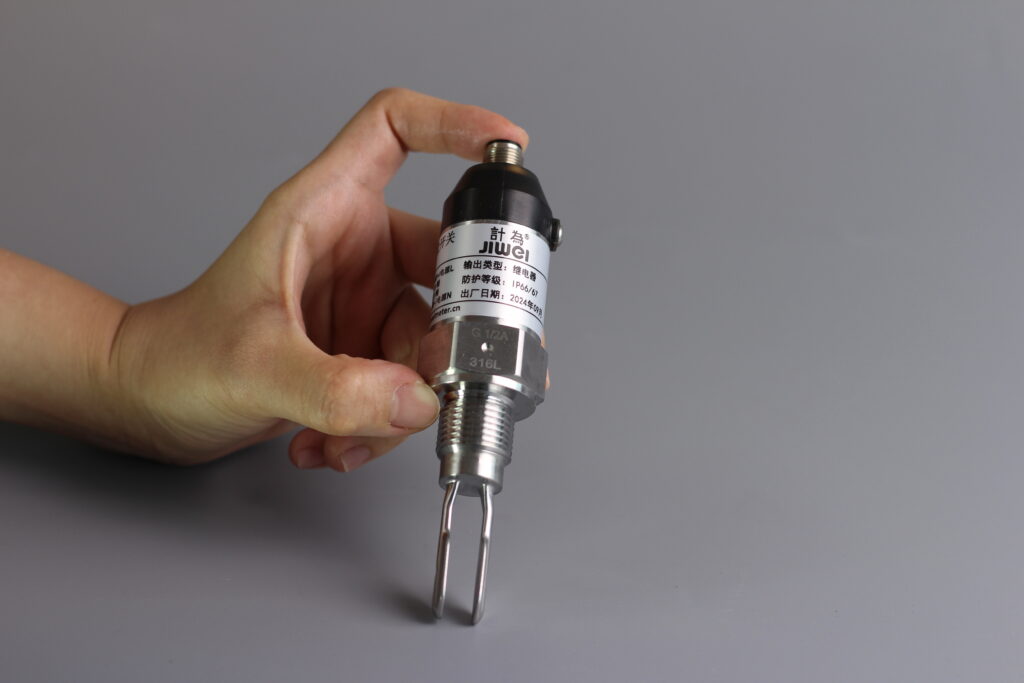
1. Project Background: Challenges in Small-Diameter Pipeline Level Detection
A certain environmental protection equipment manufacturer implemented a circulating water treatment system requiring level detection in a section of DN50 stainless steel pipeline. The purpose was to determine whether the pipeline was fully filled with water and to enable interlocking control of downstream pump operation.
The core challenges of this project were mainly caused by the combination of installation constraints and complex operating conditions.
First, the pipeline diameter is only DN50, leaving extremely limited internal space. This places high demands on the probe size of the level switch. If the structure is too large, installation becomes difficult or even leads to mechanical interference with the pipe wall.
Second, the pipeline carries continuously flowing water, which inevitably includes turbulence and air bubbles during operation. Such dynamic conditions significantly affect measurement stability and may cause false triggering.
In addition, the installation location is compact with limited reserved space, requiring not only a compact device body but also reliable fixation and sealing within a confined environment.
The customer also emphasized that the device must operate reliably over long periods without frequent false alarms or failures, as this would directly affect the interlocking control logic of the entire system.
Furthermore, the humid environment increases requirements for sealing performance and long-term protection capability.
In previous attempts, the customer tested other types of level switches, but the overall performance was unsatisfactory. Some products had overly long probes or bulky structures, making installation difficult or causing wall interference during operation. Others lacked sufficient sensitivity and failed to accurately distinguish real liquid conditions under flowing water and bubble interference, resulting in frequent misjudgments. More critically, weak anti-interference performance led to unstable output signals during pump startup or electrical fluctuations, increasing system uncertainty. These accumulated issues made it necessary to find a more reliable solution in terms of structure, stability, and interference resistance.
2. Solution: Ring-21 Tuning Fork Level Switch
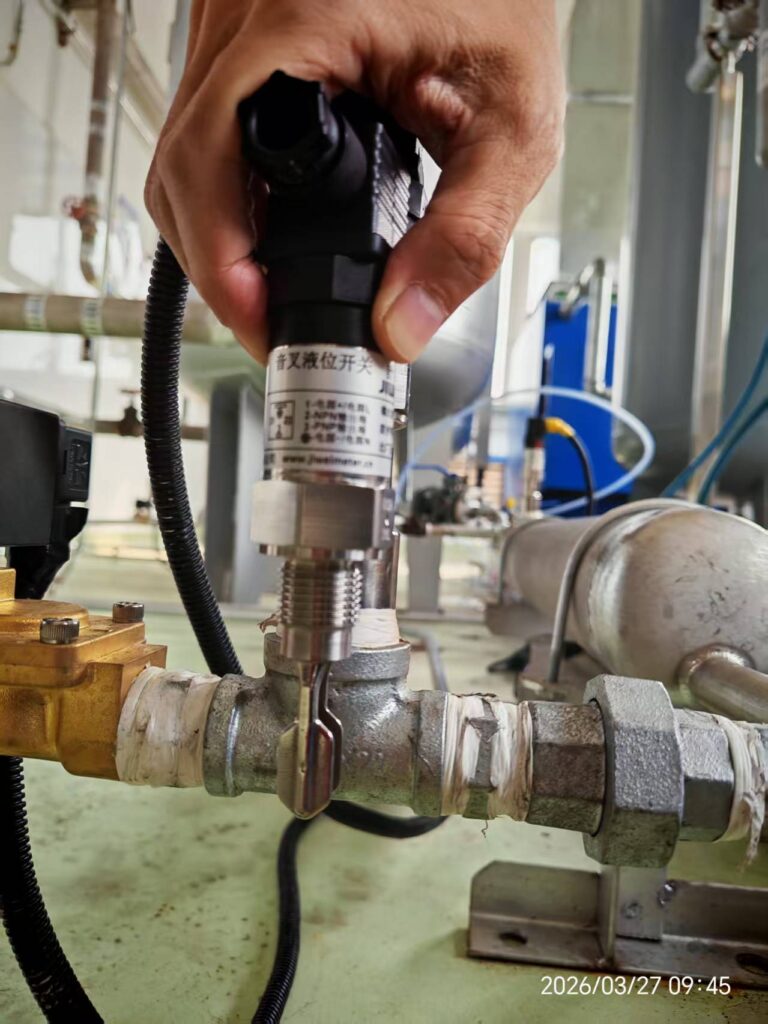
For this application, Shenzhen Jiwei Automations Ltd recommended the Ring-21 tuning fork level switch. The product is particularly suitable for liquid level detection in small-diameter pipelines due to its structural design and sensing principle, and it is completely unaffected by pump operation interference.
3. Key Advantages: Why Choose Ring-21?
1️⃣ Ultra-Short Fork Design for Compact Spaces
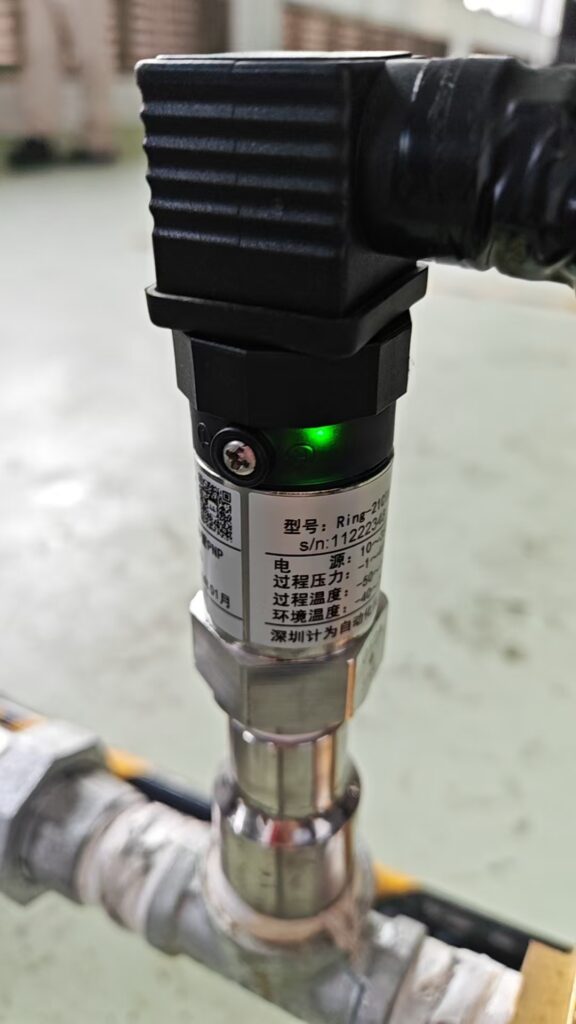
Ring-21 features a compact design with a fork length of only 38mm, significantly shorter than conventional tuning fork level switches. This effectively solves installation challenges in small-diameter pipelines.
In pipelines of DN50 or even smaller, the probe can be smoothly inserted without mechanical interference with the pipe wall, avoiding installation risks and long-term operational issues caused by dimensional mismatch.
This design is particularly suitable for skid-mounted systems and modular equipment where installation space is limited. In small pipeline applications, probe size often determines whether installation is feasible, and Ring-21 provides a clear advantage in this regard.
2️⃣ Mature Tuning Fork Technology for Dynamic Flow Conditions
Ring-21 is based on proven tuning fork vibration technology, which detects liquid presence by monitoring frequency changes of the fork.
When the fork comes into contact with liquid, its vibration characteristics change. The internal electronic unit detects this change and outputs a stable signal.
In practical applications, even under continuous flow conditions with turbulence and air bubbles, the device maintains stable detection without false triggering. It is insensitive to bubbles and minor flow disturbances, effectively avoiding transient misjudgments and ensuring accurate “liquid present / absent” detection for industrial process control stability.
Stable Liquid Detection in Flowing Conditions Based on Vibrating Fork Principle
3️⃣ Industrial-Grade Anti-Interference Design
For environments with frequent pump startup and complex electromagnetic conditions, Ring-21 is designed with strong EMC anti-interference capability.
Even under motor startup, voltage fluctuation, or electrical noise, the output signal remains stable without false alarms or signal drift.
This is particularly important for interlocking control systems, as it effectively prevents incorrect triggering that could lead to process disruption or equipment shutdown, thereby improving overall operational safety and reliability.
4️⃣ Standard Installation Interface for Easy Maintenance
Ring-21 supports standard threaded or flanged connections, allowing flexible adaptation to different installation requirements.
The device requires no complex commissioning and can be put into operation immediately after wiring. This significantly reduces installation time and commissioning workload.
Due to its simple structure and absence of moving wear parts, it enables long-term maintenance-free operation, reducing operational costs and minimizing human intervention. It is especially suitable for continuous industrial processes requiring high reliability.
4. Field Performance Results
A total of 12 units of Ring-21 level switches were installed in this project, distributed across key pipeline sections for interlocking control.
Operating performance:
- Continuous operation for over 2 years, with repeat customer orders
- Zero failure records
- No false alarms or sticking issues
- No additional maintenance required
Customer feedback:
“Previously, we always worried about false triggering with other brands. With this batch, we basically installed them and no longer needed to worry.”
5. Why Small-Diameter Pipelines Prefer Ring-21?
For applications such as pipeline level detection and small-bore liquid monitoring, selection is mainly based on three key factors:
- Installation adaptability
- Signal stability
- Anti-interference performance
Ring-21 aligns well with all three:
| Requirement | Ring-21 Performance |
|---|---|
| Compact installation | ✔ 38mm ultra-short fork |
| Flow disturbance resistance | ✔ Stable detection |
| Anti-interference | ✔ Industrial-grade reliability, unaffected by pumps |
6. Conclusion
In small-diameter pipeline level measurement, incorrect selection often leads to long-term operational issues rather than short-term problems. Reliability is more important than simply “whether it works”.
The Ring-21 tuning fork level switch delivers:
- Easy installation in confined spaces
- Stable detection under flowing conditions
- Long-term maintenance-free operation
For applications such as DN50 and smaller pipeline level measurement, water treatment systems, and equipment internal level detection, Ring-21 provides a reliable and practical solution combining adaptability and stability.