Jiwei 80GHz Radar Level Meter: Penetrating Plastic IBC Totes for Continuous Level Monitoring
White Paper on Non-Contact Level Measurement for Plastic IBC Totes and Intermediate Bulk Containers
Plastic IBC totes, also known as intermediate bulk containers, plastic bulk containers, chemical tote tanks, or portable liquid storage containers, are widely used in chemical processing, water treatment, environmental protection, food additives, cleaning chemicals, lubricants, new energy materials, and fine chemical production. These containers are valued for their mobility, cost efficiency, compact footprint, and convenient liquid storage and transfer capabilities.
However, as industrial sites move toward automation, digital inventory control, and safer production management, traditional manual level inspection methods are no longer sufficient. Operators often rely on visual scale readings, manual opening, dipsticks, or weight estimation to determine the liquid level inside a plastic IBC tote. These methods are discontinuous, labor-intensive, and difficult to integrate into PLC, DCS, SCADA, or industrial IoT systems.
For corrosive liquids, volatile chemicals, odorous media, high-value materials, and contamination-sensitive liquids, opening the container can also create safety, environmental, and quality risks. As a result, more industrial users are looking for a non-contact level measurement solution that can continuously monitor liquid level without modifying the container or contacting the medium.
Jiwei 80GHz radar level meter provides an advanced solution for plastic IBC tote level measurement. With high-frequency millimeter-wave radar technology, a narrow beam angle, strong signal focusing capability, and flexible installation options, the instrument can measure liquid level through non-metallic plastic surfaces under suitable conditions. This allows users to obtain reliable level information without direct contact with the liquid.
Why IBC Tote Level Measurement Requires a Smarter Solution
At first glance, measuring the liquid level in an IBC tote may seem simple. In practice, continuous and accurate measurement can be challenging.
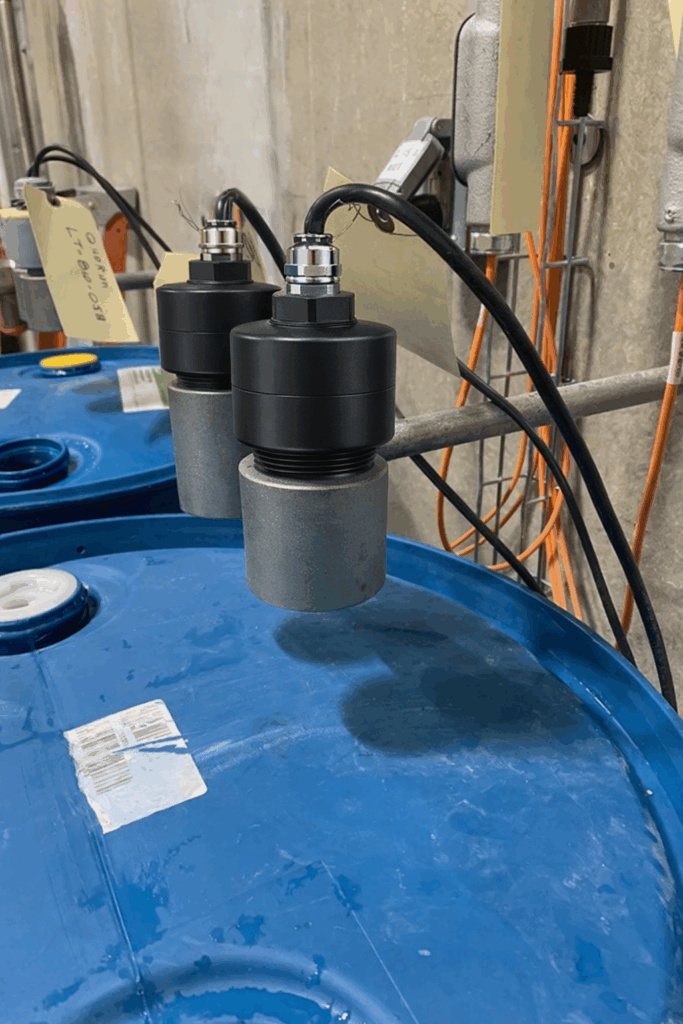
Plastic IBC totes are often movable and are frequently used in batch production, temporary storage, chemical dosing, raw material transfer, and waste liquid collection. Installing a traditional contact-type instrument may require opening the container, modifying the lid, or inserting a probe into the liquid. These changes can affect sealing performance, increase installation cost, and introduce maintenance issues.
Many liquids stored in plastic IBC totes are corrosive, sticky, crystallizing, volatile, or easy to contaminate. Contact-type level instruments such as float switches, capacitance probes, pressure transmitters, and guided sensors may suffer from corrosion, buildup, scaling, or medium adhesion. These problems can reduce measurement reliability and increase maintenance workload.
Manual inspection also cannot provide real-time data. Without continuous level monitoring, production sites may face unexpected empty-tote conditions, dosing pump dry running, overflow risks, delayed replenishment, inaccurate inventory records, and inefficient material management.
A non-contact radar level meter helps solve these problems. Jiwei 80GHz radar level meter does not require the sensing element to be immersed in the liquid. It sends radar signals toward the liquid surface, receives the reflected echo, and calculates the level based on the distance between the sensor and the liquid surface. In suitable plastic IBC tote applications, the radar signal can pass through the non-metallic plastic wall or lid, allowing external or minimally invasive measurement.
This makes the technology especially valuable for chemical dosing systems, water treatment chemical storage, raw material supply, hazardous chemical handling, cleaning liquid distribution, environmental waste collection, and smart factory liquid inventory management.
How Can 80GHz Radar Penetrate a Plastic IBC Tote?
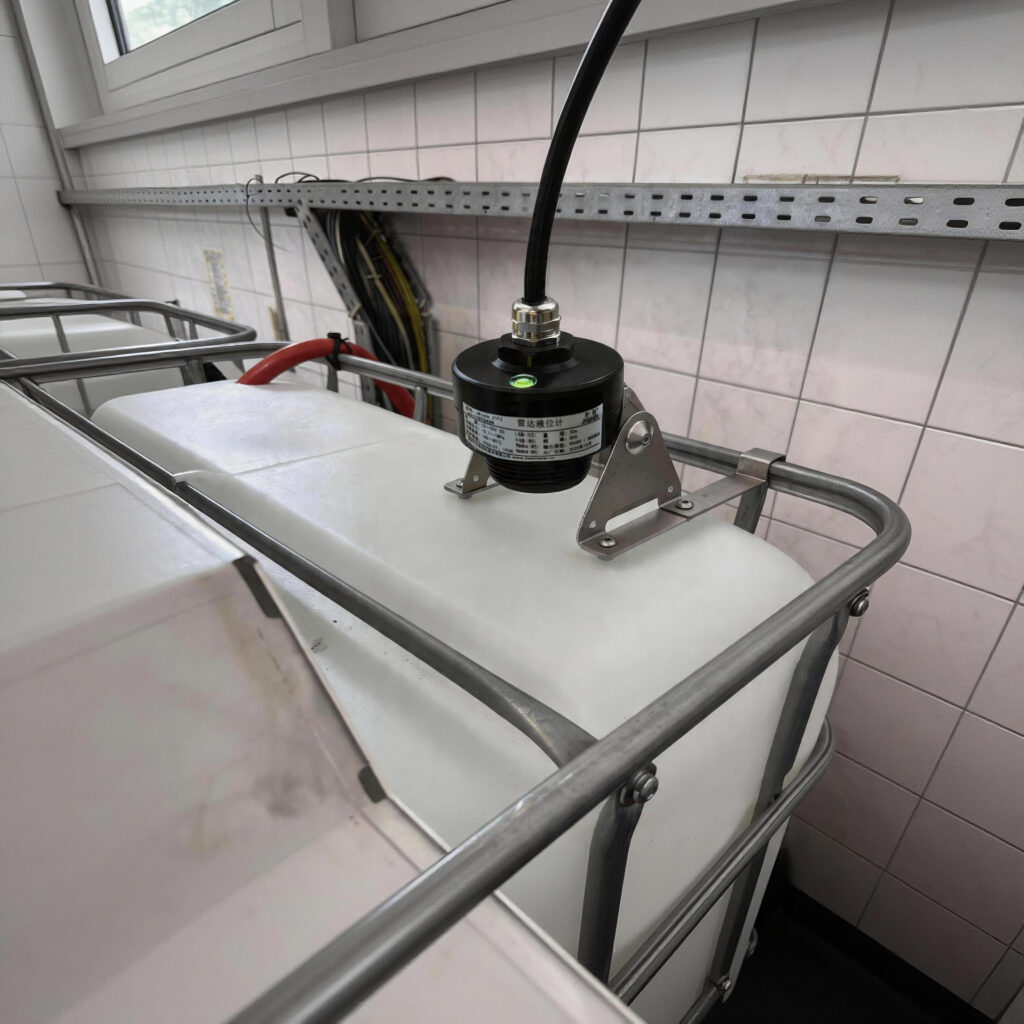
An 80GHz radar level meter uses electromagnetic waves to perform non-contact distance measurement. The instrument emits high-frequency millimeter-wave radar signals toward the liquid surface. When the signal reaches an interface with different dielectric properties, part of the energy is reflected back to the sensor. The instrument analyzes the echo signal and calculates the distance to the liquid surface. By combining this distance with the container height, the system determines the actual liquid level.
Plastic IBC totes are commonly made of non-metallic materials such as polyethylene or polypropylene. These materials are generally non-conductive and have relatively low signal attenuation compared with metal. Unlike metal surfaces, which strongly reflect and block radar waves, suitable plastic materials allow a portion of the radar energy to pass through the wall or lid and enter the container.
When the radar wave reaches the liquid surface inside the IBC tote, the dielectric difference between air, plastic, and liquid creates a measurable reflection. Water-based solutions, acids, alkalis, salt solutions, chemical additives, and liquids with relatively high dielectric constants usually provide stronger reflections. The radar level meter can identify the liquid surface echo and filter out weaker interference echoes from the plastic wall, container lid, or surrounding structures.
Therefore, the phrase “penetrating plastic IBC totes” does not mean that radar waves pass through every type of plastic without loss. It means that under suitable conditions, 80GHz radar technology can transmit through non-metallic, non-conductive, moderately thick, and structurally uniform plastic surfaces, then detect the actual liquid surface inside the container.
For best performance, the installation should avoid metal frames, metal lids, metal nameplates, metal foil labels, thick reinforcement ribs, handles, irregular surfaces, heavy condensation, and areas with strong structural interference. When properly installed and configured, Jiwei 80GHz radar level meter can provide stable and continuous level information for plastic IBC tote applications.
Advantages of 80GHz Radar Level Meter for Plastic IBC Tote Applications
Compared with low-frequency radar, ultrasonic level sensors, float level switches, capacitance probes, and pressure transmitters, an 80GHz radar level meter offers several advantages in plastic IBC tote level measurement.
First, the 80GHz radar beam is narrower and more focused. Plastic IBC totes usually have limited internal space, while frames, walls, ribs, caps, and edges may generate interference echoes. A narrow beam helps direct more energy toward the liquid surface and reduces unwanted reflections from surrounding structures.
Second, 80GHz radar provides higher resolution and better performance in short-range measurement. IBC totes are relatively small compared with large storage tanks, so the level range is limited and small changes must be detected accurately. High-frequency radar is well suited for compact vessels and short measuring distances.
Third, non-contact measurement reduces maintenance. Since the radar level meter does not touch the liquid, it is less affected by corrosion, viscosity, crystallization, contamination, or buildup. This is especially important for chemical liquids, wastewater chemicals, cleaning agents, corrosive fluids, and contamination-sensitive materials.
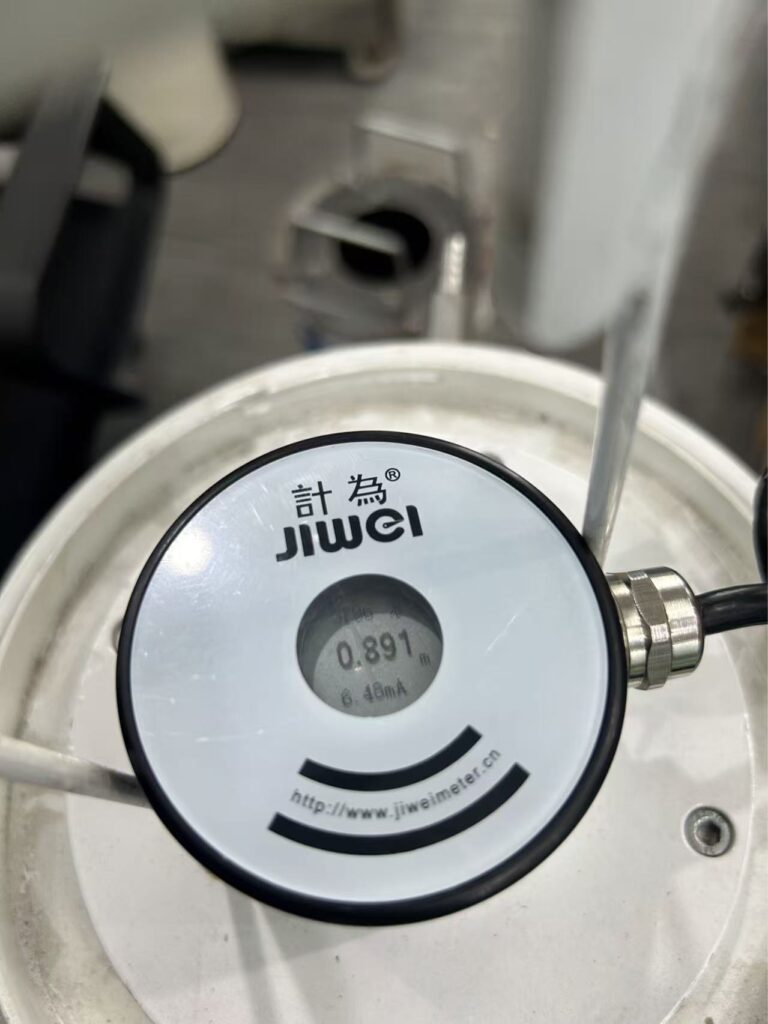
Fourth, radar measurement supports industrial automation. Jiwei 80GHz radar level meter can be integrated with control systems through common industrial output and communication options such as 4-20mA, RS485, Modbus, HART, or switching signals, depending on the model and configuration. This enables low-level alarms, high-level overflow protection, automatic replenishment, remote monitoring, and digital inventory control.
Fifth, the installation is flexible. In many applications, the instrument can be mounted above or outside a plastic container without direct contact with the medium. This helps reduce container modification, downtime, and maintenance costs.
Typical Applications of Jiwei Radar Level Meter in Plastic IBC Totes
In water treatment plants, plastic IBC totes are often used to store PAC, PAM, sodium hypochlorite, acid, alkali, antiscalant, disinfectant, and other dosing chemicals. Jiwei 80GHz radar level meter can continuously monitor the chemical level and help the control system determine when replenishment is required. This reduces the risk of dosing pump dry running and chemical interruption.
In fine chemical production, IBC totes may contain solvents, additives, resins, emulsions, intermediates, and specialty chemicals. Non-contact radar level measurement reduces the need to open containers and helps improve operational safety.
In new energy and electronic chemical applications, liquid materials may be expensive, sensitive, or contamination-critical. A radar level sensor that does not contact the liquid can help reduce contamination sources and simplify maintenance.
In environmental protection and waste liquid collection, plastic containers are often used for acid waste, alkaline waste, cleaning wastewater, or process wastewater. Continuous radar level monitoring enables high-level alarms and remote supervision, reducing the risk of overflow.
In smart warehouse and liquid inventory management, radar level transmitters can provide real-time data from multiple IBC totes. The information can be connected to digital platforms for inventory tracking, consumption analysis, replenishment planning, and production scheduling.
Installation and Selection Recommendations
To obtain reliable measurement through a plastic IBC tote, proper installation and product selection are essential.
The radar level meter should be aligned as vertically as possible with the liquid surface. A tilted installation may cause the reflected signal to deviate from the sensor, resulting in unstable readings.
The radar signal path should avoid metal frames, metal guards, metal lids, metal labels, steel cages, container edges, and thick structural ribs. Metal materials can strongly reflect or block radar waves and may interfere with the real liquid surface echo.
The installation position should be selected on a relatively flat and uniform plastic surface. Areas with reinforcement ribs, irregular thickness, thick plastic layers, or strong curvature should be avoided when possible.
For low dielectric liquids, heavy foam, turbulent surfaces, thick plastic walls, condensation, buildup, or crystallization, field testing and parameter optimization are recommended. Radar echo filtering, false echo suppression, and proper mounting accessories can help improve measurement stability.
The selected radar level meter should match the container height, medium characteristics, output signal, power supply, protection rating, communication protocol, installation environment, and automation system requirements. Jiwei can provide application-specific selection support to help users achieve reliable plastic IBC tote level monitoring with minimal container modification.
From Single-Point Measurement to Smart Liquid Level Management
The value of IBC tote level monitoring goes beyond simply knowing how much liquid remains in a container. When Jiwei 80GHz radar level meter is connected to PLC systems, wireless data collectors, edge gateways, SCADA platforms, or cloud-based monitoring systems, users can build a more complete liquid level management solution.
The system can analyze consumption trends, generate replenishment alerts, prevent pump dry running, reduce overflow risks, and monitor multiple plastic IBC totes from a centralized interface. It can also connect liquid level data with procurement, production planning, warehouse management, and safety systems.
For companies building smart factories, digital chemical dosing systems, or automated inventory control platforms, a radar level meter is not only a measuring instrument. It is also a reliable data entry point for industrial digitalization.
Conclusion: 80GHz Radar Is an Efficient Solution for Plastic IBC Tote Level Measurement
As industrial sites demand higher safety, better environmental control, improved efficiency, and stronger digital management, manual level inspection is becoming increasingly insufficient. Jiwei 80GHz radar level meter uses high-frequency millimeter-wave technology to measure liquid levels through suitable non-metallic plastic surfaces, enabling non-contact, continuous, and intelligent level monitoring.
For plastic IBC totes, intermediate bulk containers, chemical tote tanks, portable plastic containers, and plastic storage vessels, 80GHz radar level measurement offers flexible installation, low maintenance, strong anti-interference capability, and easy integration with automation systems.
Whether used in chemical raw material monitoring, water treatment chemical dosing, environmental waste collection, new energy material handling, or fine chemical production, Jiwei radar level meter provides a safer, more efficient, and more reliable level measurement solution.
In the future of industrial automation, plastic IBC tote level measurement will continue to move from manual inspection to online monitoring, and from single-point reading to intelligent data management. Jiwei 80GHz radar level meter helps build the data foundation for continuous level monitoring, level alarms, inventory optimization, and smart factory operation.