Field Commissioning and Application of Jiwei Radar Sensor in Equipment Inspection Ports and Closed Containers
1. Project Background: Practical Requirements for Level Measurement in Industrial Closed Vessels
Radar Sensor technology is widely applied in modern industrial production systems, particularly in industries such as food processing, pharmaceutical manufacturing, fine chemical production, and environmental treatment. These applications require high sealing integrity, operational safety, and hygienic conditions to ensure stable and contamination-free production processes.
However, as equipment operation continues over time, maintenance personnel often need to verify internal material conditions, including liquid level, solid level changes, and equipment operating status. Traditional methods typically rely on manual inspection by opening covers or low-accuracy contact-based sensors. These approaches present significant limitations, such as high safety risks, poor data continuity, and increased maintenance costs.
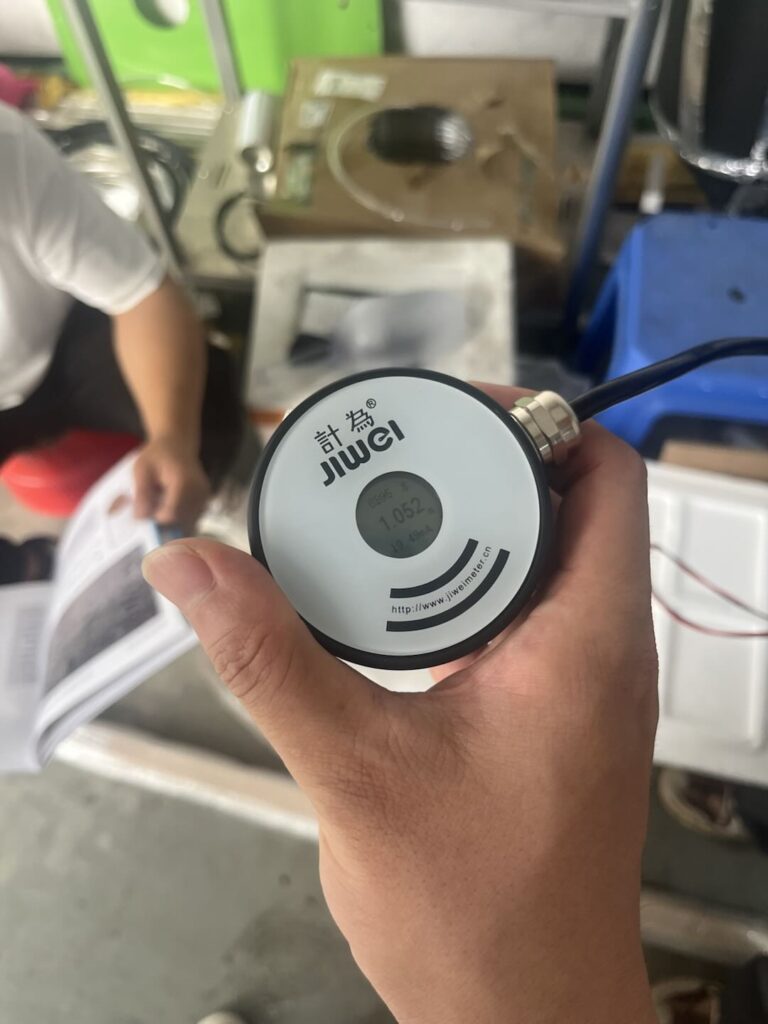
In this case, the customer’s equipment is a sealed industrial processing vessel equipped with an inspection port on the top, used for maintenance and commissioning. Field engineers used the Jiwei (Jiwei Automation) radar sensor system for non-contact measurement and verification of internal material conditions, enabling digital monitoring and remote commissioning of the system.
2. Application Scenario: Level Measurement Requirements in Inspection Port Environments
As shown in the field image, the top of the equipment is a circular inspection opening with an internal metal grid protection structure designed to prevent foreign objects from entering while ensuring operational safety. During maintenance conditions, engineers perform sensor installation, signal verification, and system commissioning through this opening.
This application scenario has the following typical characteristics:
Firstly, the equipment is a typical sealed industrial container, where internal conditions cannot be directly observed, requiring external instrumentation for monitoring.
Secondly, installation space is limited, making large structural modifications impossible. This places higher requirements on instrument size, installation flexibility, and signal stability.
Thirdly, the presence of internal metal structures such as grids, supports, and vessel walls may introduce interference to traditional low-frequency measurement devices.
Under such complex conditions, high-frequency radar level measurement technology becomes the preferred solution. The Jiwei JWrada® 80GHz radar sensor demonstrates excellent adaptability due to its high resolution, narrow beam angle, and strong anti-interference capability.
3. Technical Solution: Advantages of 80GHz Non-Contact Radar Sensor Measurement
The Jiwei radar sensor adopts 80GHz FMCW (Frequency Modulated Continuous Wave) technology, which provides extremely high signal focusing capability and superior echo resolution.
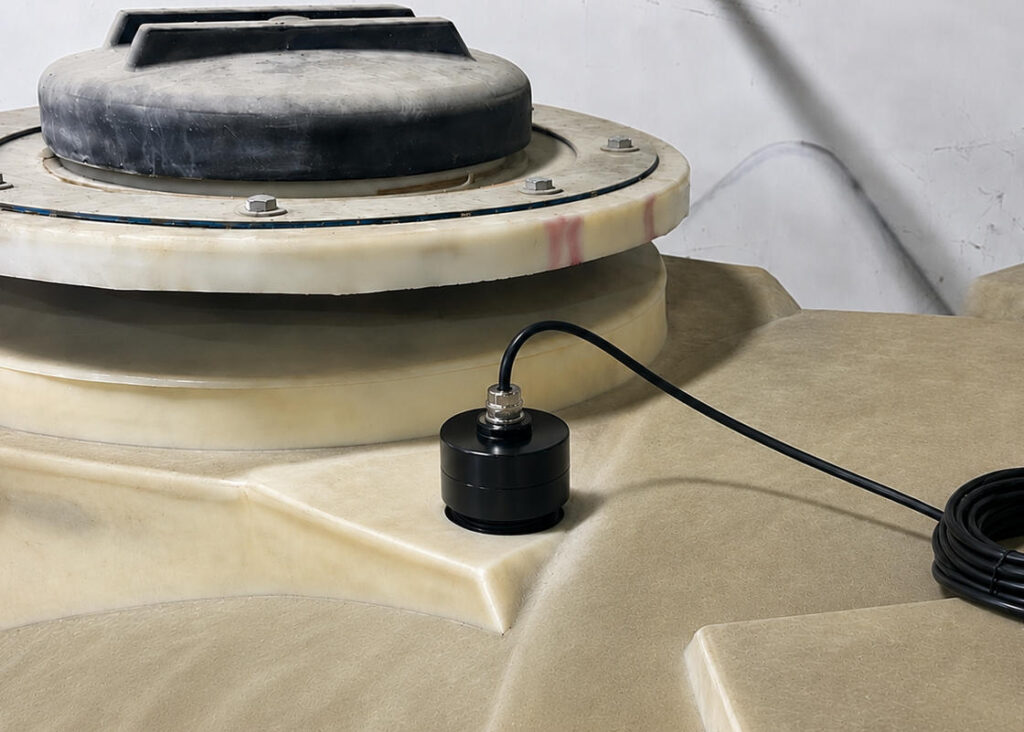
In this case, the device is aligned and installed through the inspection port to achieve accurate measurement of the internal material surface.
Compared with traditional 26GHz or low-frequency radar systems, 80GHz radar has a much narrower beam angle, typically around 3°, which allows the emitted energy to be highly concentrated on the target area. This significantly reduces interference echoes from tank walls, internal structures, and metal supports—making it particularly suitable for complex industrial vessels.
In addition, the device offers strong media adaptability. Whether measuring liquids, slurries, or granular solids, the echo processing algorithm ensures stable and reliable detection. In this application, the radar signal passes through the inspection port into the vessel and clearly identifies the true material interface, providing reliable data output for process control systems.
4. Field Commissioning Process: Application of Bluetooth and Smart Debugging System
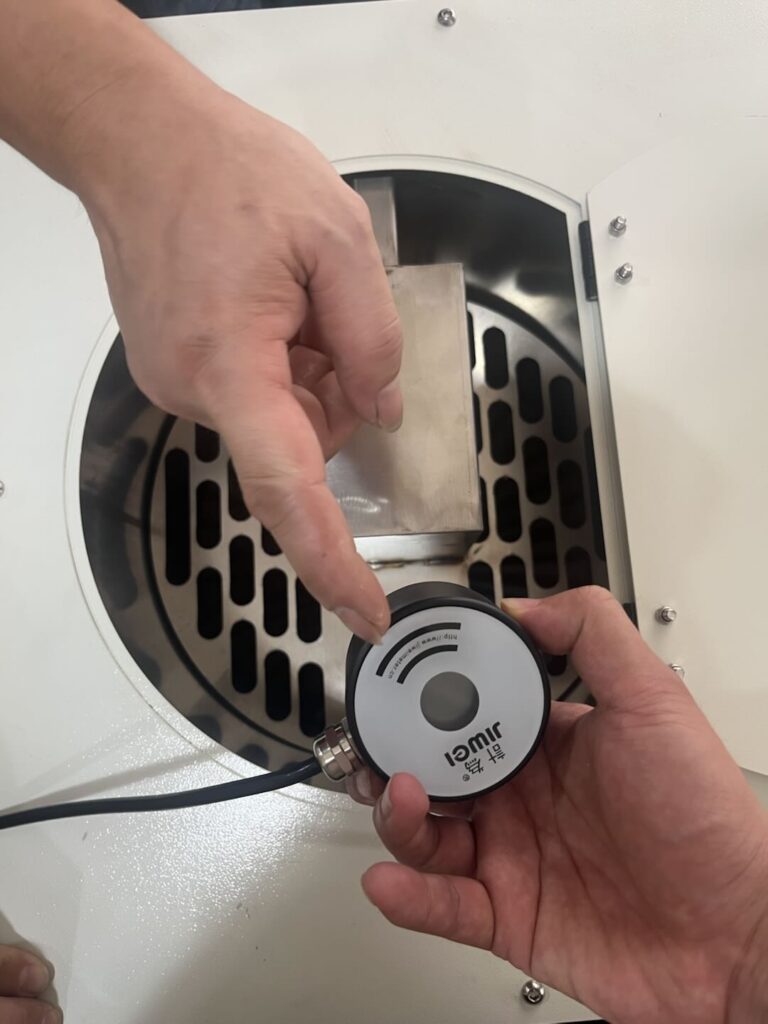
During actual commissioning, engineers use Jiwei radar sensor systems with smart configuration tools via handheld terminals or mobile devices for parameter setup and signal analysis.
As shown in the field image, engineers operate the radar device at close range to confirm signal direction and adjust installation alignment.
The Jiwei radar sensor supports Bluetooth wireless commissioning, enabling the following operations without removing the device:
Parameter configuration and range setting
Real-time echo curve monitoring and analysis
Signal strength and interference evaluation
Installation angle optimization and calibration
Historical data and status monitoring
This wireless commissioning method significantly reduces installation complexity and improves commissioning efficiency. In sealed or hazardous environments, it also reduces personnel exposure to dangerous areas, enhancing overall operational safety.
5. Measurement Stability in Complex Structural Environments
In industrial applications, factors affecting radar measurement stability typically include structural reflections, multipath interference, and media fluctuations. Although the equipment in this case contains internal metal grid structures, the use of high-frequency narrow-beam radar technology allows the signal to effectively avoid non-target reflections and lock onto the true material interface.
In addition, the 80GHz radar offers a higher signal-to-noise ratio, enabling stable output even in weak echo environments. This is particularly important for materials with low dielectric constants or unstable surface conditions.
During long-term operation, the device uses intelligent echo learning algorithms to automatically identify and filter fixed interference signals, such as reflections from internal structures or vessel walls, thereby improving measurement stability and repeatability.
6. Industrial Application Value: Transition from Manual Inspection to Intelligent Monitoring
This case is not only a simple field commissioning application, but also reflects the transformation of industrial measurement methods from traditional manual inspection to intelligent and digital monitoring systems.
In the past, material level monitoring in sealed containers relied heavily on manual inspection or periodic maintenance, which was inefficient and posed safety risks.
By adopting Jiwei radar sensors, continuous non-contact real-time monitoring becomes possible. Data can be continuously recorded and transmitted to PLC, DCS, or industrial IoT systems, forming a complete digital monitoring architecture.
In practical applications, this solution provides the following engineering value:
Firstly, it improves operational safety by reducing personnel entry into confined spaces.
Secondly, it enhances production efficiency through continuous process control.
Thirdly, it reduces maintenance costs by minimizing manual inspection requirements.
Finally, it supports the development of smart factory digitalization through reliable data infrastructure.
7. Applicable Industries and Extended Applications
This solution is not limited to the current case but can be widely applied in multiple industrial sectors, including:
In the food and beverage industry, for fermentation tanks, storage tanks, and mixing vessels level monitoring.
In the pharmaceutical industry, for sterile reactors and hygienic storage tank process control.
In the fine chemical industry, for highly corrosive or viscous media non-contact measurement.
In environmental and water treatment systems, for sealed process units and dosing system level monitoring.
These industries share common characteristics of high sealing requirements, complex processes, and strict safety standards, which create strong demand for high-reliability level measurement instruments.
8. Conclusion: Technical Advantages of Jiwei Radar Sensor in Complex Inspection Environments
Based on this case study, the Jiwei JWrada® 80GHz radar sensor demonstrates significant advantages in inspection port and sealed container applications.
Through high-frequency narrow beam technology, intelligent echo processing algorithms, and wireless commissioning capabilities, the device achieves stable and reliable level measurement even in complex structural environments.
In addition, the solution requires no modification of the original equipment structure, enabling rapid deployment and commissioning, which is highly suitable for modern industrial requirements for efficiency and safety.
As industrial automation and smart manufacturing continue to evolve, non-contact radar sensor technology will play an increasingly important role in complex applications and is expected to become a mainstream solution in industrial level measurement. Radar Sensor
Radar Sensor