How to Detect Sand Levels in Grit Chambers: Cable-Type Vibrating Rod Level Switch
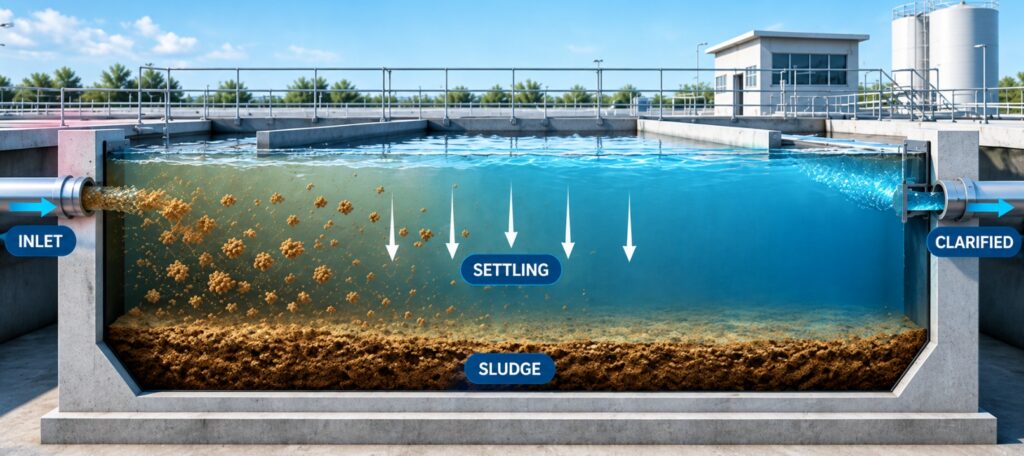
In wastewater treatment plants, mine drainage systems, and sand washing facilities, sand and other granular particles gradually settle at the bottom of grit chambers. As the sediment layer grows, it reduces the effective chamber capacity and can interfere with sand removal efficiency.
In these applications, water level alone does not indicate how much sand has accumulated at the bottom. Effective grit chamber sand level detection requires a reliable way to identify when the submerged sediment layer reaches a predetermined height.
For deep chambers where the detection point is close to the bottom and installation must be carried out from above, a cable-type vibrating rod level switch, such as the Jiwei Tube-11, may provide a practical solution. The sensing probe is suspended at a defined elevation to detect whether the accumulating sand has reached the required level.
1. Challenges of Sand Level Detection in Grit Chambers
A grit chamber contains water, suspended particles, and settled sand. These conditions can make sediment detection more complicated than conventional liquid level measurement.
Water Level Does Not Indicate Sand Accumulation
During normal operation, the water level may remain relatively stable while sand continues to accumulate at the bottom. Monitoring only the water level cannot determine the thickness of the sediment layer or indicate when sand removal is required.
A dedicated sand level detection point can provide more direct information for sediment management and discharge control.
The Sand Surface Is Often Uneven
Water flow, inlet direction, particle size, and the location of the sand removal equipment can cause uneven sediment accumulation. The sand surface may develop slopes or localized deposits rather than forming a uniform horizontal layer.
Under these conditions, the measurement result from a single location may not represent the sediment profile across the entire chamber. The appropriate detection method therefore depends on whether the process requires a complete sediment profile or simply confirmation that the sand has reached a specific height.
Suspended Solids and Water Movement Can Interfere with Detection
Suspended particles, bubbles, and water flow can complicate the detection of submerged solid-liquid interfaces.
If the control requirement is simply to determine whether the sand layer has reached a predefined discharge point, continuous level measurement may provide more information than the process actually needs.
A point-level detection solution can instead focus on the specific condition that triggers sand removal.
2. Point-Level Detection for Sand Removal Control
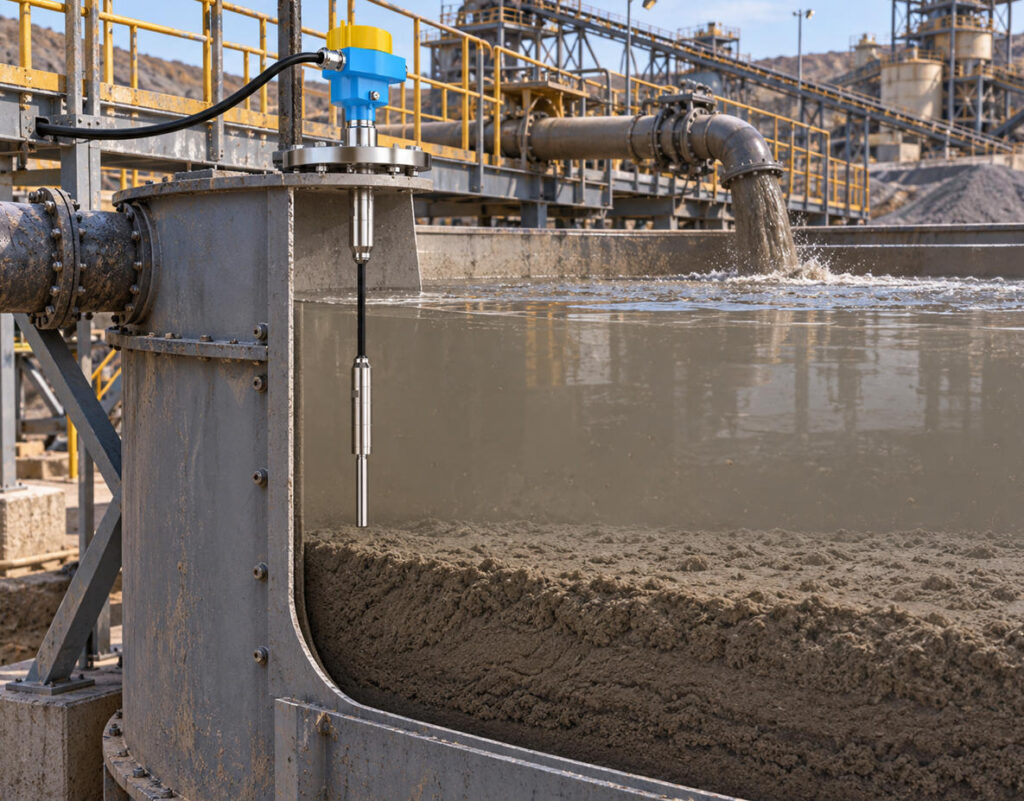
A common requirement in grit chamber operation is to start sand removal when the sediment layer reaches a predetermined height.
For example, if the process requires sand detection at a point 1 meter above the chamber bottom, the sensing probe can be positioned at that elevation, subject to the actual installation and operating conditions.
When the sand layer remains below the probe, the switch maintains its corresponding output state. As sand accumulates and covers the sensing element, the instrument detects a change in its operating condition and switches its output.
The resulting signal can be connected to a programmable logic controller (PLC) or control cabinet to initiate a predefined response, such as activating a sand removal pump or opening a discharge valve.
Compared with continuous measurement, point-level detection does not require a complete profile of the sediment layer. It is particularly relevant when the primary objective is to determine whether the sand has reached a specific control position.
The key principle is simple: detect when the sand reaches the preset level and use the switching signal to support sand removal control.
3. How a Vibrating Rod Level Switch Detects Settled Sand
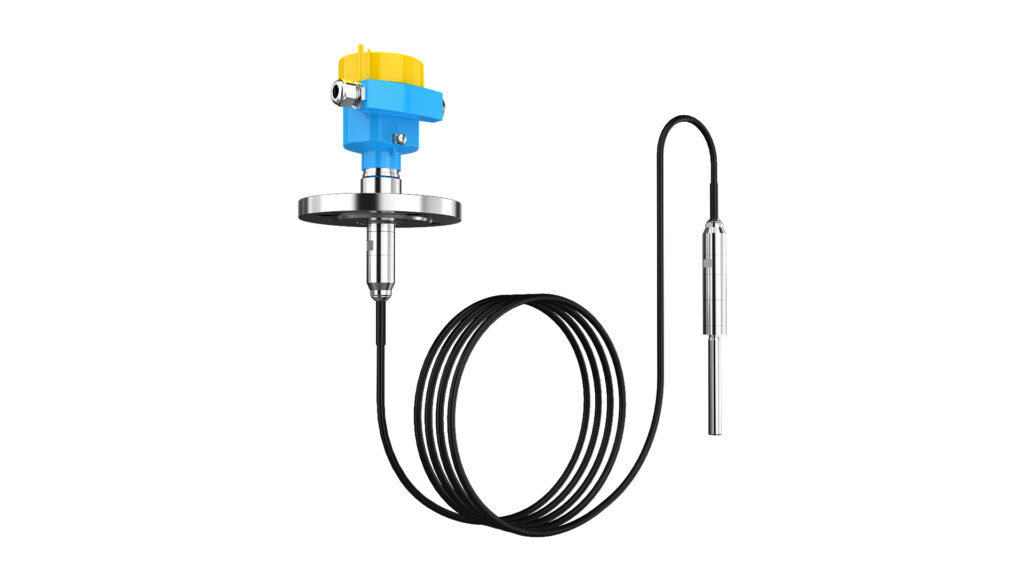
A vibrating rod level switch operates by monitoring changes in the vibration behavior of its sensing element.
During operation, the sensing rod vibrates at its designed operating condition. When the surrounding medium changes, the mechanical behavior of the probe changes accordingly. The electronic unit detects this change and generates a switching signal.
In a suitable grit chamber application, the probe is installed at the target sand detection elevation. Before the sediment reaches the probe, the sensing element remains exposed to the surrounding water. As the sand layer rises and covers the probe, the change in vibration behavior can be used to indicate that the sediment has reached the preset detection point.
The instrument therefore provides a point-level switching signal rather than a continuous numerical measurement of sediment height.
Important selection note: A vibrating rod level switch must be verified for the actual submerged operating conditions. Sand particle size, sediment density, accumulation characteristics, probe geometry, and the instrument’s sensitivity can all affect suitability. Detection performance should not be assumed to be identical in water and settled sand.
4. Why Choose a Cable-Type Vibrating Rod Level Switch?
Suitable for Deep Chambers
In deep grit chambers, the installation point may be at the top of the structure while the required detection point is near the bottom.
A long rigid probe can introduce transportation, handling, installation, and mechanical support challenges. A cable-type design allows the sensing probe to be suspended from the upper installation point, reducing the need for an equally long rigid extension.
The required cable length and probe position should be determined according to the chamber dimensions and the intended detection elevation.
Top-Mounted Installation
Some existing grit chambers have limited access to their sidewalls. Drilling new mounting holes or modifying the chamber structure may also be difficult during a retrofit project.
A cable-type configuration allows the instrument to be installed from the top, where the probe can be lowered to the required detection point. This arrangement can offer a practical alternative when side-mounted installation is inconvenient.
Flexible Detection Point Positioning
The detection point can be selected according to the required sand removal threshold.
For example, a plant may need to detect when sediment has accumulated to a defined height above the chamber bottom. Positioning the probe at the corresponding elevation allows the switching signal to represent that specific process condition.
The installation position should account for the expected sediment profile, water movement, probe clearance, and the required control margin.
5. Key Features of a Vibrating Rod Level Switch for Grit Chambers
Detection at a Defined Height in Deep Chambers
A cable-type vibrating rod level switch can extend the sensing position away from the top mounting point. This is useful when the chamber is deep and the required detection point is far below the installation platform.
The cable arrangement can simplify positioning compared with a long rigid probe, subject to the mechanical and environmental requirements of the installation.
Direct Point-Level Switching
Point-level detection focuses on whether the sediment has reached the probe rather than calculating the complete shape of the sand layer.
This approach is well suited to control strategies that require a switching signal when sand accumulation reaches a specified elevation. However, an uneven sediment surface means that the detected condition applies to the probe location, not necessarily to the entire chamber.
Integration with PLCs and Sand Removal Equipment
The level switch output can be integrated into a PLC or control cabinet when the selected electrical interface is compatible with the control system.
The switching signal can be used to initiate a predefined sequence involving sand removal pumps, discharge valves, alarms, or other equipment.
The final control logic should account for the required switching behavior, equipment interlocks, and any delay or hysteresis needed to prevent unnecessary repeated operation.
Top Installation for Retrofit Projects
For existing grit chambers where sidewall access is restricted, top-mounted installation may reduce structural modifications.
The probe can be positioned at the required detection elevation, provided that the mounting arrangement, cable length, immersion conditions, and mechanical loads are within the instrument’s specified limits.
Jiwei Tube-11 vibrating rod level switch installed in a grit chamber for sediment level detection.
6. Suitable Applications and Selection Considerations
A cable-type vibrating rod level switch may be considered for grit chamber sand detection when the following conditions apply:
- The sediment mainly consists of granular solids, such as sand or mineral particles.
- Settling produces a recognizable sediment layer.
- The process requires detection at a fixed sediment height rather than continuous height measurement.
- The chamber is deep, with the detection point located well below the top installation position.
- Top-mounted installation is preferred or sidewall access is restricted.
- The switching signal is intended to support sand removal control or process status monitoring.
However, not all settled materials behave in the same way.
Highly adhesive sludge, gel-like deposits, loose biological flocs, and materials that form heavy coatings on the sensing element may affect detection performance. Their suitability must be assessed according to material properties, sediment density, adhesion, probe design, and instrument sensitivity.
The presence of sediment alone does not establish that a particular level switch is suitable. Actual operating conditions must be reviewed before selecting the instrument.
The following information is useful when evaluating an application:
- Chamber depth and required detection elevation
- Sand particle size and sediment composition
- Sediment density and degree of compaction
- Water flow and turbulence near the probe
- Expected sediment accumulation pattern
- Mounting arrangement and available installation space
- Required electrical output and control system interface
Where the process requires continuous sediment height data, a point-level switch may not meet the measurement objective. In that case, a suitable continuous measurement technology should be evaluated instead.
7. Benefits of Point-Level Sand Detection in Grit Chambers
Grit chamber management does not always require continuous, high-resolution measurements of sediment height. In many applications, the essential process requirement is to determine when the accumulated sand reaches a predefined point so that sand removal can begin.
A cable-type vibrating rod level switch can support this approach by suspending the sensing probe at the target elevation from the top of the chamber. When the accumulating sediment reaches the probe and the instrument detects the corresponding change in vibration behavior, the switch generates an output signal for monitoring or control.
For suitable applications, this method can simplify the detection task by focusing on a clearly defined operating threshold. It can also provide a practical installation option for deep chambers and existing structures where side access is limited.
The Jiwei Tube-11 vibrating rod level switch can be evaluated for grit chamber sediment detection, bottom sand accumulation monitoring, and submerged point-level detection applications.
Before finalizing the configuration, confirm the chamber depth, sand characteristics, sediment compaction, water flow, mounting position, target detection height, and required output interface.
Looking for a sand level detection solution for a grit chamber? Contact Jiwei Automations to discuss your application conditions and identify a suitable instrument configuration.