Comprehensive Analysis of Swivel Mounting Flanges in Radar Level Transmitter Installation
In the realm of industrial process automation, the accuracy of level measurement is fundamentally tied to the quality of the reflected signal. For high-precision instruments like the Jiwei JWrada-35 Radar Level Meter (80GHz FMCW radar), the installation geometry is not merely a mechanical detail—it is a critical factor in performance. The Swivel Mounting Flange (also known as a universal or aiming flange) serves as the essential interface for optimizing these measurements in challenging environments.
1. Understanding the Swivel Mounting Flange
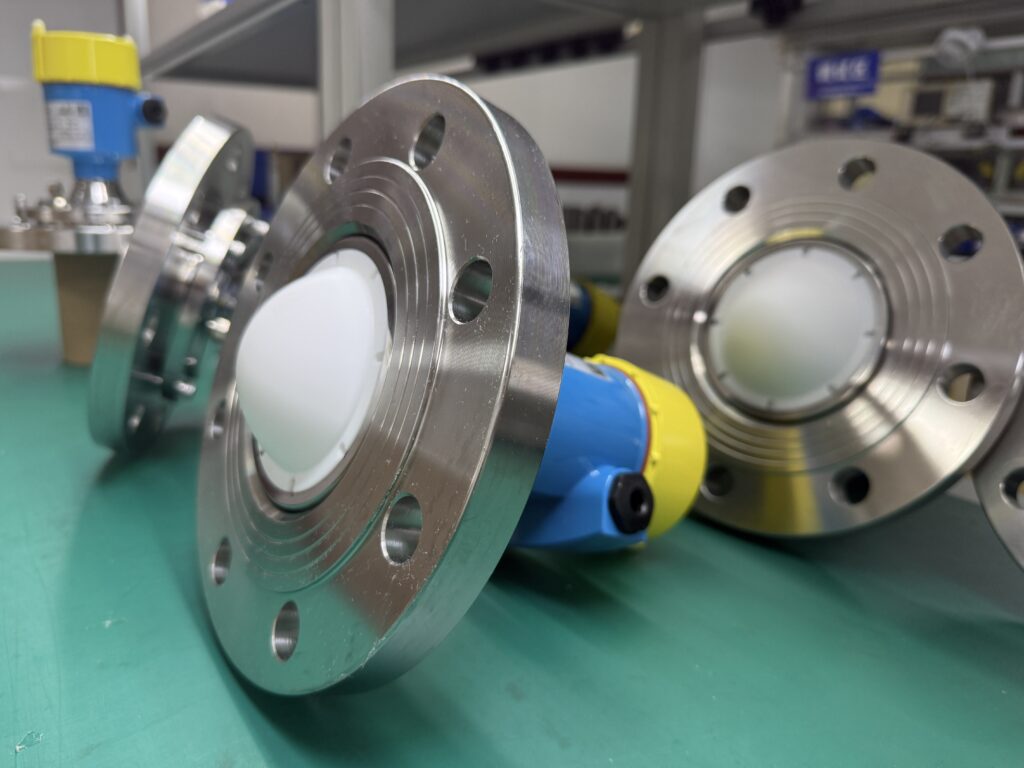
A swivel mounting flange is a specialized mechanical attachment designed to allow for multi-directional orientation of the radar sensor. Unlike a standard fixed flange, it consists of a ball-and-socket or dual-plate pivoting mechanism.
- Adjustment Range: Typically allows for a 360° horizontal rotation and a vertical tilt of 15° or more.
- Locking Mechanism: Once the optimal angle is achieved, heavy-duty bolts secure the flange in place to withstand industrial vibrations.
- Integrated Features: High-quality swivel flanges, such as those used with the JWrada-35, often include an integrated purging (air blow) port to prevent dust accumulation on the antenna.
2. Core Benefits of Using Swivel Flanges
A. Compounding the Angle of Repose
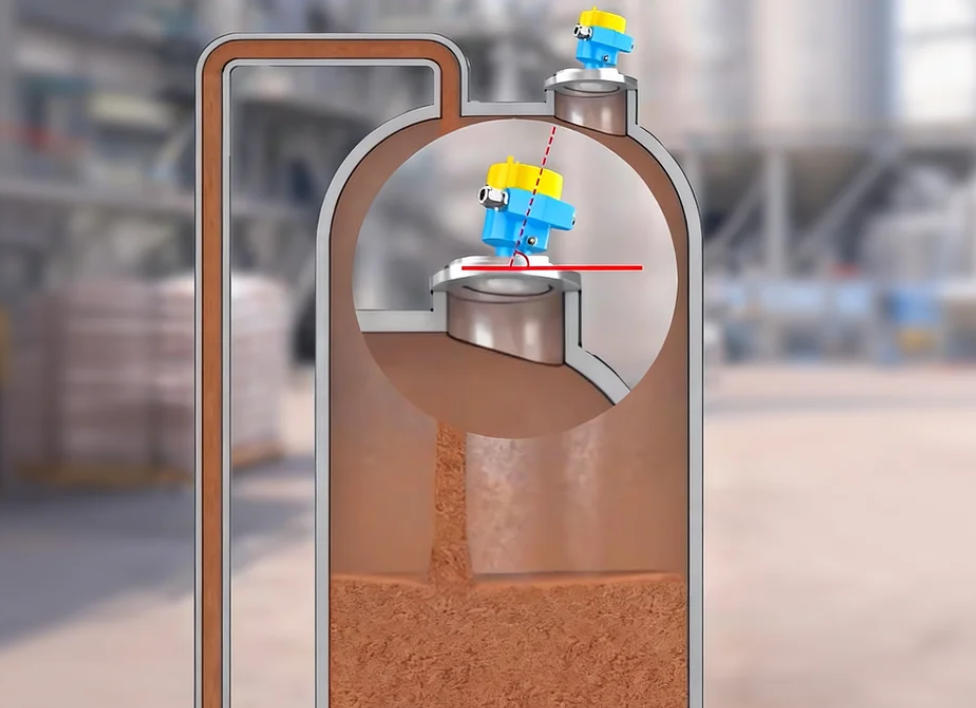
Solid materials (such as mineral ores, cement, or grain) do not sit flat; they form a conical shape with a specific angle of repose. If a radar is mounted strictly vertical, the narrow beam hits the slope and reflects away from the receiver, leading to a weak or lost signal.
- The Advantage: The swivel flange allows the user to tilt the radar beam so it is perpendicular to the material’s slope, maximizing the return signal strength (Signal-to-Noise Ratio).
B. Avoiding Internal Obstructions
Industrial silos are rarely empty voids; they contain ladders, agitators, support beams, and inflow streams.
- The Advantage: By slightly angling the radar, the beam can be “steered” away from these fixed obstacles, eliminating false echoes and simplifying the commissioning process without relying solely on software-based false echo suppression.
C. Correcting Structural Misalignments
In large-scale construction, mounting nozzles welded onto the top of a silo are frequently off-axis or not perfectly level.
- The Advantage: A swivel flange compensates for these mechanical tolerances, ensuring the instrument is positioned in its ideal working attitude regardless of the vessel’s structural imperfections.
3. Synergistic Application: JWrada-35 & 80GHz Technology
The Jiwei JWrada-35 utilizes 80GHz FMCW technology, which offers a very narrow beam angle (typically 3° depending on the antenna size).
While a narrow beam is excellent for avoiding tank walls, it is highly sensitive to alignment. A deviation of just a few degrees can cause the beam to miss the target area entirely in tall silos.
- Precision Alignment: The swivel flange provides the “fine-tuning” capability required to harness the full power of the 80GHz beam.
- Dust Management: In the heavy dust environments where the JWrada-35 excels (like cement or flour silos), the swivel flange’s built-in purging system works in tandem with the angle adjustment to keep the lens clean and the signal clear.
4. Ideal Operating Conditions (Selection Criteria)
The use of a swivel mounting flange is highly recommended in the following scenarios:
| Condition | Challenge | Swivel Flange Solution |
| Solid Bulk Solids | Sloping surfaces and uneven piles. | Tilts the beam to be perpendicular to the material surface. |
| Tall & Narrow Silos | Beam may hit the sidewall or stay too close to the nozzle. | Centers the beam path to avoid wall interference. |
| Complex Internals | Agitators or reinforcement bars create “noise.” | Redirects the beam path to a “clear window.” |
| High Dust/Steam | Antenna fouling leads to signal attenuation. | Provides the necessary interface for air-purging systems. |
5. Installation and Commissioning Tips
- Pre-Calculation: Before installation, estimate the material’s angle of repose to determine the initial tilt direction.
- Dynamic Tuning: While the radar is powered on, observe the Echo Curve on the display or software. Slowly adjust the flange angle until the amplitude of the primary reflection peak is maximized.
- Symmetrical Fastening: Once the “sweet spot” is found, tighten the locking bolts in a star pattern to ensure the seal remains airtight and the angle stays fixed.
- Air Purge Setup: For dust-heavy applications, ensure the compressed air supply is clean, dry, and set to a pressure at least higher than the internal vessel pressure.
Conclusion
For the Jiwei JWrada-35 Radar Level Meter, a swivel mounting flange is more than an accessory—it is a performance multiplier. By allowing for precise physical aiming, it ensures that the high-frequency 80GHz signal is utilized to its maximum potential, providing stable, reliable level data even in the most chaotic industrial environments.
Would you like me to generate a technical specification sheet or a “step-by-step” commissioning guide for the JWrada-35 with this flange?