Ultrasonic vs 80GHz Radar: Selection Logic for Long-Term Level Measurement Applications
With the continuous advancement of industrial automation, more and more projects are evaluating whether to upgrade from ultrasonic level transmitters to radar level transmitters during the selection stage. In particular, the rapid development of 80GHz millimeter-wave radar technology has significantly expanded its application in complex industrial environments.
However, instrument selection is not simply a matter of technological upgrade. The key principle is application matching.
1. Technical Differences Between Ultrasonic and Radar
Ultrasonic level transmitters measure level based on the travel time of sound waves in air. Their performance is influenced by the surrounding gas environment. When temperature, steam concentration, or gas density changes, the speed of sound also changes accordingly. Although most ultrasonic devices are equipped with temperature compensation, their compensation capability remains limited in cases of spatial stratification or complex vapor conditions.
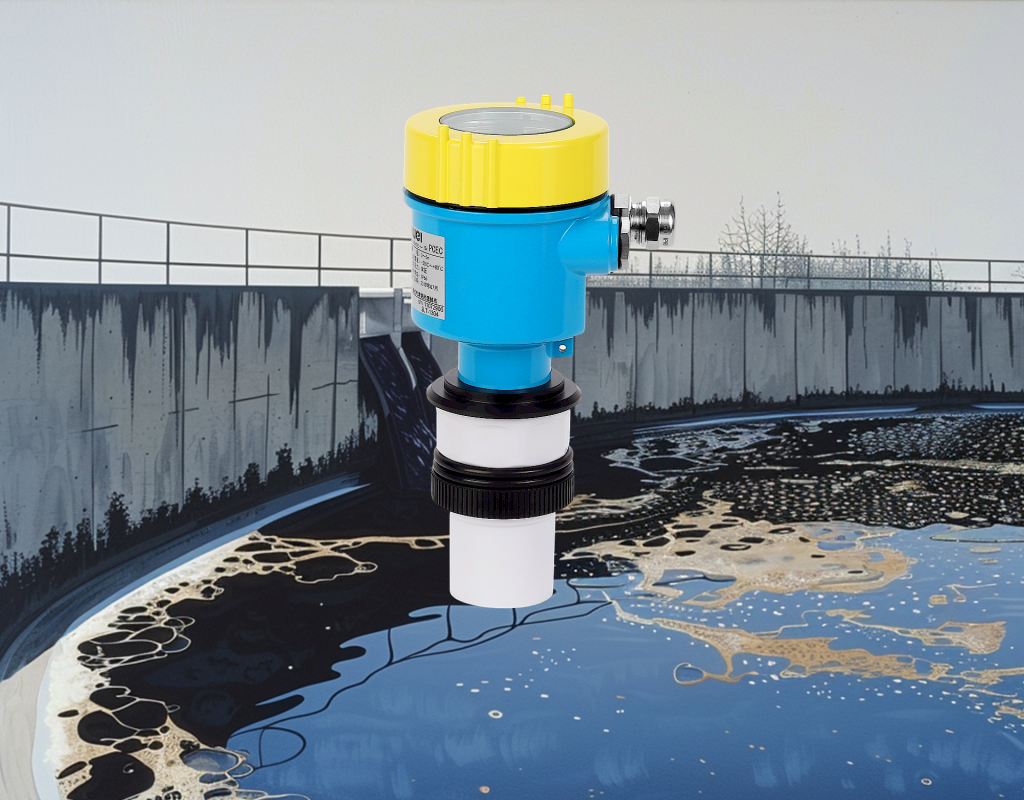
In contrast, 80GHz radar level transmitters use high-frequency electromagnetic waves for measurement. Since radar does not rely on gas propagation, it is far less affected by temperature variation and steam interference. The higher frequency provides a narrower beam angle and stronger signal focusing capability, which helps improve long-term operational stability.
2. Environmental Changes During Long-Term Operation
In the early stage of a project, tank conditions are usually stable—normal temperature, clean gas phase, and minimal disturbances. Under such ideal conditions, the performance difference between ultrasonic and radar technologies may not be significant.
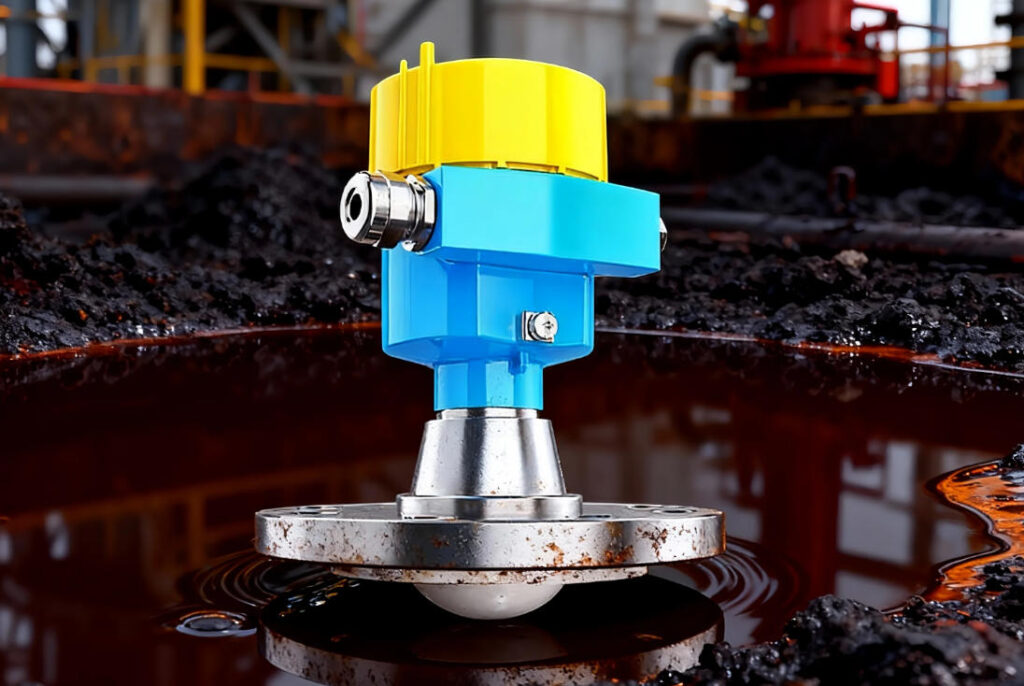
However, as equipment operates over months or years, process conditions may gradually change. Common environmental variations include:
- Increased steam concentration
- Formation of temperature stratification
- Airflow disturbance caused by mixing
- Increased dust levels
- Presence of foam or mist
These factors can affect ultrasonic signal propagation, leading to signal fluctuation or occasional loss of echoes. In safety interlock systems or critical control points, such instability may increase operational risk.
3. Advantages of 80GHz Radar Technology
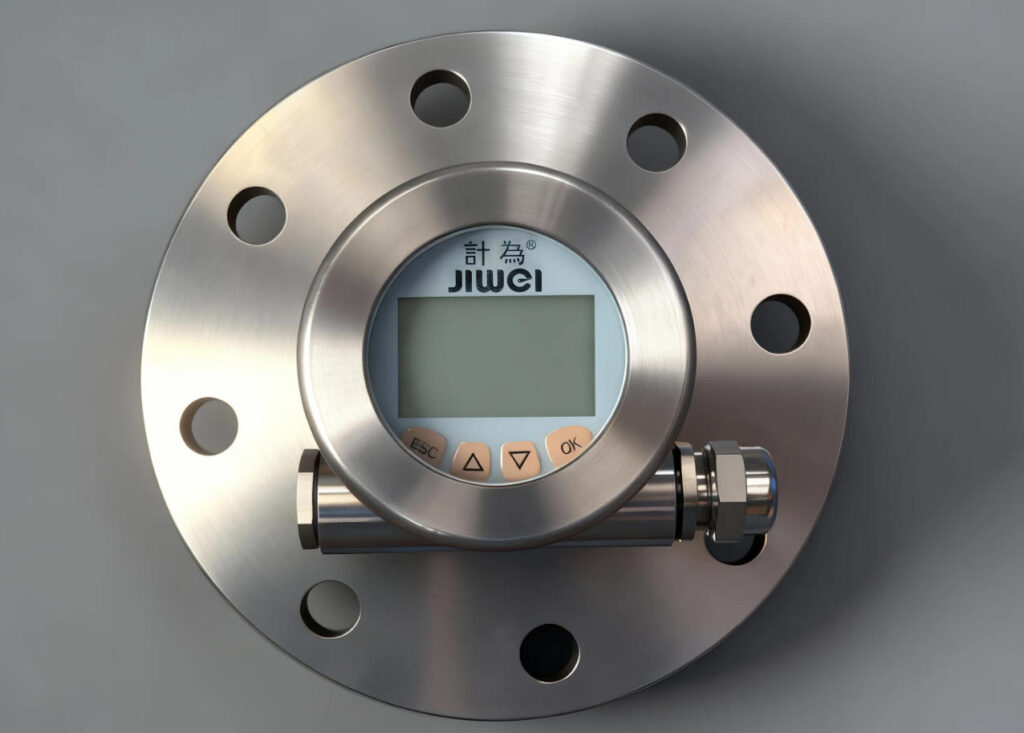
The advantages of 80GHz millimeter-wave radar lie primarily in long-term stability and adaptability to complex environments. Because it uses electromagnetic waves rather than acoustic waves, radar measurement is not dependent on the gas medium.
In industrial applications, radar typically offers:
- High resistance to steam interference
- Strong dust immunity
- Stable long-term signal performance
- Suitability for complex process conditions
- Higher reliability for safety-related signals
These characteristics make radar particularly suitable for applications requiring high system reliability.
4. Application Positioning of Different Radar Series
Based on process complexity, 80GHz radar level transmitters are generally categorized into PRO Series and MINI Series. While their hardware configurations and application focuses differ, both share the same core software architecture and remote commissioning capabilities.
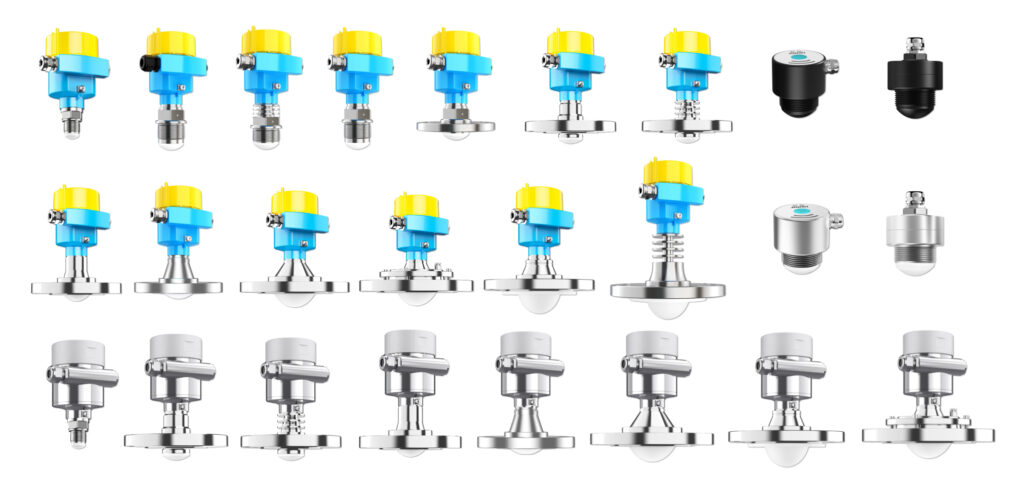
PRO Series (Complex Conditions)
The PRO Series is designed for high-temperature environments, frequent steam presence, dust-heavy conditions, and industries such as petrochemical and chemical processing where safety requirements are stringent. It typically features advanced echo processing algorithms and high-performance antenna design, making it suitable for critical tanks and interlock measurement points.
MINI Series (General Applications)
The MINI Series is suitable for water treatment, small tanks, and standard industrial level monitoring applications. With its compact structure and simplified commissioning process, it is ideal for upgrading outdated ultrasonic instruments and achieving smooth system transitions.
Both series are built on the JWrada® radar platform, sharing a unified intelligent software system.
Software and Remote Commissioning Capabilities (Common to Both Series)
One of the core competitive advantages of the JWrada® radar level transmitter lies in its advanced software platform. The system supports software updates, parameter configuration, process debugging, and fault code diagnostics, enabling refined management across various applications.
Engineers can perform one-to-one remote collaborative commissioning through a cloud server, allowing real-time viewing and analysis of echo curves and EFT curves. This capability significantly improves commissioning efficiency and enhances diagnostic accuracy in complex conditions.
Furthermore, the cloud-based remote system supports customized parameter optimization according to actual site conditions. Engineers can adjust algorithms and echo settings to ensure optimal measurement performance in different tank structures and operating environments.
This independently developed software platform provides strong system integrity and technological scalability within the domestic radar industry.
5. Core Selection Principle: Application Matching, Not Simple Replacement
Ultrasonic technology is not obsolete. In simple and stable environments, it remains a reliable solution. Likewise, radar is not required for every application.
Selection decisions should consider:
- Presence of steam
- Presence of foam
- Dust conditions
- Whether the signal is used for safety interlocking
- Tolerance for false alarms
- Long-term process variability
When operating conditions become more complex and long-term signal reliability becomes critical, 80GHz radar often provides a more suitable engineering solution.
6. Conclusion
There is no absolute superiority between ultrasonic and radar technologies. The key factor is whether the measurement principle can sustainably match real process conditions.
In stable and clean environments, ultrasonic transmitters may fully meet requirements. In complex, variable, or safety-critical applications, 80GHz radar level transmitters are generally the more appropriate choice.
Instrument selection is fundamentally about engineering compatibility rather than parameter comparison.