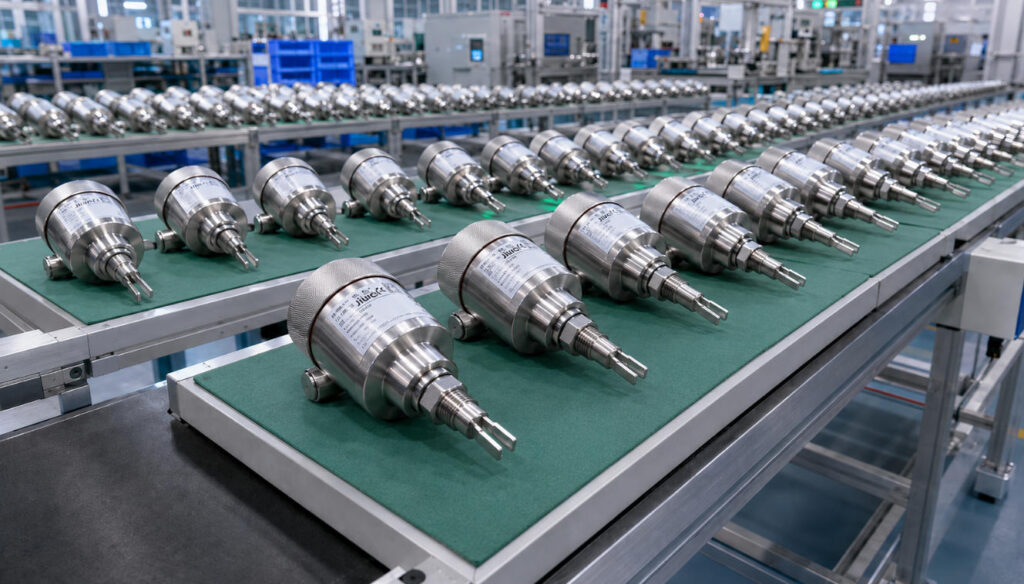
Jiwei Ring-11 Tuning Fork Level Switch Successfully Applied in Vacuum Electrical Equipment Industry
In industries such as ultra-high voltage power transmission, new energy, aerospace, and high-end equipment manufacturing, vacuum drying and vacuum impregnation processes play a critical role in determining the drying performance, impregnation quality, and long-term reliability of insulation components.
Vacuum process systems typically consist of multiple functional units, including liquid storage, circulation, condensation, recovery, and separation modules. During operation, these systems undergo various stages such as vacuum evacuation, vacuum release, liquid filling, liquid discharge, and medium circulation.
For level detection devices installed in these systems, challenges often include limited installation space, complex media characteristics, liquid flow, mechanical vibration, and frequent operating condition changes. Therefore, level switches are required to provide reliable switching performance, compact mechanical design, and strong resistance to interference.
Recently, the technical and sales team from Shenzhen Jiwei Automations Ltd visited a leading domestic enterprise in the vacuum electrical equipment industry to inspect the actual installation and operation of the Jiwei Ring-11 tuning fork level switch in vacuum equipment. During the visit, Jiwei engineers held in-depth discussions with the customer’s technical, production, and equipment teams regarding product performance, application conditions, and future cooperation.
A Leading Vacuum Equipment Manufacturer Promoting Localization of Core Components
The customer visited in this project was established in 1997 and is a high-tech state-owned enterprise specializing in the research, development, manufacturing, sales, and service of vacuum technology equipment.
After nearly three decades of development, the company has become one of the leading manufacturers in China’s vacuum electrical equipment industry, with a market share exceeding 30%. Its products cover vacuum processing systems, new material equipment, optoelectronic equipment, and environmental protection equipment, serving industries including ultra-high voltage power transmission, aerospace, new energy, superconductivity, rail transportation, and marine engineering.
The company’s products are exported to more than 40 countries and regions worldwide.
With increasing production capacity and expanding international projects, the customer has raised higher requirements for supporting instruments, focusing not only on basic detection functions but also on product reliability, installation adaptability, standardization, delivery capability, and technical support.
Although a level switch is only one component of a complete vacuum system, its output signals directly participate in pump control, valve operation, liquid presence detection, and system interlocking. Any signal instability, false switching, or failure to switch may affect equipment commissioning efficiency and process continuity.
Driven by the demand for localization of key components and supply chain optimization, the customer began evaluating domestic level detection solutions based on different measurement principles. The Jiwei Ring-11 tuning fork level switch was selected for actual equipment verification and application.
Water-Oil Mixed Medium Application
In this project, the detected medium is not pure water or oil, but a mixture of both.
During equipment operation, the oil-water ratio, density, flow condition, and separation status of the medium may change depending on different process stages. In some cases, bubbles, liquid disturbance, and temporary impact may occur, creating additional challenges for level detection equipment.
For measurement technologies that rely on electrical conductivity or dielectric constant, changes in water-oil ratio may affect the electrical characteristics of the medium and sometimes require parameter adjustment.
The Ring-11 tuning fork level switch, however, detects liquid presence based on changes in the vibration frequency of the fork. With optimized tuning technology, it can detect liquids with densities as low as 0.5 g/cm³.
When the tuning fork is exposed to air, it vibrates at a preset frequency. When the water-oil mixture contacts the fork, the vibration frequency and amplitude change. The electronic module analyzes the feedback signal and determines whether liquid is present, then outputs the corresponding switching signal.
This operating principle is independent of medium color, transparency, and conductivity. Even when the oil-water ratio changes within a certain range, the Ring-11 can continue to provide stable point-level detection based on whether the fork is covered by liquid.
According to the customer’s technical team:
“The medium here is a mixture of water and oil, and its condition changes during operation. The tuning fork mainly detects whether liquid reaches this point. We do not need to repeatedly adjust parameters when the oil-water ratio changes. It is very convenient in actual operation.”
40 mm Compact Fork Design for Limited Installation Space
Another important feature of this application is that the installation environment is closer to a pipeline system rather than a conventional large storage tank.
The installation position has limited internal space, while the medium is continuously flowing or circulating. The Tuning Fork Level Switch must ensure reliable contact with the medium while avoiding interference with the pipe wall, internal structures, or other components.
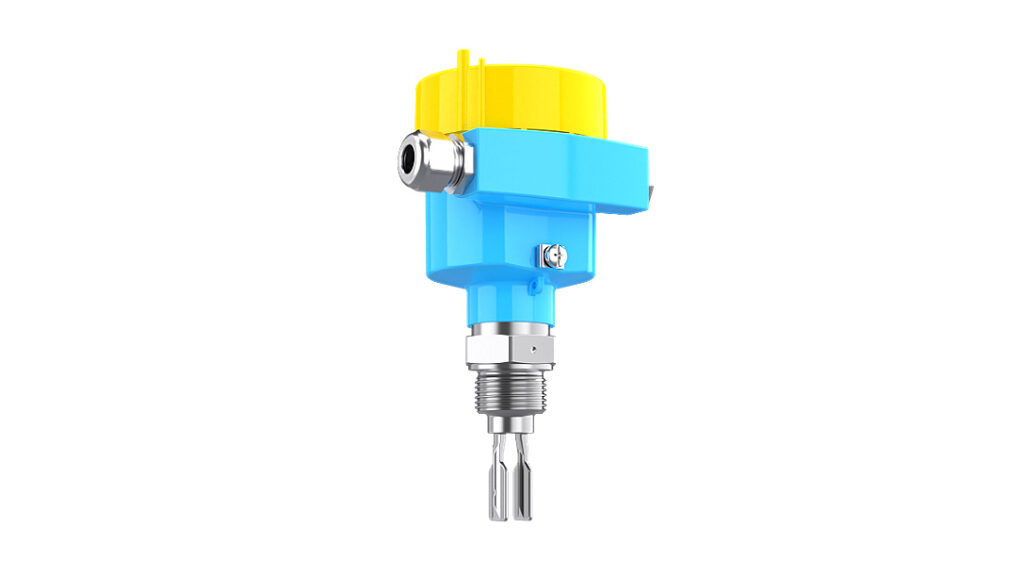
The Ring-11 adopts an ultra-short 40 mm fork design. Its compact structure makes it suitable not only for tanks and vessels but also for pipelines, small chambers, and other space-restricted installations.
Key advantages include:
- Reduced installation space requirements
The short fork minimizes the risk of interference with surrounding structures. - Lower mechanical impact from flowing media
The shorter insertion length reduces stress caused by direct liquid impact. - Reduced residual liquid attachment
The smaller fork surface helps the medium leave the sensor more quickly after drainage. - Flexible installation adjustment
Customers can easily adjust installation direction according to equipment layout.
During installation, the customer optimized the fork orientation according to pipeline direction and liquid flow conditions, allowing the medium to pass smoothly through the fork gap while reducing long-term direct impact.
The assembly team commented:
“This position is very compact and similar to a pipeline installation. A longer fork would create challenges in installation space and liquid impact. The short fork design of Ring-11 Tuning Fork Level Switch makes installation much easier.”
Multiple Tuning Fork Level Switches Supporting Equipment Interlocking
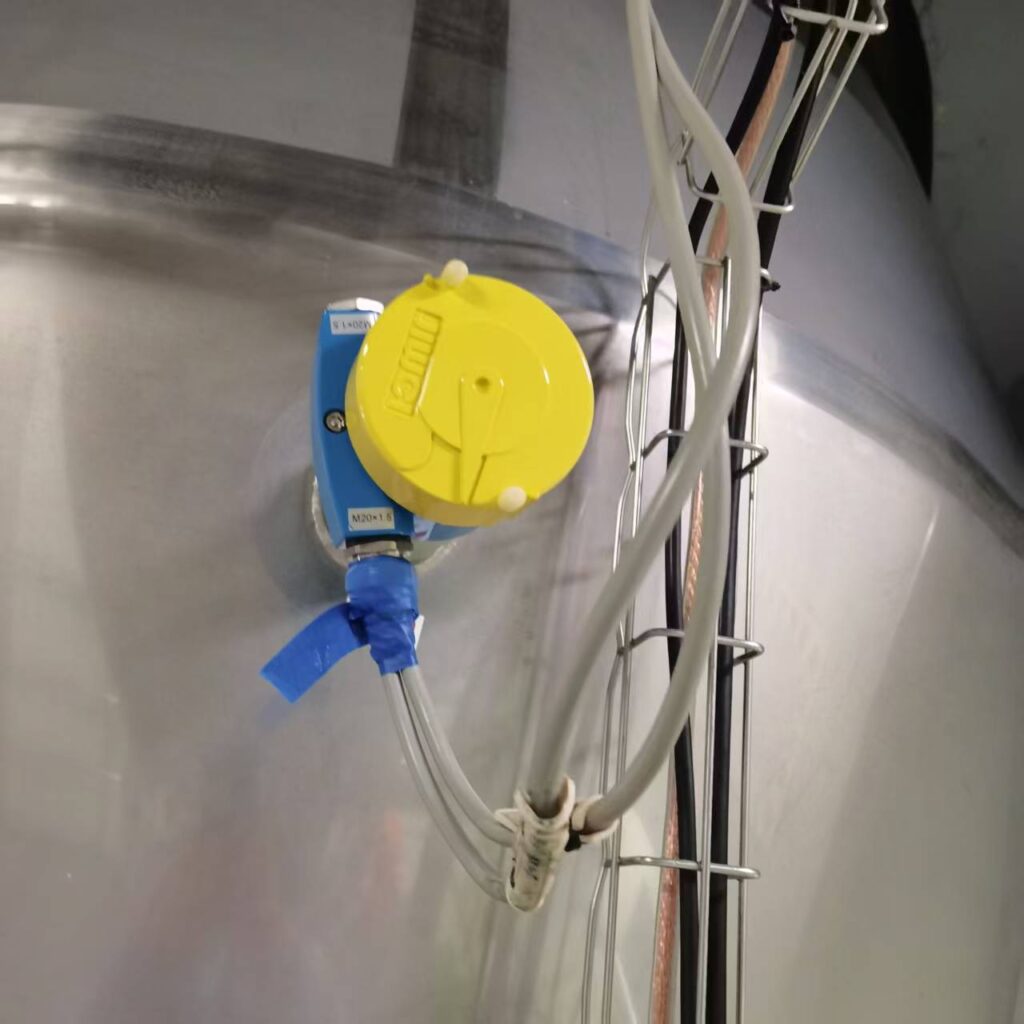
In the customer’s large vacuum processing systems, multiple Ring-11 tuning fork level switches are installed at different process points to detect liquid presence or absence.
These signals participate in the control logic of pumps, valves, and automation systems. Although each switch monitors only one individual point, together they form an important part of the liquid circulation and protection system.
Therefore, the customer pays close attention not only to whether a single instrument operates correctly, but also to consistency among multiple units during long-term operation.
The commissioning engineer explained:
“A typical system uses four tuning fork switches. All signals participate in control. During commissioning, the biggest concern is repeated switching at one point because troubleshooting becomes difficult. The Ring-11 Tuning Fork Level Switch provides clear switching action, and the performance consistency among multiple points is good.”
Interface Adaptation: Thread Connection Converted to Clamp Installation

Based on the initial selection, Jiwei supplied the customer with a threaded Ring-11 tuning fork level switch.
During equipment integration, the customer designed a customized adapter structure according to its own pipeline configuration, assembly requirements, and maintenance considerations, converting the threaded connection into a clamp-type installation.
During the site visit, Jiwei’s technical and sales teams inspected the actual installation structure, including the adapter design, fork position, wiring space, installation direction, and operating conditions.
The customer’s assembly team commented:
“Jiwei supplied the threaded version, and we designed an adapter according to our equipment interface to achieve clamp installation. This allows us to use a verified tuning fork product while making assembly and maintenance more convenient.”
Better Stability Recognized After Comparison with Multiple Technologies
As a leading vacuum equipment manufacturer, the customer has extensive experience selecting instruments for different industries and technical requirements.
Previously, the company had applied various level detection technologies, including float switches, magnetostrictive level transmitters, and microwave level switches.
The customer’s technical manager stated:
“We have used many different instrument brands and technologies, including float switches, magnetostrictive devices, and microwave level switches. Based on this water-oil mixed medium and installation condition, the tuning fork level switch provides better stability.”
It should be noted that different level measurement principles have their own applicable scenarios. The customer’s recognition of Ring-11 Tuning Fork Level Switch is based on actual application conditions, including medium characteristics, installation environment, and control requirements.
Stable Performance Under Liquid Disturbance and Mechanical Vibration
During operation, vacuum equipment generates mechanical vibration from vacuum pumps, circulation pumps, and other driving components. Liquid circulation may also cause flow impact, bubbles, and temporary fluctuations.
For tuning fork level switches, the key challenge is accurately distinguishing frequency changes caused by liquid contact from external mechanical disturbances.
The Ring-11 Tuning Fork Level Switch adopts optimized fork structure and vibration detection technology. By monitoring the natural resonance characteristics of the fork, it accurately identifies whether the medium has reached the detection point.
Through stable frequency processing and signal analysis, the product reduces false switching caused by external vibration, liquid fluctuations, bubbles, and medium variation.
The compact 40 mm fork structure also provides improved mechanical rigidity, helping reduce the influence of pipeline impact and equipment vibration.
During actual operation, four Ring-11 Tuning Fork Level Switch units maintained stable switching output during equipment startup, shutdown, liquid circulation, and pump operation, with no obvious signal fluctuation observed.
The equipment manager commented:
“This position has both liquid flow and equipment vibration. We care not only about whether the switch can detect liquid, but also whether it will generate false alarms during operation. The Ring-11 signal is stable and has not created additional commissioning or operation issues.”
Gradually Becoming a Standardized Supporting Solution
Based on actual operation results and the site evaluation, the customer has formed a clear understanding of the suitability of the Ring-11 tuning fork level switch for similar vacuum equipment applications.
With multiple output options and certifications available, Ring-11 provides flexible solutions for equipment exported to different international markets.
The customer’s equipment manager stated:
“Whether a domestic instrument can become a long-term supporting product depends on actual performance in equipment. Ring-11 has shown stable operation, and its compact size fits our installation requirements. For similar applications in the future, we will continue considering this product.”
Conclusion
In vacuum process equipment, selecting a Tuning Fork Level Switch requires more than simply comparing measurement range, accuracy, or purchase cost. Engineers must consider medium characteristics, installation space, liquid flow conditions, external vibration, and control objectives.
With its 40 mm ultra-short fork design, liquid detection capability down to 0.5 g/cm³, maintenance-free structure, strong resistance to vibration and medium variation, and multiple electrical output options, the Jiwei Ring-11 Tuning Fork Level Switch has demonstrated excellent adaptability and stability in real industrial applications.
The customer’s acceptance of the tuning fork technology is based on long-term performance under actual operating conditions, including real media, real installation environments, and real equipment control logic.
This factory visit once again demonstrates that the value of industrial instruments lies not only in product performance, but also in whether suppliers can deeply understand equipment structures, process conditions, and control requirements to provide accurate selection guidance and technical support. Tuning Fork Level Switch Tuning Fork Level Switch