Is a Smaller Beam Angle Better for an 80GHz Radar Level Meter? The Key Is Not “Smaller,” but “Application Fit”
An 80GHz radar level meter does not mean the smaller the beam angle, the better. A small beam angle can concentrate radar energy and make it easier to avoid interference from tank walls, agitators, brackets, coils, and other internal structures. However, if the installation angle is unsuitable, the liquid surface fluctuates greatly, or the nozzle condition is unreasonable, it may also increase commissioning difficulty.
Therefore, during selection, the beam angle should be evaluated together with the measuring range, tank type, medium characteristics, and installation conditions.
Key Points at a Glance
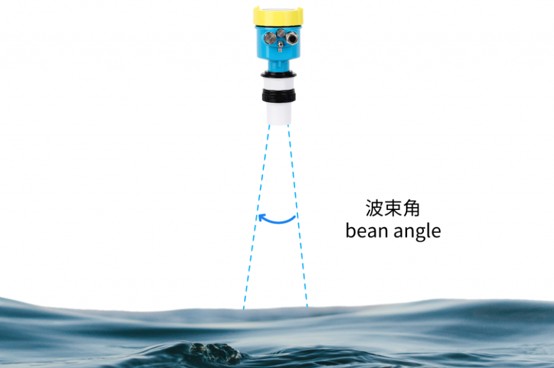
The beam angle can be understood as the “detection cone angle” formed when the radar signal is emitted downward. The smaller the angle, the more concentrated the energy and the narrower the irradiation range. The larger the angle, the wider the coverage, but the easier it is to scan non-target objects such as tank walls, agitators, coils, ladders, and feed inlets.
For an 80GHz radar level meter, a small beam angle is indeed an important advantage. It is especially suitable for narrow tanks, small tanks, deep wells, long measuring ranges, tanks with complex internal structures, or measurement points with limited installation space. However, in engineering applications, it is not enough to simply look at whether the beam angle is small. It is also necessary to consider whether the medium foams, whether there is steam, whether it is corrosive, whether there are high-temperature and high-pressure conditions, whether the nozzle size is suitable, and whether the installation position can directly face the liquid surface.
1. What Is the Beam Angle of a Radar Level Meter?
Jiwei radar level meter emits electromagnetic waves toward the liquid surface through an antenna. After the electromagnetic waves encounter the liquid surface, they are reflected back. The instrument calculates the distance from the antenna to the liquid surface based on the echo signal, and then converts it into the liquid level height.
The beam angle is the angle formed when radar energy is emitted downward. It can be compared to a flashlight beam: floodlight covers a wider area but easily illuminates nearby objects, while focused light is more concentrated on the target but needs to be aimed accurately.
In level measurement, the beam angle affects several key issues:
• Whether the radar easily scans obstacles such as tank walls, reinforcing ribs, coils, and agitator blades;
• Whether it can avoid feed inlets, foam accumulation areas, material buildup areas, and strongly disturbed areas;
• Whether it is suitable for small-diameter nozzles, long nozzles, narrow tanks, or deep-well installation;
• Whether a stable and clear true liquid surface echo can be obtained in the effective area;
• Whether later commissioning, maintenance, and troubleshooting are convenient.
Therefore, the beam angle is not an isolated parameter, but an important factor in radar level meter selection and installation design.
2. Why Do 80GHz Radar Level Meters Often Emphasize Small Beam Angles?
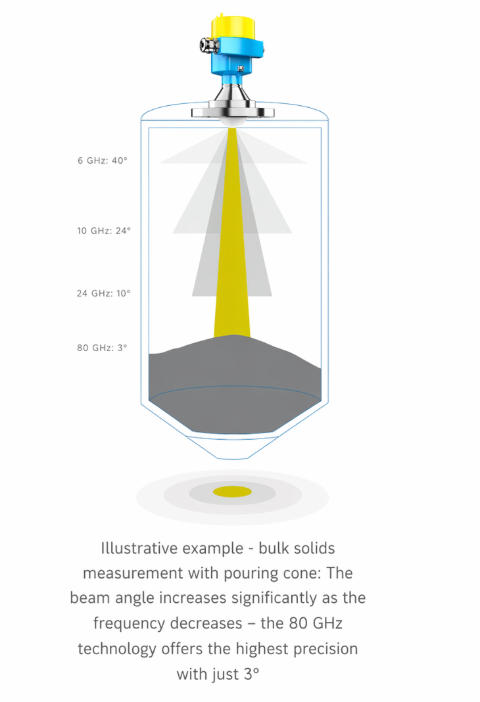
80GHz radar is a high-frequency millimeter-wave radar. The higher the frequency, the shorter the wavelength. Under the same antenna conditions, it is usually easier to achieve a narrower beam. Many products in the Jiwei JWrada series use 80GHz FMCW technology and support HART/Modbus, Bluetooth commissioning, intelligent echo processing, and other functions. Different models correspond to different measuring ranges, structures, and application scenarios. The Jiwei JWrada-21 product is based on 80GHz FMCW technology, supports HART/Modbus communication and Bluetooth 5.0, and features false echo recognition, multi-layer echo separation, target dynamic tracking, and other functions.
The small beam angle advantage of 80GHz radar level meters is mainly reflected in the following aspects.
2.1. Easier Avoidance of Internal Tank Obstacles
In chemical storage tanks, reactors, sewage pools, dosing tanks, food mixing tanks, powder silos, and other sites, the internal structure is often not simple. There may be agitators, coils, brackets, ladders, feed pipes, spray devices, or buildup inside the tank. When the beam angle is too large, the radar signal may scan both the liquid surface and obstacles at the same time, generating false echoes and causing level jumps, false alarms, or unstable curves.
The value of a small beam angle lies in the fact that, when the installation position is reasonable, the radar can concentrate its main energy on the target liquid surface area and reduce “false viewing” of surrounding structures.
2.2. More Suitable for Narrow Tanks, Small Tanks, and Deep-Well Applications
In small storage tanks, narrow tanks, underground wells, sewage wells, pump stations, sluices, and open channels, the tank wall or well wall is close to the measurement center. If the beam angle is too large, the signal can easily irradiate the side wall and generate interference echoes.
The Jiwei JWrada-20 model is an 80GHz high-frequency radar level meter with a measuring range of 10m and a beam angle of 13°. It is especially suitable for hydrological and water level measurement, simple liquid level measurement, and small-range material level measurement. This shows that even for 80GHz radar, a suitable structure must be selected according to the measuring range and application conditions, rather than simply pursuing the smallest beam angle.
2.3. Beneficial for Complex Echo Recognition
High-frequency radar has concentrated energy and high resolution, which is more conducive to distinguishing true liquid surface echoes from interference echoes. For sites with steam, foam, agitation, buildup, dust, or complex internal structures, hardware beam angle alone is not enough. Echo algorithms, installation commissioning, and application adaptation are also needed.
Jiwei JWrada-31 uses 80GHz FMCW technology, supports on-site wireless commissioning, parameter configuration, and real-time monitoring, and features false echo recognition, multi-layer echo separation, and target dynamic tracking. For engineering sites, such functions help reduce commissioning difficulty and make it easier for maintenance personnel to view echo status and identify interference sources later.
3. Is the Smaller the Beam Angle, the Better?
The answer is no. A small beam angle is an advantage, but it is not a universal solution.
If the beam angle is very small, the radar signal is more concentrated, and its resistance to tank wall interference is usually better. However, it also depends more on correct installation. If the installation position deviates from the target area, the nozzle blocks the antenna, or the antenna is not aligned with the effective liquid surface, a small beam may also fail to “see” the ideal echo.
Common Misunderstanding 1: Only Looking at Beam Angle and Ignoring Nozzle Conditions
Many sites install radar on existing nozzles. If the nozzle is too long, the diameter is too small, the inner wall is uneven, or the antenna does not extend out of the nozzle, the radar signal may first reflect from the inner wall of the nozzle and form interference. In this case, even if the beam angle is small, the measurement may still be unstable.
Common Misunderstanding 2: Equating a Small Beam Angle with Suitability for All Complex Conditions
Problems such as steam, foam, dust, corrosion, high temperature, high pressure, and low-dielectric-constant media cannot be solved by beam angle alone. Beam angle solves the problem of “where to look,” while material, sealing, explosion protection, temperature and pressure suitability, echo algorithms, and installation methods solve the problem of “whether it can measure stably over the long term.”
Common Misunderstanding 3: Ignoring Liquid Surface Conditions
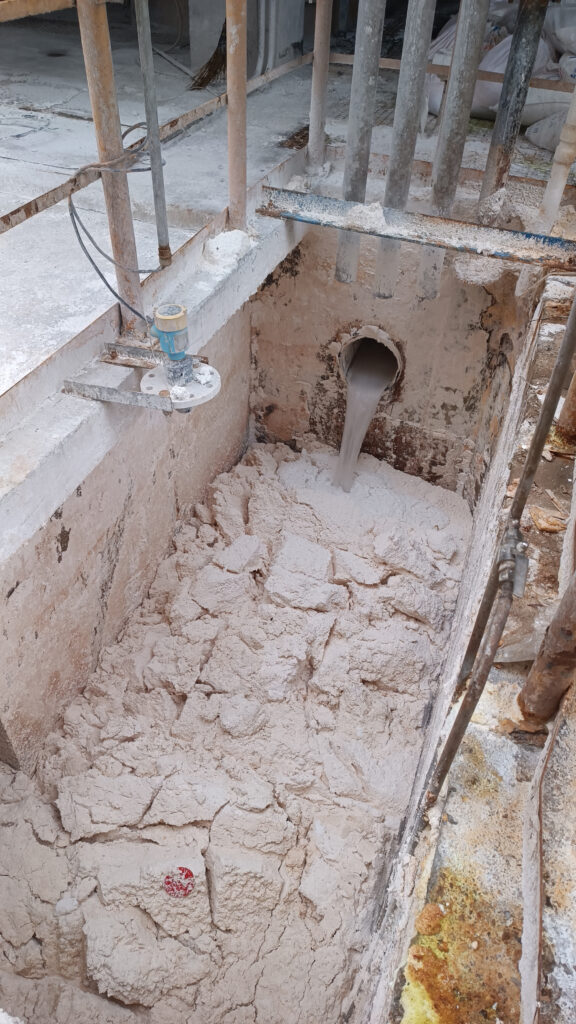
A calm liquid surface usually makes it easier to obtain stable echoes. However, if the liquid surface fluctuates strongly, agitation is intense, or foam is very thick, the echo signal will change with the liquid surface condition. In this case, the installation position, filtering settings, bypass pipe or guided wave solution, and whether an independent high/low level switch is required for safety alarm should be comprehensively considered.
Common Misunderstanding 4: Thinking That a Narrower Beam Means Less Commissioning
The narrower the beam, the more it acts like “precise aiming.” It can avoid interference, but it also requires the installation to be aligned with the target area. For eccentric installation, conical material piles, sloped material surfaces, or tanks with complex internal structures, a universal flange or angle adjustment structure should be used when necessary to direct the radar toward the effective reflection area.
4. How Should Different Beam Angles Be Understood?
A relatively wide beam angle is usually suitable for measurement points with simple structures, short measuring ranges, open containers, and few obstacles. Examples include simple water pools, open channels, hydrological and water applications, and small-range liquid level scenarios. Installation tolerance is relatively high, but it is still necessary to avoid pool walls, brackets, and inlet disturbances.
A medium beam angle is suitable for common liquid level measurement points in general industrial storage tanks, water treatment, dosing tanks, buffer tanks, food, or pharmaceutical applications. It balances coverage and anti-interference capability, but attention should still be paid to avoiding feed inlets, agitators, and protrusions on tank walls.
A small beam angle is suitable for narrow tanks, small tanks, deep wells, long measuring ranges, complex internal structures, or applications with limited installation space. It can concentrate radar energy on the target liquid surface or material surface area and reduce the influence of false echoes, but it has higher requirements for installation position, nozzle size, and alignment angle.
An extremely narrow beam angle is more suitable for long-range, tall tanks, powder silos, reactors, and strong-interference containers. Jiwei JWrada-32 is an 80GHz radar level meter with a measuring range of 60m and a beam angle of ≥3°. It can be used for liquid measurement and is suitable for flammable and explosive hazardous areas in petroleum, chemical, mining, and other industries. For such applications, not only the beam angle but also explosion protection, temperature and pressure, materials, and installation conditions must be checked carefully.
5. Selection Logic for Jiwei JWrada Series: One Model Does Not Fit All Applications
The Jiwei JWrada series covers different application directions such as water level, liquid level, and material level. Different models vary in measuring range, beam angle, antenna structure, process connection, material, protection, explosion protection, and applicable industries.
For hydrological and water applications, rivers and lakes, open channels, sewage treatment, pump stations, reservoirs, sluices, and other scenarios, attention can be focused on compact structure, installation convenience, protection rating, low maintenance, and communication methods. JWrada-20 supports 4–20mA/HART, RS485/Modbus, and Bluetooth v5.4, has a protection rating of IP68 (0.2bar), and is used in applications including hydrology and water management, sewage treatment plants, wastewater treatment systems, reservoirs, sluices, and pump stations.
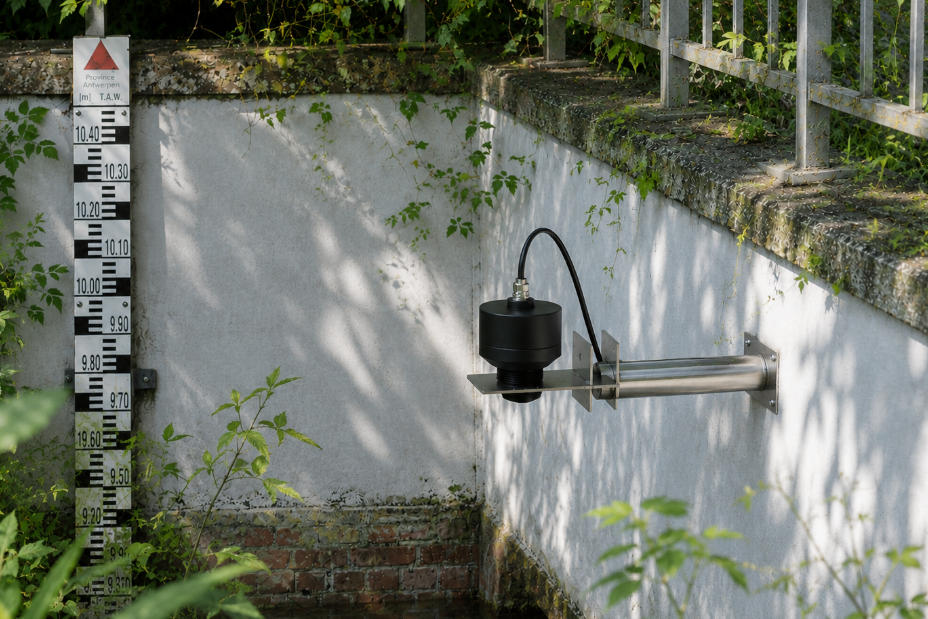
For continuous liquid level measurement in pharmaceutical, food, energy, water, and other industries, attention can be focused on non-contact measurement, wireless commissioning, echo recognition, and compact installation. JWrada-31 is suitable for liquid level measurement in pharmaceutical, food, energy, hydrological, and water applications.
For flammable and explosive hazardous areas in petroleum, chemical, mining, and other industries, explosion-proof certification, process temperature, process pressure, antenna material, sealing structure, and on-site installation method should be carefully checked. JWrada-32 provides gas and dust explosion-proof certification information and offers antenna material options such as PFA, 316L+PTFE, and 316L+PFA.
For complex material level, dust, tall tanks, long measuring ranges, foam, steam, high temperature and high pressure applications, further attention can be paid to large-diameter lenses, purge structures, universal flanges, intelligent echo algorithms, and remote commissioning capability. JWrada-34 uses 80GHz millimeter-wave technology and is equipped with a purge system and universal flange, targeting material level measurement and complex application conditions.
6. Selection Suggestions: Confirm These Questions Before Judging Beam Angle
First, confirm the measuring range. The longer the range, the larger the coverage area under the same beam angle, and the more obvious the value of a small beam angle. Tall tanks, deep wells, and silos should usually pay more attention to beam angle.
Second, confirm the tank diameter. In narrow tanks, small tanks, and well-type applications, the tank wall is close to the measurement center, so the beam should be prevented from scanning the side wall.
Third, confirm the internal structure. Agitators, coils, ladders, brackets, spray pipes, and feed inlets will all affect echoes. Tank structure drawings or site photos should be provided during the selection stage.
Fourth, confirm the medium condition. Foam, steam, dust, crystallization, buildup, volatilization, and low dielectric constant will all affect radar echo strength and stability.
Fifth, confirm temperature, pressure, and corrosiveness. In high-temperature, high-pressure, highly corrosive, or explosion-proof areas, beam angle alone is not enough. Materials, sealing, process connection, and certification requirements must also be considered.
Sixth, confirm the nozzle size. A nozzle that is too long, too narrow, or has a rough inner wall may cause interference echoes. Before installation, the nozzle height, diameter, and antenna insertion position should be checked.
Seventh, confirm output and commissioning methods. If on-site maintenance is inconvenient, the tank top is high, or integration with a DCS/PLC system is required, attention should be paid to HART, Modbus, Bluetooth commissioning, remote monitoring, and other configurations.
7. Installation Notes: Small-Beam Radar Also Needs to “See” the Liquid Surface Correctly
During installation, the feed inlet should be avoided as much as possible to prevent the radar from directly measuring the incoming flow. For containers with agitators, the area swept by the agitator blades should be avoided. When there are coils, ladders, or brackets inside the tank, the main radar beam should avoid these fixed obstacles.
For dome-roof tanks, installation should not be carried out randomly in positions that easily generate multiple reflections. For long nozzles, the nozzle should be prevented from blocking the antenna. For solid material level measurement, the material pile angle, feed position, and dust concentration should be considered. When necessary, angle adjustment should be used to direct the radar toward the effective material surface.
A small beam angle can reduce interference, but it cannot replace standardized installation. Truly reliable level measurement in engineering comes from reasonable selection, correct installation, and standardized commissioning working together.
8. Conclusion: Small Beam Angle Is an Advantage, but Suitable Selection Is the Answer
The small beam angle of an 80GHz radar level meter can indeed improve anti-interference capability in complex tanks, especially for narrow tanks, deep wells, long measuring ranges, and measurement points with agitators or complex internal structures. However, beam angle is not the only indicator, nor is it true that the smaller it is, the better.
For simple water applications, small-range liquid level measurement, ordinary storage tanks, chemical reactors, powder silos, high-temperature and high-pressure conditions, or explosion-proof scenarios, the selection logic is not the same. A reasonable approach is to first confirm the medium, measuring range, tank type, temperature and pressure, corrosion, explosion protection, installation nozzle, and communication requirements, and then match the appropriate radar model and installation solution.
If there are issues such as steam, foam, dust, buildup, corrosion, strong agitation, or limited installation space on site, you can contact Jiwei Automation and provide complete application parameters to obtain selection suggestions, product information, and technical support for the JWrada series radar level meters/material level meters.