China’s First-Tier Level Switch Brand: Jiwei Fork-11 Vibrating Fork Level Switch
China’s Level Switch Industry Enters the Era of High Reliability
With the continuous advancement of industrial automation, accurate detection of powders and granular materials has become increasingly essential across chemical, construction, food, metallurgy, power, and environmental industries. Especially for powders, fine granular materials, and ultra-low-density materials, traditional mechanical level switches often suffer from misoperations, material bridging, or short service life, making them unable to meet modern industrial requirements for stability and reliability.
Against this market backdrop, high-end Chinese instrumentation brands have rapidly emerged. Shenzhen Jiwei Automations Ltd., leveraging independent R&D capabilities, extensive on-site experience, and strict industrial-grade manufacturing standards, has become a representative of China’s first-tier level switch brands.
Jiwei’s Fork-11 Vibrating Fork Level Switch is specially designed for detecting powders and fine granular solids. It is widely applicable to complex industrial conditions such as flour, cement, fine sand, plastic granules, chemical powders, salt, and feed, providing high-reliability and high-stability level monitoring solutions for industrial sites.

Fork-11 Series: Designed for Ultra-Low-Density Powders
Traditional vibrating fork level switches often cannot reliably detect ultra-light powders due to insufficient sensitivity. The Fork-11 has been specifically optimized to overcome this challenge.
- Minimum detectable material density: ≥0.008 g/cm³
Even extremely low-density, highly fluid powders can be accurately and stably detected. Compared with traditional level switches that only measure standard granular or higher-density materials, Fork-11 demonstrates significant advantages in ultra-low-density powder measurement. Suitable materials include flour, starch, fly ash, PVC powder, chemical powders, feed, fine sand, salt, fine plastic granules, cement powder, and lime powder.
In modern industrial production, ultra-low-density powders often generate serious problems such as dust suspension, material bridging, false level readings, and unstable flow behavior. Ordinary level switches are prone to misoperation, malfunction, or long-term instability under such conditions. Fork-11 uses high-sensitivity vibration detection technology, optimized fork design, and advanced signal processing algorithms to significantly improve recognition of light powders and resistance to interference. Even under high dust, high humidity, continuous operation, or complex vibration conditions, it maintains stable and reliable level output, providing safer, more efficient, and precise monitoring for industrial sites.
High-Sensitivity Vibration Detection Technology
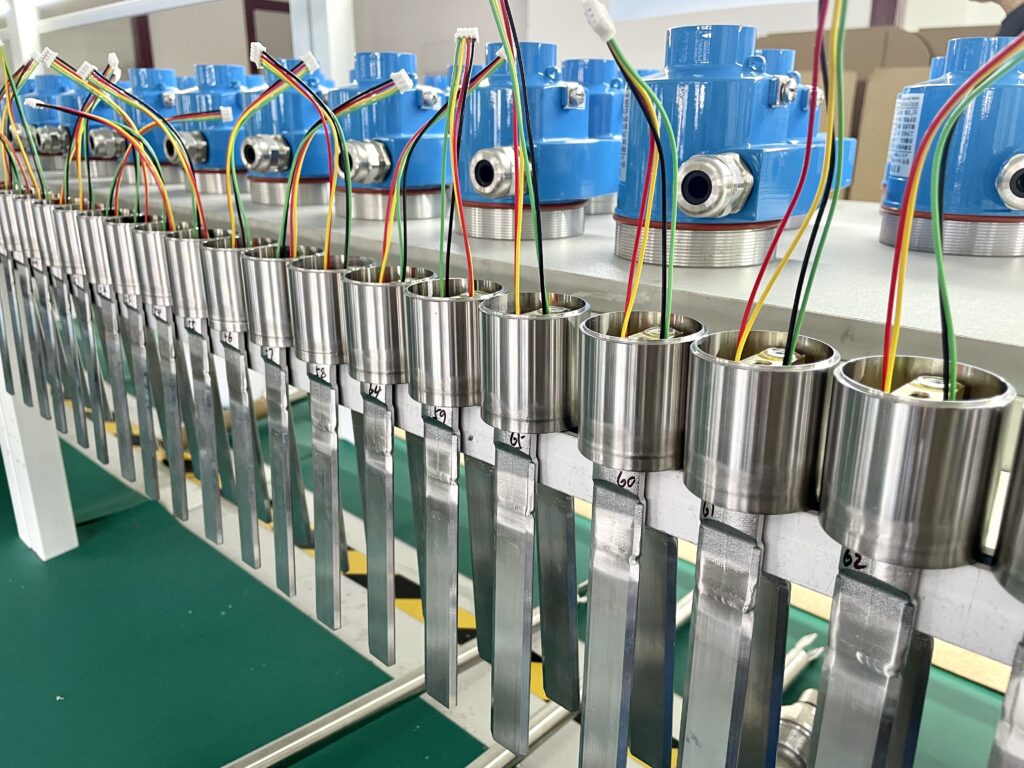
Fork-11 operates at a stable vibration frequency of approximately 140 Hz. The fork continuously vibrates at a fixed frequency. When the fork comes into contact with material, the vibration changes, and the high-precision electronic module instantly analyzes the frequency shift to determine the presence of material.
Compared with traditional mechanical level switches that rely on gravity, pendulum, or simple contact, Fork-11 offers superior stability, sensitivity, and interference resistance, particularly in dusty, complex, and continuously operating industrial environments.
- Rapid response time: 0.5 seconds when in contact, 1 second when material is absent
- Dust resistance: Optimized fork design and high-sensitivity detection maintain stability in high dust environments
- Interference reduction: Advanced algorithms differentiate real material contact from false signals
For modern automated factories, fast, stable, and reliable level feedback is critical for both production efficiency and operational safety. Fork-11 provides precise, high-speed, and reliable level monitoring even under complex powder conditions.
Adaptability to Harsh Industrial Environments
Modern industrial sites often feature high temperatures, high pressures, corrosive conditions, heavy dust, and long continuous operation, which pose extreme challenges to equipment reliability. Especially in cement, chemical, metallurgy, power, and new energy industries, ordinary level switches often experience component aging, probe failure, misoperation, or long-term instability at high temperatures, seriously affecting production safety and automation stability.
Fork-11 was developed from the ground up following strict industrial-grade standards, focusing on long-term reliable operation under high-temperature conditions. It is suitable not only for standard powder applications but also for high-temperature, dusty, and complex industrial environments, fully meeting modern industrial requirements for high-reliability level detection.
- Temperature versions:
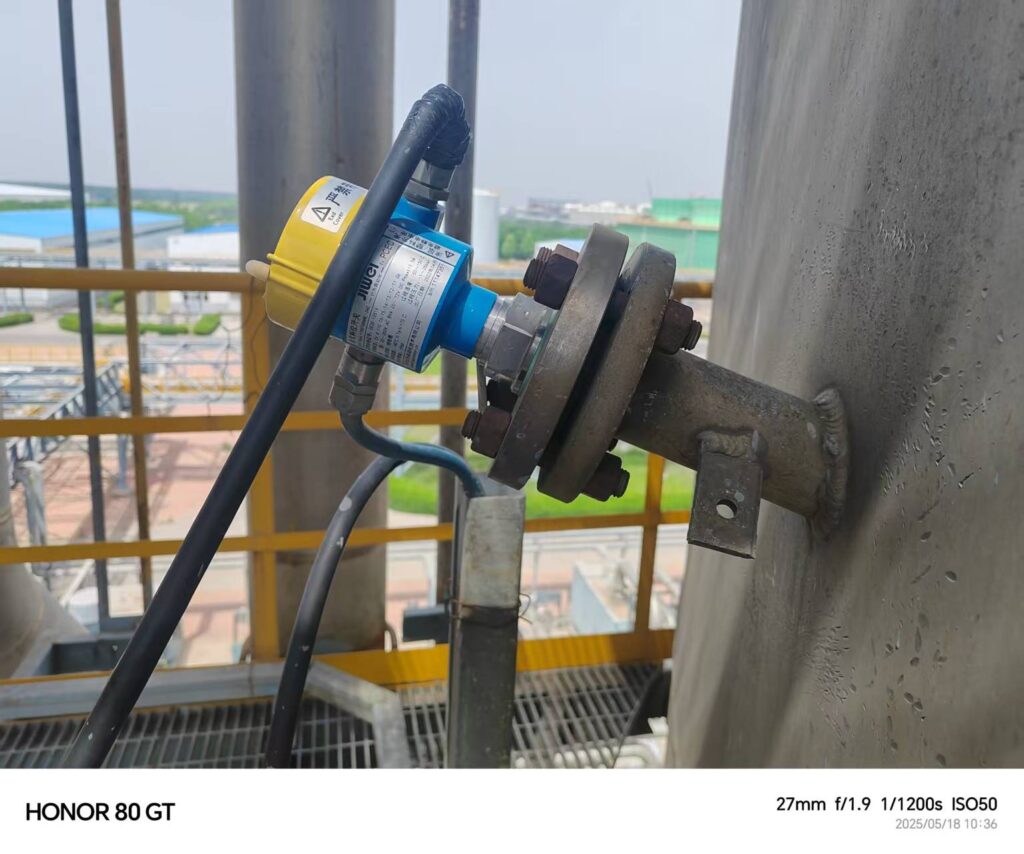
- Standard: -50°C to 150°C
- High-temperature: -50°C to 250°C
- Ultra-high-temperature: -50°C to 400°C
The ultra-high-temperature version is one of Fork-11’s core advantages. While many traditional switches are limited to 100–200°C, Fork-11 can withstand up to 400°C, maintaining stable vibration frequency and precise level output, suitable for boilers, high-temperature powder transport, cement kilns, metallurgical silos, chemical reactors, and high-temperature dust collection systems.
Industrial-Grade Construction
Fork-11 employs industrial-grade reinforced construction from the fork body to process connections, housing, and sealing systems, ensuring stable operation in dusty, corrosive, humid, and continuous operation environments.
- Fork body: 316L stainless steel, optional PTFE coating for enhanced corrosion and adhesion resistance
- Housing: Aluminum alloy or stainless steel
- Protection rating: IP66 / IP67
The fork body exhibits excellent corrosion resistance, wear resistance, and long-term stability, even in abrasive materials like fly ash, cement powder, lime powder, or salt granules. The housing provides full protection against dust and water, ensuring reliable performance in harsh industrial conditions.
Explosion-Proof Certification
Fork-11 meets comprehensive industrial explosion-proof standards:
- Flameproof: Ex db IIC T1…T6 Gb; Ex tb IIIC T80℃…T440℃ Db
- Intrinsic safety: Ex ia IIC T1…T6 Ga; Ex ia IIIC T200100℃…T200450℃ Da
It also holds CE, EMC, and LVD certifications, meeting international industrial safety, electromagnetic compatibility, and electrical reliability standards.
Signal Outputs and System Integration
- Relay output: DPDT 5A/253V AC, 5A/24V DC
- Two-wire output: 8mA /16mA, alarm <2.3mA
Compatible with PLC, DCS, SCADA, HMI, and industrial automation systems, enabling real-time digital material level management.
Why Fork-11 is a Leading Brand in China
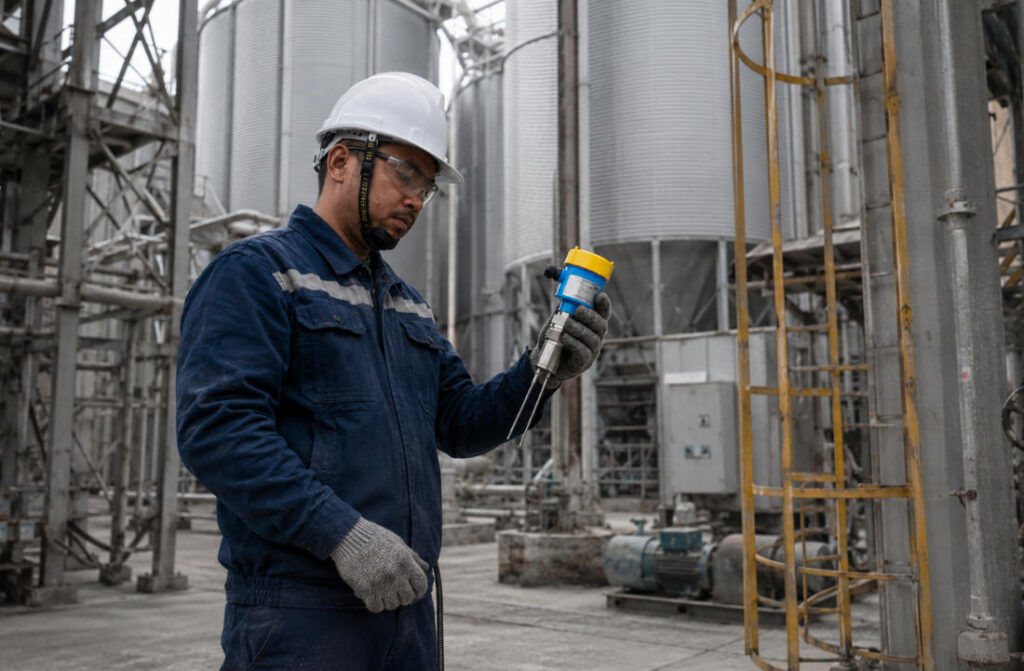
China’s industrial instrumentation market is shifting from low-cost competition to high-reliability competition. Fork-11 stands out due to:
- Independent R&D: Full control of core technology
- Extensive field experience: Applied in chemical, cement, power, metallurgy, food, environmental, and new energy industries
- Industrial-grade manufacturing: Ensures long-term stability
- High-end application capabilities: Excels in ultra-low-density powders, high temperature, dusty, and corrosive environments
Applications Across Industries
- Chemical: Chemical powders, resin powders, PVC powders
- Food: Flour, starch, sugar powder
- Construction: Cement, lime, fly ash
- Environmental: Dust treatment systems, ash silos
- New Energy: Lithium battery powder handling
Fork-11 ensures reliable, stable, and accurate level monitoring across all these industries.
Conclusion
As industrial automation progresses, enterprises require higher stability and reliability from level measurement instruments. Jiwei Fork-11 Vibrating Fork Level Switch, a first-tier Chinese brand, provides ultra-low-density detection, industrial-grade construction, explosion-proof certification, and robust field adaptability. It delivers accurate, reliable, and efficient level measurement for complex industrial applications, enhancing both production safety and automation efficiency.
FAQ
What materials can Fork-11 detect?
Fork-11 Vibrating Fork Level Switch is designed for powders and fine granular solids. It is suitable for materials such as flour, starch, fly ash, PVC powder, cement powder, lime powder, salt, feed, resin powders, and fine plastic granules. The device performs especially well in ultra-low-density powder applications.
Is Fork-11 suitable for ultra-low-density powders?
Yes. Fork-11 is specifically optimized for ultra-low-density powder measurement, with a minimum detectable material density of ≥0.008 g/cm³. Its high-sensitivity vibration detection technology and advanced signal processing algorithms ensure stable and reliable detection even in lightweight, highly fluid powder conditions.
Can Fork-11 work in high-temperature environments?
Yes. Fork-11 is available in multiple temperature versions:
- Standard version: -50°C to 150°C
- High-temperature version: -50°C to 250°C
- Ultra-high-temperature version: -50°C to 400°C
The ultra-high-temperature version is widely used in boilers, cement kilns, metallurgical systems, chemical reactors, and high-temperature powder conveying applications.
Does Fork-11 support PLC or DCS integration?
Yes. Fork-11 supports relay output and two-wire output, allowing easy integration with PLC, DCS, SCADA, HMI, and other industrial automation systems. This helps users achieve digital level monitoring, automatic control, and remote process management.
Is Fork-11 explosion-proof?
Yes. Fork-11 provides both flameproof and intrinsically safe explosion-proof certifications, suitable for hazardous gas and combustible dust environments.
- Flameproof: Ex db IIC T1…T6 Gb; Ex tb IIIC T80℃…T440℃ Db
- Intrinsic safety: Ex ia IIC T1…T6 Ga; Ex ia IIIC T200100℃…T200450℃ Da
It also holds CE, EMC, and LVD certifications, meeting international industrial safety and compliance standards.