
Complete Guide to Electrical Wire Color Codes (2026 Edition)
In industrial applications, power engineering, and residential installations, electrical wire color codes are essential for ensuring safety and correct wiring practices. Whether it is a three-phase RYB system or the orange high-voltage cables used in electric vehicles, each color represents a specific function.
However, several important questions arise:
Are wire color standards unified across countries?
What are the differences between IEC, NEC, and BIS regulations?
Are AC and DC color codes the same?
This guide organizes global wire color standards by country, power type (AC/DC), and modern versus legacy systems for structured reference.
1. Why Must Wires Be Color-Coded?
Wire color coding is not merely an industry convention. It is a proven safety framework developed through decades of engineering practice. Its primary objectives are to ensure personnel and equipment safety and to improve maintenance efficiency.
1️⃣ Improving Safety
Incorrect wiring can cause serious hazards in any electrical system. Clear color identification allows technicians to quickly determine conductor functions and reduce connection errors.
For example:
If a live wire is mistakenly connected to a neutral terminal, short circuits or fire hazards may occur.
If a neutral wire is misidentified as a live conductor, equipment may remain energized, increasing shock risk.
If the grounding conductor is incorrectly connected or missing, protective systems may fail during insulation faults.
Color coding helps prevent these risks during installation, significantly improving overall system safety.
2️⃣ Improving Maintenance Efficiency
In industrial environments, electrical systems can be highly complex. Distribution panels, motor control centers (MCC), automation lines, and vehicle harness systems may contain dozens or even hundreds of conductors.
A clear and consistent color code enables technicians to quickly identify circuit functions, reduce troubleshooting time, minimize operational errors, and improve maintenance efficiency. During inspections or system upgrades, wire color identification is often the first step in diagnostics, helping reduce downtime.
⚠ It is important to note that electrical design standards vary by country. Wire color codes are not globally unified, and local regulations must always be followed in international projects.
2. Basic Conductor Functions (Global Concept)
In single-phase systems, three main conductors are typically present:
- Live (Line) — supplies power
- Neutral — completes the electrical circuit
- Protective Earth (PE) — provides fault current path
Three-phase systems usually include:
- Three phase conductors (L1, L2, L3)
- One neutral conductor
- One protective earth conductor
3. United Kingdom / European Wire Color Standards
The United Kingdom and most European countries follow standards issued by the
International Electrotechnical Commission (IEC), specifically IEC 60445:2021.
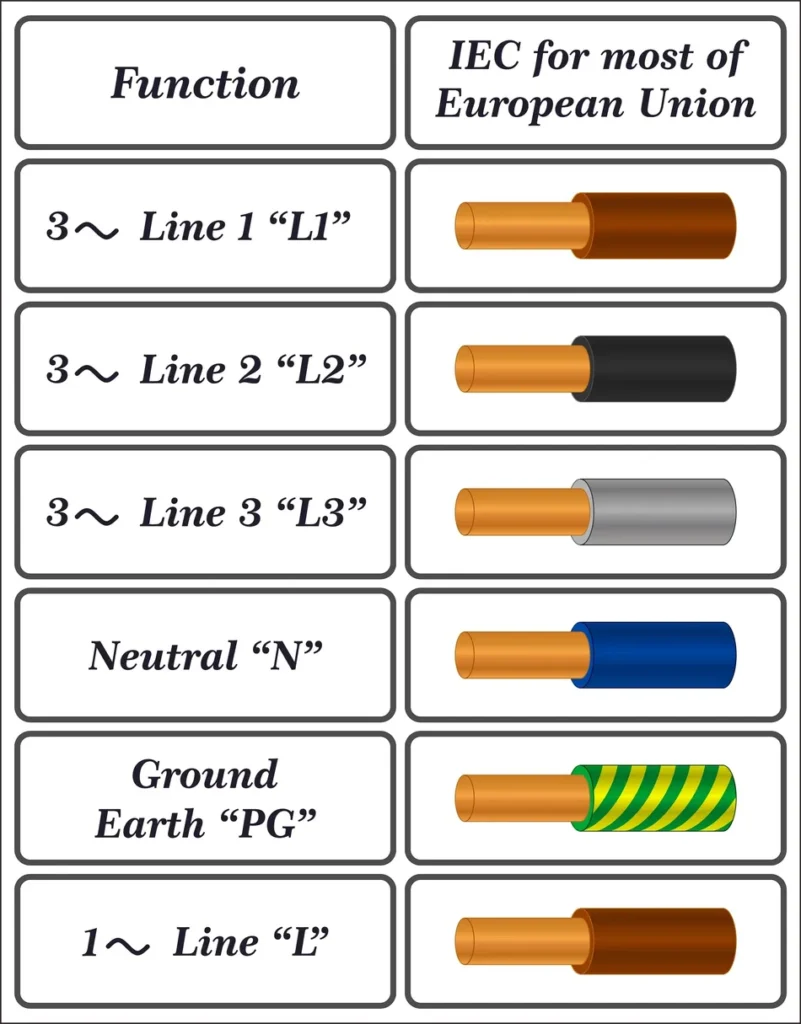
In modern three-phase four-wire AC systems, brown, black, and gray are used for phase conductors (L1, L2, L3). Light blue is designated for neutral, while green-yellow is reserved for protective earth (PE). This system is widely used in industrial distribution, commercial buildings, and infrastructure projects.
For single-phase systems, brown is used for the live conductor, light blue for neutral, and green-yellow for protective earth. This unified design ensures consistency between single-phase and three-phase installations.
Legacy buildings may still contain older color schemes. Under previous standards, single-phase systems used red for live and black for neutral. Three-phase systems used red, yellow, and blue for phases, with black as neutral. Due to differences between old and new standards, clear identification is required during renovation or maintenance.
In DC systems, color logic remains partially aligned with AC conventions. In non-grounded two-wire systems, brown is typically positive, gray negative, and green-yellow is used for protective earth. Three-wire grounded systems introduce blue as a center conductor, maintaining structural clarity and reducing cross-system confusion.
4. United States Wire Color Standards
In the United States, conductor identification is governed by the National Electrical Code (NEC), published by the National Fire Protection Association (NFPA).
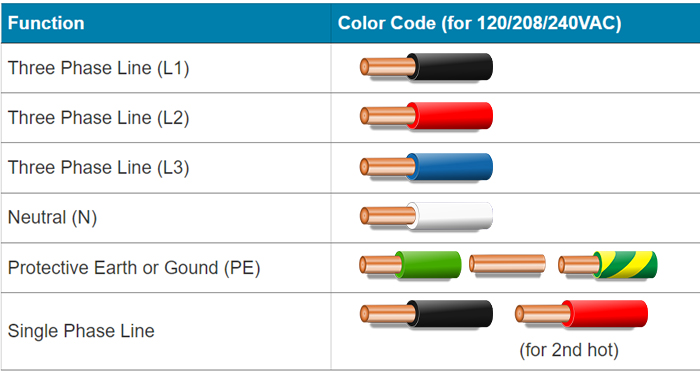
In common 120/240V split-phase systems, black and red are used as ungrounded conductors (L1 and L2). Blue may be used in three-phase variations. White is designated for neutral, while bare copper or green insulation is used for grounding conductors.
In commercial and industrial 277/480V three-phase systems, brown, orange, and yellow are commonly used for phase conductors. Gray is used for neutral, and green or bare copper for grounding. Orange may indicate special high-voltage configurations in certain installations.
In DC systems, such as automotive, solar, and energy storage applications, red is typically positive and black is negative. White or gray may serve as grounding conductors depending on system design. Project documentation should always be verified before installation.
5. Asian Wire Color Standards
Unlike Europe or North America, Asia does not have a single unified wire color standard. Each country establishes its own regulations.
Japan
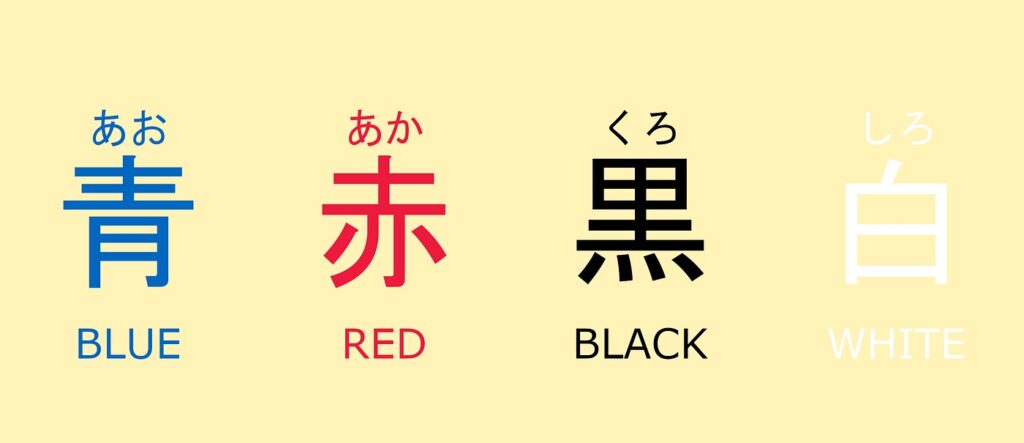
Japan operates 100V single-phase and 200V three-phase systems. In single-phase installations, black or red is commonly used for live, white for neutral, and green for grounding. In three-phase systems, black, red, and white represent the phases, with green as protective earth.
China
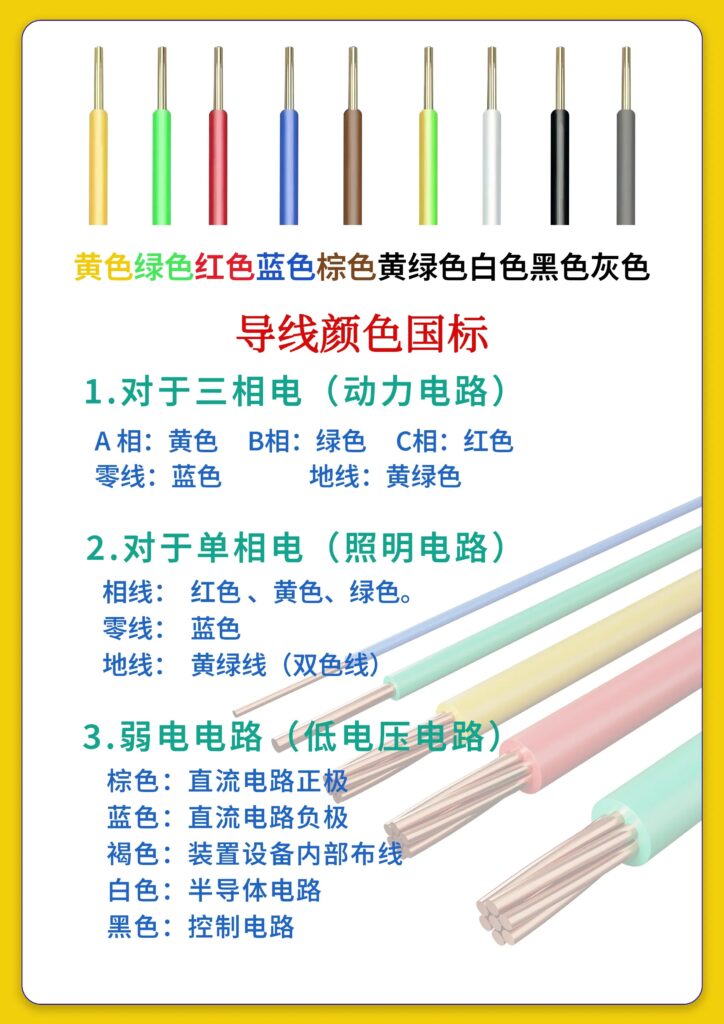
In single-phase systems, yellow is often used for live, light blue or black for neutral, and green-yellow for grounding. In three-phase systems, yellow, green, and red represent L1, L2, and L3 respectively, with light blue for neutral and green-yellow for grounding.
India
India follows IS 11353:2023 issued by the Bureau of Indian Standards (BIS), which is based on IEC 60445:2021. As a result, its recommended color scheme closely aligns with modern IEC standards, improving compatibility with international projects.
6. Global Comparison Summary
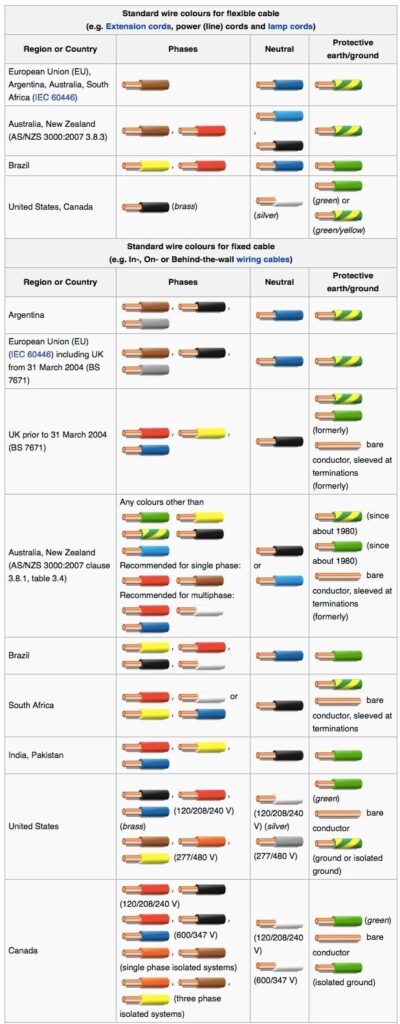
Different regions use different color systems. While grounding conductors are often consistently identified with green or green-yellow insulation, phase and neutral colors vary significantly between countries. Therefore, international engineering projects must strictly follow local regulations.
Conclusion
Understanding electrical wire color codes is fundamental to electrical safety and system reliability. Whether in residential wiring or industrial three-phase systems, proper color identification helps reduce wiring errors, improve installation efficiency, comply with local regulations, and enhance overall electrical safety.