
How to Choose 2-Wire, 4-Wire and 6-Wire Radar Level Meters
Introduction
During the selection of a radar level meter, many users focus mainly on measuring range, frequency, accuracy, antenna type, explosion-proof rating and process connection. However, one very important question is often overlooked: should the instrument be 2-wire, 4-wire or 6-wire?
From the outside, they may all look like the same radar level meter. However, there are significant differences in power supply, signal output, wiring method, system compatibility and field maintenance. Choosing the wrong wiring type may increase installation and commissioning costs. In some cases, the instrument may even fail to connect properly to the PLC, DCS or field control system.
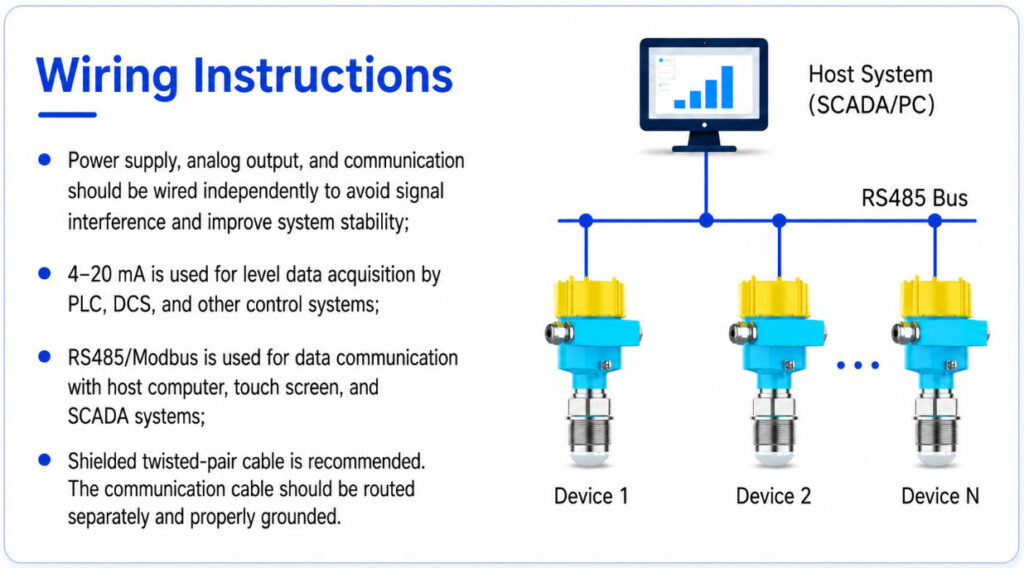
1. What Does the Wiring Type of a Radar Level Meter Mean?
The “wiring type” of a radar level meter usually refers to the number of wires required for power supply and signal output. It does not directly determine the measuring accuracy. Instead, it determines how the instrument is powered, how it transmits signals to the control system, and whether it can provide additional relay or switching outputs.
Common radar level meters are mainly divided into 2-wire, 4-wire and 6-wire types. A 2-wire radar level meter usually uses the same two wires for both power supply and 4-20 mA signal transmission. A 4-wire radar level meter normally separates the power supply from the signal output. A 6-wire radar level meter is often used when the application requires analog output together with relay, alarm or other switching outputs.
The exact definition may vary slightly from one manufacturer to another. Therefore, the final selection should always be based on the product wiring diagram and technical manual.
2. 2-Wire Radar Level Meter: The Most Common Choice for Continuous Measurement
The 2-wire radar level meter is one of the most widely used types in industrial applications. It usually uses 24 V DC power supply. The same two wires are used for both instrument power and 4-20 mA signal transmission. HART communication can also be superimposed on the current loop.
For DCS, PLC, data acquisition systems and safety barrier input modules, 2-wire connection is simple and cost-effective. It is especially suitable for continuous level measurement in storage tanks, wastewater pits, chemical tanks, food silos and similar applications.
The advantages of 2-wire radar level meters are clear. They require fewer wires, are easy to install, have good system compatibility and offer low maintenance cost. If the site already has a 4-20 mA analog input channel, a 2-wire radar level transmitter is usually the preferred option.
In hazardous areas, 2-wire instruments are also easier to work with intrinsic safety barriers, isolation barriers or explosion-proof systems. This makes them widely accepted in chemical, petrochemical, water treatment and general industrial applications.
However, 2-wire radar level meters also have some limitations. Since the power supply and signal share the same loop, the available power is relatively limited. If the application involves heavy dust, strong steam, severe agitation, long measuring range, fast response requirements, complex display functions or multiple output demands, a 2-wire instrument may not be as flexible as a 4-wire or 6-wire type.
Therefore, if the application only requires continuous output of liquid level, solid level or distance signal to a PLC or DCS, the 2-wire radar level meter is usually the most economical and reliable choice.
3. 4-Wire Radar Level Meter: Stronger Power Supply for Complex Applications
A 4-wire radar level meter usually separates the power supply from the signal output. For example, two wires are used for instrument power, while the other two wires are used for 4-20 mA output, RS485, Modbus or other signal outputs. Some 4-wire instruments use 220 V AC or 24 V DC independent power supply and provide an independent analog output signal.
The biggest advantage of a 4-wire radar level meter is stronger and more stable power supply. This gives the instrument more room for function expansion. For long-range radar level measurement, high-temperature and high-pressure applications, dusty silos, complex tank structures, local displays and multiple communication outputs, the 4-wire type is often more suitable.
In solid level measurement, dust, material angle of repose, false echoes and surface fluctuation may all increase the difficulty of signal processing. Independent power supply helps the radar level meter maintain stronger signal transmission, echo processing and display performance.
The 4-wire type is also suitable for sites where an independent power supply is already available, or where the control system requires an isolated signal. For example, some old control systems do not support loop-powered instruments. In other cases, the site may only have 220 V AC power available. Under these conditions, a 4-wire radar level meter is easier to integrate.
However, the disadvantages of 4-wire instruments should also be considered. They require more wiring, higher installation cost and more commissioning work. In hazardous areas, the power supply, explosion-proof junction box, cable glands and certification compatibility must also be checked carefully.
If the application is only a standard liquid storage tank, choosing a 4-wire radar level meter may lead to unnecessary additional cost.
4. 6-Wire Radar Level Meter: Suitable for Alarm, Interlock and Multiple Outputs
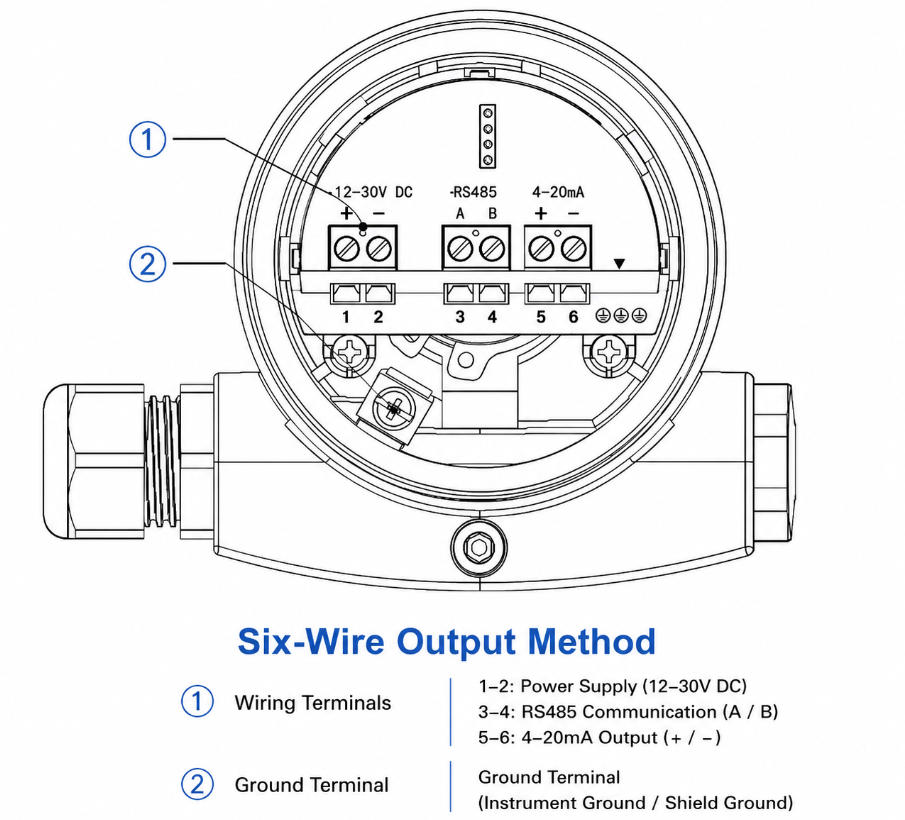
The definition of a 6-wire radar level meter is not always the same among different manufacturers. In engineering applications, it often refers to a structure such as “independent power supply + analog output + relay output” or “power supply + multiple switching outputs”.
In simple terms, the purpose of a 6-wire radar level meter is usually not to improve the basic measuring accuracy, but to provide more output functions.
For example, the user may want the radar level meter to continuously output a 4-20 mA signal while also providing high-level alarm, low-level alarm, pump start/stop control or local alarm interlock. In this type of application, a 6-wire radar level meter may be required.
It can reduce the need for external control logic and is suitable for small control systems, independent storage tanks, local control applications and retrofit projects.
The advantage of the 6-wire type is that it combines measurement and alarm control in one instrument. It offers flexible outputs and can meet both continuous measurement and local control requirements.
However, the selection of a 6-wire radar level meter must be more careful. First, the relay contact rating must be confirmed, including AC/DC voltage, current, resistive load and inductive load. Second, it is necessary to check whether the alarm points can be set on site and whether fail-safe mode is supported. Third, the electrical compatibility with PLC, relay, alarm horn, beacon or pump control circuit must be verified.
If the project only needs to send the level signal to the DCS for centralized control, the 6-wire type is usually not the first choice. If the instrument needs to directly participate in local alarm or interlock control, the 6-wire type becomes more valuable.
5. How to Choose Between 2-Wire, 4-Wire and 6-Wire Radar Level Meters

In practical selection, the following logic can be used.
If the site is a standard liquid storage tank, wastewater pit or chemical tank, and the application requires continuous measurement with signal transmission to PLC or DCS, a 2-wire radar level meter should be selected first. It is simple to install, cost-effective and accepted by most automation systems.
If the site conditions are complex, such as heavy dust, strong steam, long measuring range, strong interference, or if the instrument requires stronger signal processing capability, independent power supply and multiple communication options, a 4-wire radar level meter can be considered. It is more suitable for demanding process conditions and applications with higher functional requirements.
If the user requires not only continuous measurement but also local alarm, relay output, pump control or high/low level interlock, a 6-wire radar level meter may be selected. Before using it, the relay capacity, alarm logic, wiring method and explosion-proof certification must be confirmed.
6. Other Technical Points to Consider During Selection
The wiring type is only one part of radar level meter selection. It cannot determine the final model alone. A complete selection process should also confirm the medium type, dielectric constant, measuring range, process temperature, process pressure, tank structure, agitation, foam, dust, antenna type, installation position, blind zone, explosion-proof rating, ingress protection rating and communication protocol.
For hazardous areas, it is also necessary to confirm whether the requirement is for gas explosion protection or dust explosion protection. The area classification may be Zone 0, Zone 1, Zone 2, or Zone 20, Zone 21 and Zone 22. A 2-wire, 4-wire or 6-wire radar level meter can all be designed with explosion-proof protection, but the certificate must cover the actual hazardous area.
Users should not only check whether the instrument is described as “explosion-proof”. They should check the complete Ex marking, temperature class, equipment protection level and certification body.
The control system is also very important. Is the PLC or DCS input module active or passive? Does it support loop-powered instruments? Is HART communication required? Is a relay dry contact required? Is the site power supply 24 V DC or 220 V AC? These questions directly affect the selection of wiring type.
7. Conclusion
There is no absolute answer as to whether a 2-wire, 4-wire or 6-wire radar level meter is better. The right choice depends on the application.
A 2-wire radar level meter is suitable for most continuous level measurement applications. It is economical, simple and highly compatible. A 4-wire radar level meter is suitable for complex conditions and independent power supply requirements, offering better stability and expandability. A 6-wire radar level meter is suitable for applications requiring alarm, interlock or relay output.
For new projects, it is recommended to confirm three key points before selection: the field power supply, the control system input type, and whether local alarm or interlock is required. Once these three points are clear, the choice between 2-wire, 4-wire and 6-wire radar level meters becomes much easier.
Correctly selecting the wiring type can not only reduce installation cost, but also improve system stability and long-term maintenance efficiency.
radar level meter, radar level transmitter, 2-wire radar level meter, 4-wire radar level meter, 6-wire radar level meter, level measurement, level meter selection