Why the JWrada® PRO Radar Level Meter Uses a Six-Wire 4–20mA + RS485/Modbus Output for Industrial Silo Level Measurement
1. Why Industrial Silo Level Measurement Requires More Reliable Signal Output
In mining, aggregates, cement, metallurgy, chemical processing, new energy powder production, grain processing, and other industrial sites, silo level measurement directly affects production continuity, inventory management, equipment interlocking, and operational safety. As industrial automation and digital factory construction continue to develop, the requirements for radar level meters are no longer limited to “accurate measurement.” Users now expect stable signal output, complete data, reliable communication, and easy integration with automation systems.
Traditional silo measurement environments are often complex. On site, there may be heavy dust, steam, material buildup angles, feeding impact, material adhesion on silo walls, mechanical vibration, strong electromagnetic interference, and temperature fluctuations. For applications such as crusher buffer bins, ore silos, cement powder silos, lime silos, plastic pellet silos, lithium battery powder silos, and other bulk solid storage systems, the instrument must not only capture a true level echo reliably, but also transmit measurement data accurately to PLC, DCS, SCADA, or digital management platforms.
Against this background, the Jiwei JWrada® PRO Series radar level meter adopts 80GHz FMCW radar technology and supports a six-wire 4–20mA + RS485/Modbus output solution. This configuration combines analog output with digital communication. It retains the compatibility of 4–20mA signals with traditional industrial control systems while providing richer data transmission capability through RS485/Modbus. As a result, it offers a more stable, flexible, and digitalized solution for industrial silo level measurement.
2. What Is a Six-Wire System? How Is It Different from Two-Wire and Four-Wire Systems?
In industrial instrumentation, two-wire, four-wire, and six-wire connections are common wiring configurations for power supply, signal output, and communication. The main difference lies in whether the power supply, analog signal, digital communication signal, or control signal share the same wires, and whether each function is independently wired.
A two-wire system usually uses the same two wires for both power supply and 4–20mA signal transmission. It is simple to wire and widely used in common liquid level and solid level measurement applications. However, because the power supply and signal share the same loop, its function expansion capability is relatively limited.
A four-wire system usually separates the power supply wires from the signal wires. The power supply is more independent, and the signal output is more stable. It is suitable for instruments with higher power consumption or applications requiring more stable signal output.
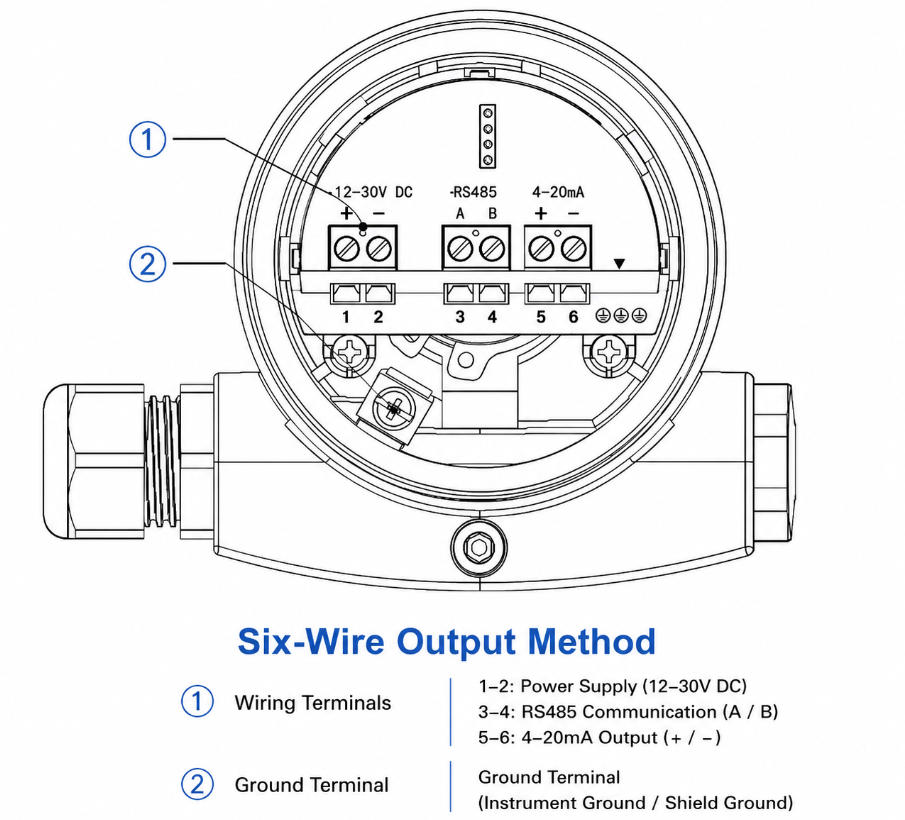
A six-wire system further adds independent communication wires or functional wires based on the four-wire structure. Taking the Jiwei PRO Series radar level meter as an example, the six-wire system can generally be understood as independent wiring for power supply, 4–20mA analog output, and RS485/Modbus communication. This allows the instrument to provide continuous analog level signals to the control system while transmitting more parameters, status information, and diagnostic data through digital communication.
For industrial solid level measurement, the advantage of a six-wire system is clear. It is not simply about having “more wires”; it represents a more complete signal architecture. The 4–20mA output is used for real-time level signal transmission, while RS485/Modbus is used for digital data communication. The two methods complement each other and better meet modern industrial requirements for reliability, compatibility, and intelligent management.
3. The Role of 4–20mA Output: Stable, Universal, and Suitable for Control Systems
The 4–20mA signal is one of the most common and mature analog signals in industrial automation. It offers strong anti-interference capability, relatively long transmission distance, and excellent system compatibility. It is widely used in PLCs, DCS systems, display instruments, signal isolators, safety barriers, and secondary instruments.
In silo level measurement, the 4–20mA signal usually corresponds to the empty-to-full level range of the silo. For example, 4mA can represent 0% level, while 20mA can represent 100% level. By collecting the current signal, the control system can determine the material height or inventory percentage inside the silo in real time.
For many existing production lines or traditional control systems, 4–20mA remains one of the most reliable and easiest signal types to integrate. Many factories already have analog input modules installed. Directly using 4–20mA output can reduce modification costs and avoid large-scale replacement of the control system.
The Jiwei JWrada® PRO Series radar level meter retains 4–20mA output, allowing it to be easily integrated into existing automation systems. In applications such as mining crushing lines, cement production lines, powder conveying systems, and aggregate storage systems, users can connect the radar level meter directly to PLC or DCS systems for continuous level monitoring, high and low level alarms, conveyor start-stop control, and inventory statistics.
4. The Role of RS485/Modbus: Enabling Digital Communication for Level Meters
Compared with 4–20mA, which can only transmit a single analog value, RS485/Modbus communication can transmit more digital information. Through the Modbus protocol, the control system can read not only the current level value, but also device status, echo quality, diagnostic information, temperature data, alarm status, and related parameters.
This is very important for modern smart factories and digital mining systems. Enterprises no longer focus only on a simple level value. They also want to fully understand instrument operating status, measurement reliability, and changes in field conditions.
For example, in a high-dust silo, if the echo signal is affected by short-term dust interference, a traditional analog system may only show a fluctuating value. However, through RS485/Modbus communication, the system can further read device status and diagnostic information. This helps engineers determine whether the change is caused by actual level variation, dust interference, installation angle issues, or false echoes from internal silo structures.
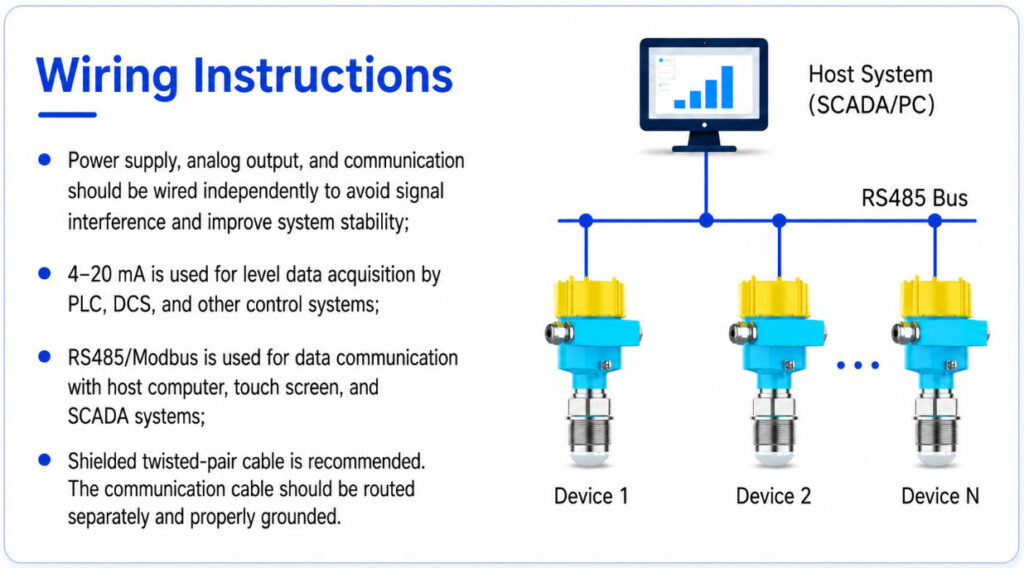
RS485 communication is also suitable for multi-point networking. In a large mining crushing station or powder storage and conveying system, there may be dozens or even hundreds of level meters distributed across the site. Through an RS485 bus network, multiple instruments can be connected to the same communication network, making centralized data acquisition, centralized management, and remote monitoring easier.
Therefore, the Jiwei PRO Series radar level meter with six-wire 4–20mA + RS485/Modbus output is suitable not only for single-point measurement, but also for multi-silo, multi-point, and centralized industrial level monitoring systems.
5. Core Advantages of 4–20mA + RS485/Modbus Combined Output
The greatest value of the Jiwei PRO Series radar level meter with six-wire 4–20mA + RS485/Modbus output lies in its ability to realize both analog control and digital management.
First, it offers stronger system compatibility. The 4–20mA output can be directly connected to traditional PLC, DCS, or secondary instruments to meet on-site control requirements. RS485/Modbus can be connected to host computers, data acquisition systems, SCADA systems, or IoT gateways to meet digital management requirements.
Second, the data is more complete. The 4–20mA output provides a continuous level signal, while Modbus provides more device data and status information. Users can understand not only “what the level is,” but also whether the device is operating normally, whether the signal quality is stable, and whether alarms or abnormalities exist.
Third, control and monitoring can be separated. The 4–20mA signal can be used for production control, while RS485/Modbus can be used for background monitoring and data analysis. In this way, even if communication with the host computer is temporarily interrupted, the PLC can still obtain key level data through 4–20mA, ensuring that production control is not affected.
Fourth, it is convenient for future expansion. Enterprises can initially use 4–20mA to connect to existing systems, and later enable RS485/Modbus for centralized management platforms when carrying out digital upgrades. This helps avoid repeated equipment purchases and repeated wiring.
Fifth, it offers better anti-interference performance. The six-wire system separates different functional cables, helping reduce mutual interference between power supply, analog output, and communication signals. For mining, metallurgy, chemical processing, and other high-interference environments, this wiring method is more suitable for long-term stable operation.
6. Why the PRO Series Radar Level Meter Is Suitable for Complex Solid Level Applications
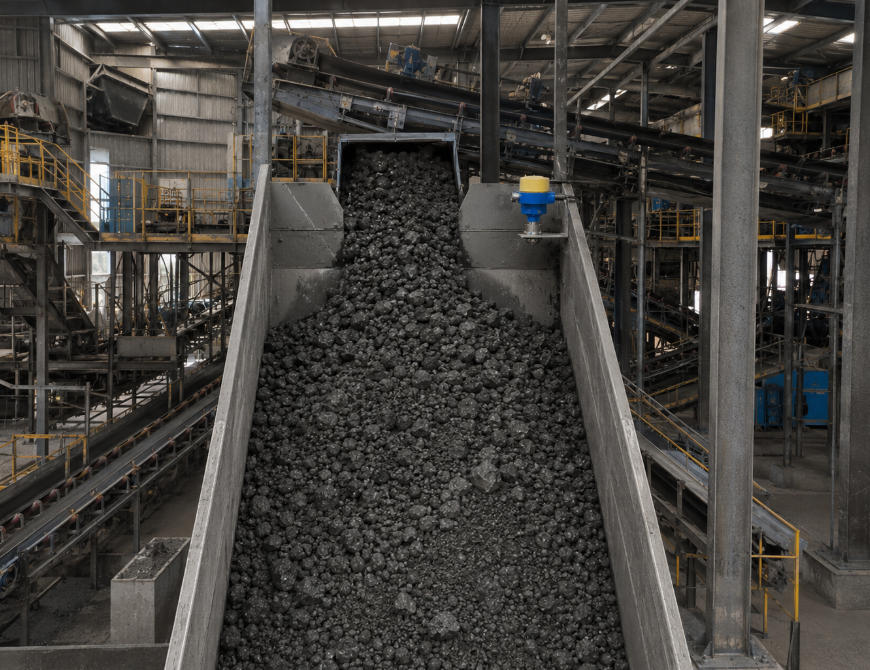
Solid level measurement is different from liquid level measurement. Liquid surfaces are usually relatively flat, while bulk solid surfaces often have material angles, depressions, collapsing material, dust, wall buildup, and irregular reflection. Especially in materials such as ore, gravel, coal, cement powder, lime powder, plastic pellets, and lithium battery powders, the material surface is complex, and traditional measuring instruments are easily affected by interference.
The Jiwei JWrada® PRO Series radar level meter adopts 80GHz high-frequency radar technology. Its narrow beam angle and highly concentrated energy allow it to aim more accurately at the target material surface, reducing interference from silo walls, brackets, beams, feeding ports, and other internal structures. For tall silos, narrow silos, cone-bottom silos, buffer bins, and transfer bins, 80GHz radar can provide more stable echo recognition capability.
At the same time, the PRO Series radar level meter is suitable for high-dust, high-noise, high-vibration, and complex electromagnetic environments. In powder loading systems, mining crushing lines, aggregate production lines, cement clinker silos, and new energy material silos, instruments must operate continuously for long periods and provide reliable data to the production system. The Jiwei PRO Series uses non-contact measurement, avoiding mechanical wear and reducing the impact of material shock on instrument service life.
Compared with contact measurement methods, radar level meters do not need to extend into the material. They are not directly affected by material adhesion, abrasion, pulling force, or impact. This reduces maintenance costs and makes them suitable for automated production sites with unattended or low-maintenance operation requirements.
7. Application of Six-Wire Output in PLC, DCS, and SCADA Systems
In actual projects, the six-wire 4–20mA + RS485/Modbus output of the Jiwei PRO Series radar level meter can be used flexibly according to different system architectures.
In PLC control systems, 4–20mA can be connected to an analog input module for continuous level display, alarm judgment, and equipment interlocking control. For example, when the silo level falls below a set value, the PLC can start the feeding equipment. When the material reaches a high level, the PLC can stop the conveyor or trigger an alarm to prevent overflow.
In DCS systems, the 4–20mA signal can be used for process monitoring and trend recording, while RS485/Modbus can be used to read more instrument parameters. This allows the control room to understand the silo status more comprehensively.
In SCADA systems or digital mining platforms, RS485/Modbus can upload data from multiple radar level meters centrally, enabling multi-silo inventory visualization, historical data analysis, abnormal alarm management, remote diagnosis, and production scheduling optimization.
For large production bases, the combination of 4–20mA and RS485/Modbus is especially valuable. The field control layer uses 4–20mA to ensure real-time performance and reliability, while the management layer uses RS485/Modbus to obtain digital data. This enables coordinated production management and equipment management.
8. Typical Application Scenarios
The Jiwei JWrada® PRO Series radar level meter is suitable for a wide range of industrial silo level measurement applications.
In the mining industry, it can be used for ore silos, crusher buffer bins, transfer bins, finished material silos, and tailings-related storage systems. Mining sites are often dusty, highly vibrational, and densely equipped. They place high requirements on the anti-interference capability and long-term stability of radar level meters. The PRO Series provides continuous level data for crushing, screening, conveying, and storage systems, helping enterprises reduce empty-silo shutdowns and full-silo overflow.
In the aggregate industry, it can be used for gravel silos, manufactured sand silos, aggregate buffer bins, and truck loading silos. By connecting 4–20mA output to the control system and RS485/Modbus to the background management platform, production line level monitoring and inventory management can be realized in real time.
In the cement and building materials industry, it can be used for cement powder silos, fly ash silos, lime powder silos, clinker silos, and additive silos. High-dust environments can easily affect ordinary measurement methods, while 80GHz radar level meters are better suited to dust and complex reflection conditions.
In chemical and new energy industries, it can be used for plastic pellets, chemical powders, lithium battery cathode and anode materials, powder raw materials, and intermediate material silos. These applications require high measurement stability, complete data, and strong system integration capability. Six-wire output can better meet the needs of automated production.
9. Bluetooth Commissioning Combined with Six-Wire Output Improves Maintenance Efficiency
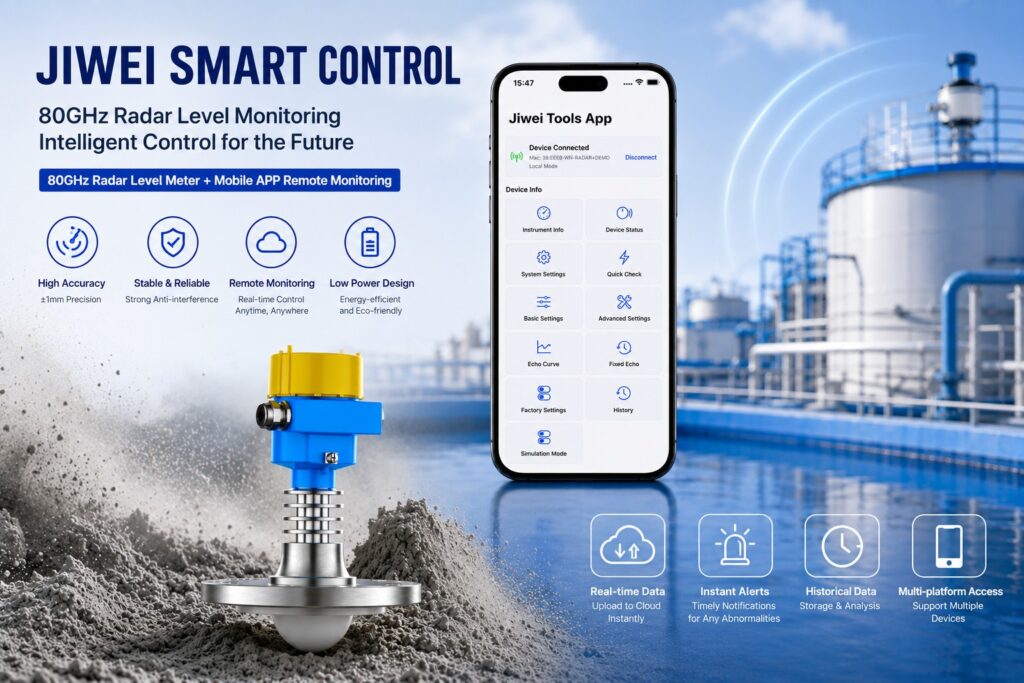
In addition to six-wire 4–20mA + RS485/Modbus output, the Jiwei JWrada® PRO Series radar level meter can also work with Jiwei’s independently developed “Jiwei Smart Control” APP for wireless commissioning and monitoring. Field engineers can use a mobile phone to set parameters, check status, and perform commissioning without frequent climbing or opening the instrument cover.
In applications with tall silos, heavy dust, or complex field environments, Bluetooth commissioning can significantly improve maintenance safety and efficiency. Engineers can check device status from a safe location, adjust range parameters, inspect echo curves, and reduce high-altitude operations and downtime.
When Bluetooth commissioning is combined with six-wire output, field operation becomes more flexible. The 4–20mA output ensures real-time data acquisition by the control system, RS485/Modbus ensures data communication and system integration, and the Bluetooth APP improves field commissioning and maintenance efficiency. This combination makes the radar level meter not only a measuring instrument, but also an important sensing terminal in an intelligent silo management system.
10. Selection and Wiring Considerations
When selecting the Jiwei PRO Series radar level meter, users should confirm the measuring range, material type, installation position, process connection, power supply, output mode, and communication requirements according to actual field conditions. For projects that require simultaneous connection to PLC and host systems, the six-wire 4–20mA + RS485/Modbus solution is recommended.
During wiring, attention should be paid to the correct separation of power supply wires, analog signal wires, and RS485 communication wires to avoid wiring errors. RS485 communication requires attention to A/B polarity, communication address, baud rate, parity, and Modbus register configuration. For long-distance transmission or high-interference sites, shielded cables are recommended, with proper grounding and anti-interference measures.
When multiple devices are networked, communication addresses should be planned properly to avoid address conflicts. For large systems, termination resistors, isolation modules, or repeaters may also need to be considered according to field distance, number of nodes, and communication quality.
In addition, the installation position of the radar level meter directly affects measurement performance. The instrument should be installed away from feeding ports, internal beams, brackets, reinforcing ribs, and areas subject to strong material impact. The radar beam should be able to stably reach the target material surface. For silos with obvious material angles, the installation angle should be selected according to actual material flow direction and silo structure.
11. Technical Value of the Jiwei PRO Series Radar Level Meter
The Jiwei JWrada® PRO Series radar level meter not only provides high-precision non-contact level measurement, but also enhances system integration capability through six-wire 4–20mA + RS485/Modbus output. For industrial users, this configuration offers clear engineering value.
It helps enterprises achieve more advanced digital upgrades without changing the original control system architecture. The 4–20mA output meets traditional automation control needs, RS485/Modbus meets intelligent data acquisition needs, and the Bluetooth APP supports fast on-site commissioning. Together, these features upgrade silo level measurement from single signal output to multidimensional data management.
In smart mining, digital factories, intelligent warehousing, and automated production lines, level data is an important type of basic production data. Only by accurately, stably, and continuously monitoring silo inventory changes can enterprises optimize production rhythm, reduce equipment idling, prevent overflow and blockage, improve production efficiency, and reduce manual inspection costs.
The Jiwei PRO Series radar level meter is designed around these practical requirements. It is suitable for long-term operation in high-dust, tall-silo, high-interference, high-vibration, and complex bulk solid environments, providing reliable level measurement and digital management support for industrial enterprises.
12. Conclusion
As industrial automation continues to move toward digitalization and intelligence, silo level measuring instruments must not only provide high-precision measurement, but also stable signal output, flexible communication interfaces, and convenient commissioning methods. The Jiwei JWrada® PRO Series radar level meter supports six-wire 4–20mA + RS485/Modbus output, meeting the needs of both traditional control systems and modern digital platforms.
The 4–20mA output is stable and reliable, making it suitable for real-time acquisition by PLC, DCS, and other control systems. RS485/Modbus communication provides richer data and is suitable for centralized monitoring by SCADA, host computers, and digital management platforms. The six-wire wiring method separates power supply, analog output, and digital communication, improving system stability in complex industrial environments.
For mining, aggregates, cement, chemical powders, new energy materials, and other industries, the Jiwei PRO Series radar level meter can provide reliable data in high-dust, high-vibration, complex-structure, and long-distance measurement scenarios. It helps enterprises achieve continuous production, safer management, and intelligent silo monitoring.
Therefore, in silo level measurement projects requiring high reliability, strong compatibility, and digital management capability, the six-wire 4–20mA + RS485/Modbus solution of the Jiwei PRO Series radar level meter is a more suitable technical choice for modern industrial sites.