
Why Modular Design Matters in Industrial Instruments
Does a Faulty Instrument Mean the Entire Device Is Broken?
Not necessarily. Many issues in industrial instruments are caused by faults in small functional units, such as mismatched communication parameters, interference in the power module, display board issues, loose wiring, or changes in field power supply and grounding. These do not mean the whole instrument must be replaced.
Communication mismatches, power disturbances, or display anomalies may make an instrument “unusable,” but the sensor itself may still be fine. This illustrates the importance of modular design in industrial instruments.
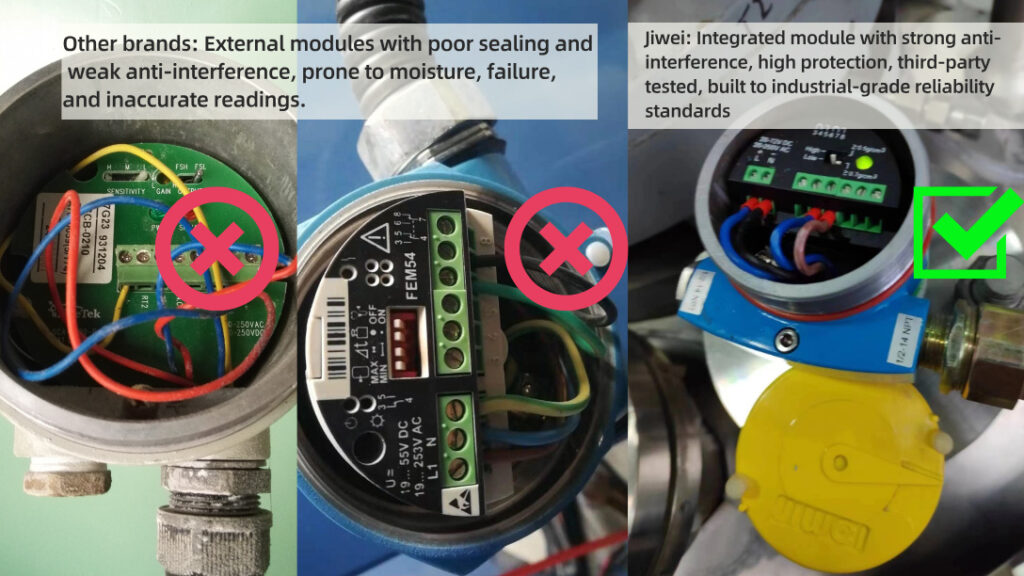
The Purpose of Modular Design
Traditional devices were often highly integrated, combining sensing, power, communication, display, and signal processing in a single unit. While compact, even minor maintenance issues could force complete system downtime.
Modular design separates parts that are more likely to change, require frequent maintenance, or may need upgrades in the future. At the same time, it ensures the core measurement chain remains stable and consistent.
The goal is not simply “easy to disassemble,” but to make troubleshooting easier, reduce system-wide impact during maintenance, and allow room for future upgrades.
How Data Is Generated Inside an Instrument
Take a liquid level switch as an example. The displayed value is not directly output by the sensor. The liquid interacts with the probe’s sensing element, generating a weak electrical signal. This signal undergoes amplification, filtering, temperature compensation, linear correction, and ADC conversion into digital form.
The MCU then calculates the level based on range, zero, and compensation parameters, and outputs it via 4–20mA, HART, RS485, Modbus, or Industrial Ethernet to a PLC, DCS, or host system.
A typical smart instrument contains the following key chains:
- Sensor module: collects measurement data
- Signal processing: conditions and amplifies signals
- Controller (MCU): performs calculation
- Output/Communication module: transmits data
- Power module: provides power, isolation, and protection
- Display module: allows local viewing and parameter configuration
Which Parts Benefit from Modular Design?
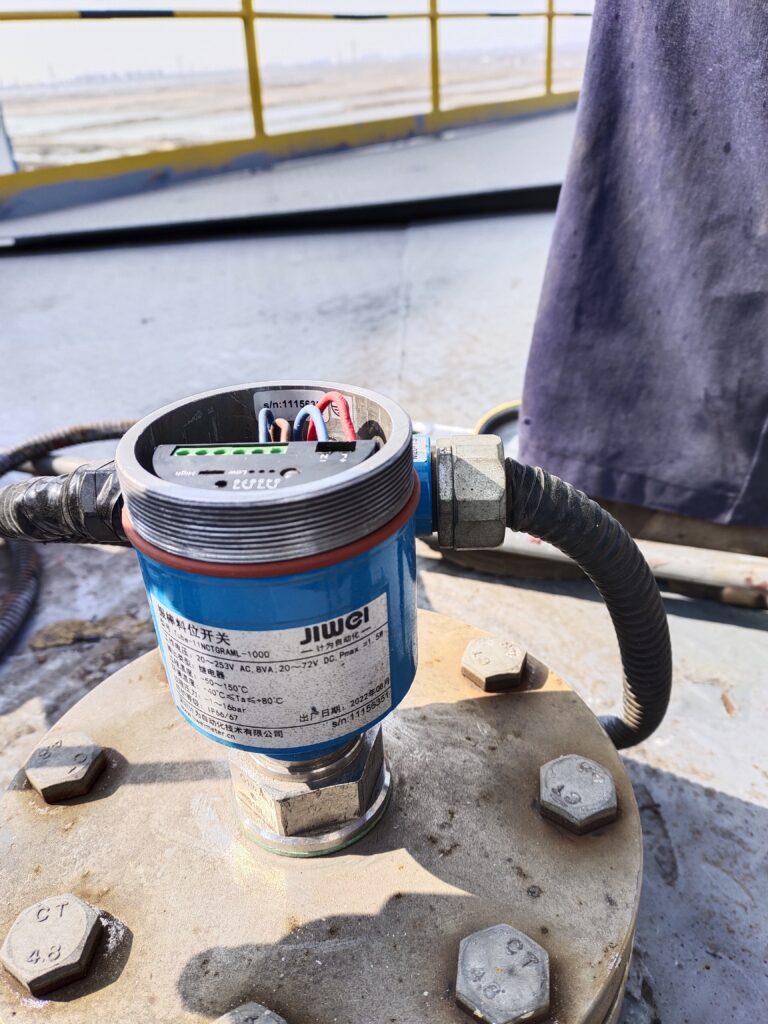
Communication Module
Field communication requirements vary: 4–20mA, HART, RS485/Modbus, Profibus, Profinet, EtherNet/IP, or IO-Link. Modular communication boards allow users to change protocols without replacing the entire instrument, reducing cost and simplifying maintenance.
Power Module
Power modules can be tailored to field conditions—DC or AC input, surge protection, isolation, and interference mitigation. Many signal instability issues stem from power quality or grounding. A separate power module makes troubleshooting easier.
Display & Operation Module
Some instruments need a display and buttons; others are in cabinets or remote locations. Modular display allows replacement or removal without affecting measurement or communication functionality.
Sensor Module
Critical for accuracy, range, response time, and media compatibility. Sensor modules should store range, zero, compensation, calibration, and serial number data. Even when replaced, verification is required for high-precision applications.
Interfaces Are Critical
Modular design requires careful attention to four types of interfaces:
- Mechanical Interface: Must withstand vibration, temperature changes, moisture, dust, and corrosive media.
- Electrical Interface: Clear pin definitions, isolation, reverse-connection protection, short-circuit and surge protection.
- Data Interface: Must support module identification, version compatibility, parameter read/write, and clear error indications.
- Maintenance Interface: Allows operators to locate faults quickly, replace modules without reconfiguration, and view module status, version, diagnostics, and fault codes.
Less Is More in Modular Design
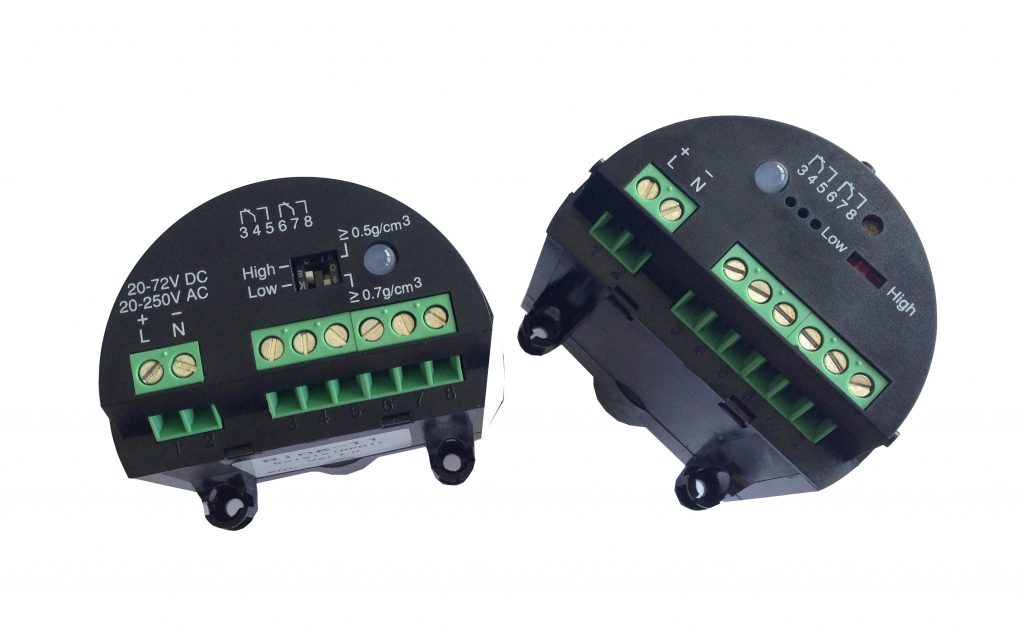
Excessive modules increase potential failure points (connectors, pins, seals, plug-ins). Reliability in harsh industrial environments is more important than ease of disassembly.
Good modular design is selective:
- Communication, power, and display modules (high variability, frequent maintenance) are ideal for modularization
- Critical sensor, sealing, measurement consistency, and certified components must be carefully managed
- Modules should not be added unnecessarily
Version Management is essential. Multiple module versions may exist on site after years of operation. Clear module codes, version numbers, compatibility rules, and replacement lists ensure proper maintenance.
Practical Benefits for Field Maintenance
- Maintenance workflow becomes clearer:
- No display? Check display and power module
- Communication issue? Check communication module, wiring, protocol
- Measurement drift? Check sensor, signal processing, temperature compensation, installation
- No response? Check power input, protection components, internal connections
- Modular design simplifies spare parts management and allows flexible upgrades.
- Field modifications are easier: swap communication types, adapt power modules, replace display modules, or upgrade communication standards without replacing the whole instrument.
Conclusion
Modular design in industrial instruments is not for complexity, but to give devices clear functional boundaries:
- Where data is collected
- Where it is processed
- Where it communicates
- Where it is powered
- Where it is displayed
A well-designed modular instrument makes fault identification easier, simplifies spare parts management, and ensures the device can adapt to system upgrades or changes in field conditions over many years.
This is the true value of modular design.