
Ex d vs Ex db: Understanding Explosion-Proof Electrical Equipment Standards
Explosion-proof marking Ex d and Ex db are classifications of electrical equipment protection for hazardous environments, based on different editions of Chinese standards. Ex d refers to the older standard GB3836.2-2010, while Ex db follows the updated GB/T3836.2-2021. Both marks indicate equipment designed to operate safely in explosive atmospheres, but they differ in technical requirements, classification, and testing procedures.
1. Ex d Marking
Definition:
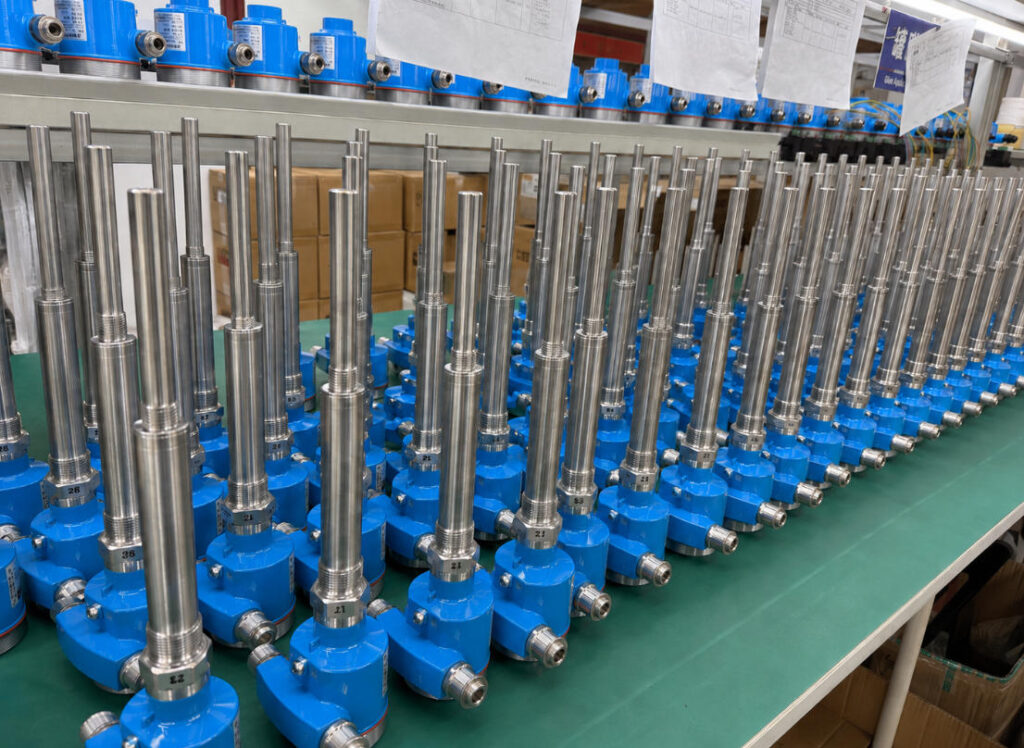
Under GB3836.2-2010, Ex d denotes equipment designed for explosive gas environments, protected by a flameproof enclosure. The enclosure contains any internal explosion caused by sparks or arcs, preventing ignition of the surrounding atmosphere. Equipment marked Ex d typically has protection levels of Gb (for stationary equipment) or Mb (for mining equipment).
Working Principle:
The flameproof enclosure isolates components that may generate sparks or arcs. If an internal explosion occurs, the enclosure withstands the pressure and prevents flame propagation to the external environment.
Applications:
Ex d devices are commonly used in industries such as pharmaceuticals, petrochemical, chemical processing, and other hazardous locations with explosive gases.
2. Ex db Marking
Definition:
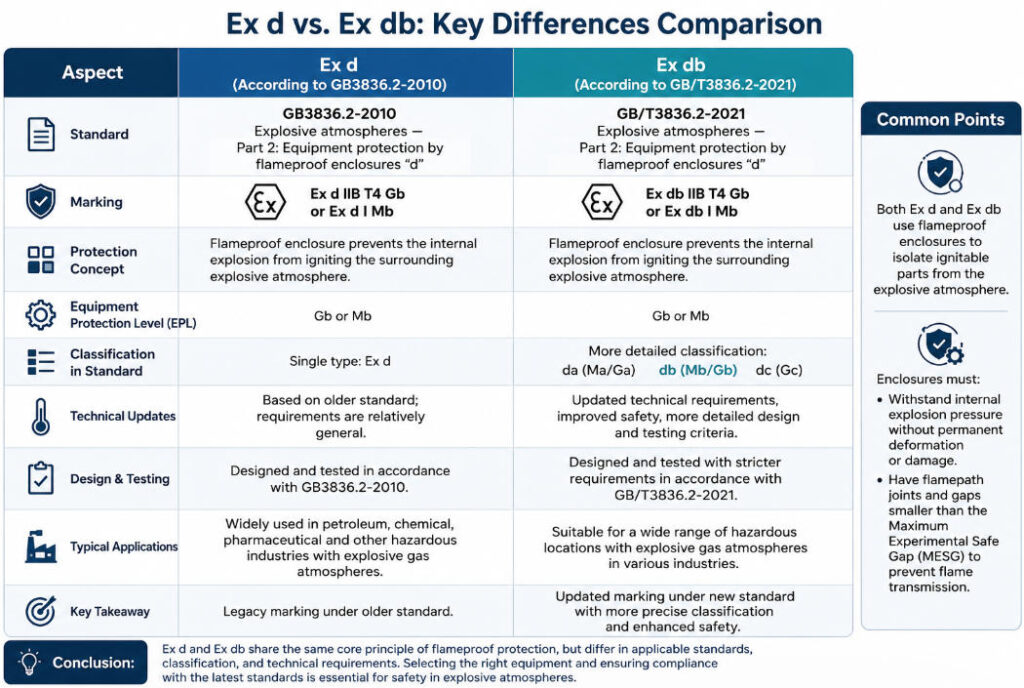
According to GB/T3836.2-2021, Ex db equipment also uses a flameproof enclosure capable of containing internal explosions. Ex db introduces sub-classifications da, db, dc, corresponding to specific protection levels:
- da: EPL Ma or Ga (e.g., portable catalytic combustion gas detectors)
- db: EPL Mb or Gb (general flameproof equipment)
- dc: EPL Gc (equipment with electrical switching contacts or Ex components)
Working Principle:
Components that may ignite explosive gas are enclosed in a robust structure that can contain the explosion pressure and prevent flame propagation to the external atmosphere.
Applications:
Ex db devices are suitable for a wide range of hazardous areas, providing enhanced safety and compliance under the latest standard.
3. Common Features
Both Ex d and Ex db employ flameproof enclosures to isolate electrical components from explosive gases. Key requirements include:
- Sufficient mechanical strength to withstand internal explosion pressures without permanent deformation.
- Joints and gaps smaller than the Maximum Experimental Safe Gap (MESG) to prevent flame transmission.
- Certification for relevant temperature groups and equipment categories.
4. Key Differences
| Feature | Ex d (GB3836.2-2010) | Ex db (GB/T3836.2-2021) |
|---|---|---|
| Standard | Older edition | Updated edition |
| Classification | Gb / Mb | da / db / dc for precise EPL levels |
| Technical requirements | Flameproof enclosure | More detailed testing, classification, and design rules |
| Temperature group & equipment category | Defined in old standard | Updated and refined for improved safety |
| Application guidance | General hazardous areas | Extended scenarios with clear EPL distinctions |
5. Conclusion
Ex d and Ex db share the core principle of explosion-proof flameproof enclosures, but differ in standard compliance, protection classification, and technical requirements. Understanding these differences is crucial for proper selection and application of explosion-proof electrical equipment. With evolving standards and technological advances, professionals must stay informed and consult relevant regulations to ensure safety and compliance in hazardous environments.