Technical Study on Penetration Measurement of Jiwei 80GHz Radar Level Transmitter in Glass/Acrylic
1. Introduction: New Challenges of Transparent Tanks for Level Measurement
With the continuous advancement of industrial automation and process control technologies, an increasing number of storage tanks, reactors, and silos are adopting transparent structural designs, such as glass observation windows, acrylic top covers, and partially transparent sight glasses. The original purpose of these designs is to improve on-site visual monitoring, allowing operators to directly observe material conditions, thereby enhancing operational safety and process control flexibility.
However, in practical industrial applications, these transparent structures pose new challenges to traditional level measurement technologies. Contact-based instruments are prone to issues such as adhesion, wear, and corrosion from process media. Meanwhile, low-frequency radar or ultrasonic instruments often suffer from multiple reflections or signal attenuation in complex structural environments, especially when glass or acrylic structures are present, making measurement stability difficult to guarantee. Therefore, achieving high-precision and reliable level measurement without compromising the integrity of transparent structures has become an important technical topic in industrial automation.
Based on independently developed JWrada® 80GHz FMCW radar level transmitters, Jiwei Automation has conducted extensive laboratory verification and field engineering applications, systematically validating the stable penetration capability of high-frequency radar in non-metallic transparent media such as glass and acrylic. This provides a new solution for complex tank level measurement applications.
2. Technical Basis: Advantages of 80GHz FMCW Radar Measurement Principle
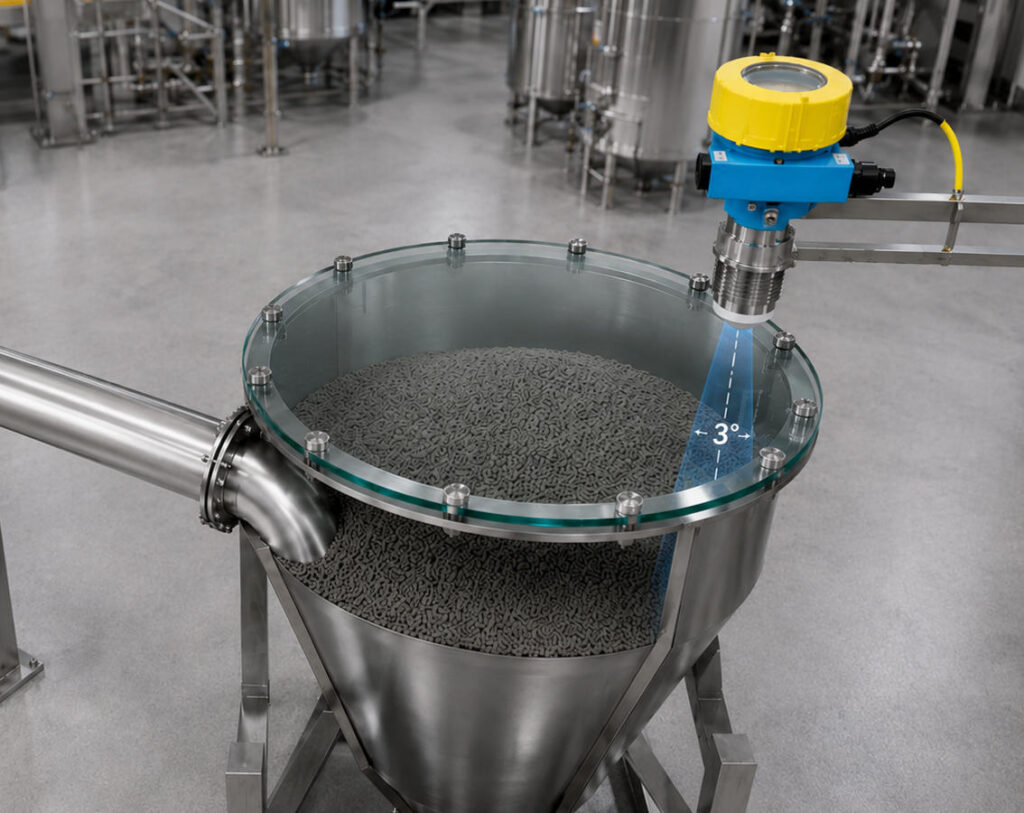
The Jiwei JWrada® radar level transmitter is based on 80GHz FMCW (Frequency Modulated Continuous Wave) technology. Its core advantage lies in extremely high signal concentration capability and excellent spatial resolution. Compared with traditional 26GHz or lower-frequency radar systems, 80GHz radar features a much narrower beam angle, typically around 3°, which allows the emitted energy to be highly focused on the target direction, effectively suppressing interference echoes from tank walls, internal structures, and supports.
During level measurement, the radar transmits high-frequency microwave signals and receives reflected signals from the target surface. The distance to the material surface is calculated based on the frequency difference. Due to the shorter wavelength of the 80GHz band, it provides higher resolution for small-particle surfaces and better differentiation between true level echoes and false echoes. This is particularly important in complex tank structures.
In transparent media structures such as glass or acrylic, these materials exhibit relatively stable dielectric constants and low loss characteristics. Their absorption and scattering effects on 80GHz electromagnetic waves are limited. As a result, radar signals can pass through with minimal attenuation, enabling accurate measurement of internal material levels. This physical property provides a theoretical foundation for non-intrusive installation.
3. Penetration Mechanism of Transparent Media: Electromagnetic Properties of Glass and Acrylic
In industrial applications, glass and acrylic (PMMA) are typical non-metallic dielectric materials. Their common characteristics include extremely low electrical conductivity, low dielectric loss, and uniform internal structure. In the microwave frequency range, these materials mainly cause slight refraction and minor energy attenuation of electromagnetic waves, rather than complete reflection like metal materials.
Jiwei’s technical team conducted systematic testing on glass thickness, acrylic thickness, and installation angles across multiple experimental scenarios. The results show that within a reasonable thickness range (typically 10mm–30mm industrial glass or acrylic panels), 80GHz radar signals can penetrate stably and generate clear echoes from the material surface. Especially under vertical incidence conditions, signal loss is further reduced, ensuring that measurement accuracy is minimally affected.
It is important to note that transparent materials do not generate effective false echoes, which is significantly different from metal structures or complex support frameworks. Therefore, installing radar above transparent structures actually improves signal purity and reduces multipath reflection interference.
4. Engineering Applications: Non-Contact Level Measurement in Transparent Structures
In real industrial environments, transparent structures are widely used for process visualization, particularly in food processing, pharmaceutical production, fine chemical industries, and laboratory reactor systems. These applications often require high sealing integrity and cleanliness, meaning that drilling or intrusive installation is not allowed.
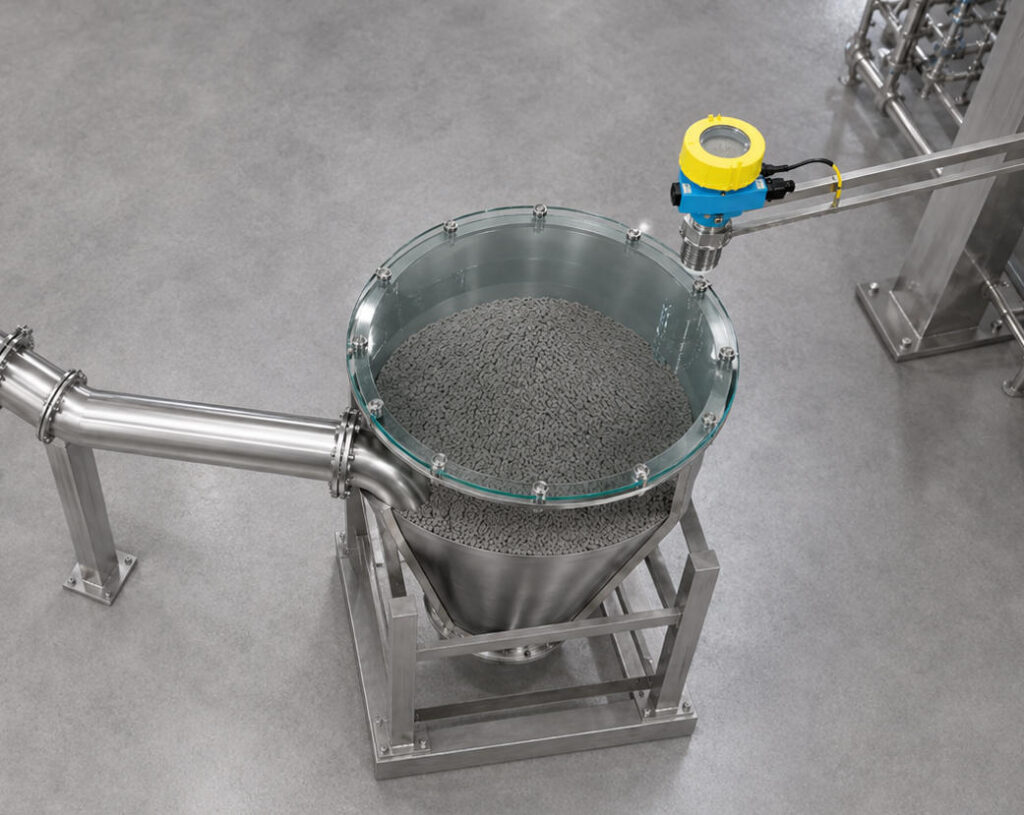
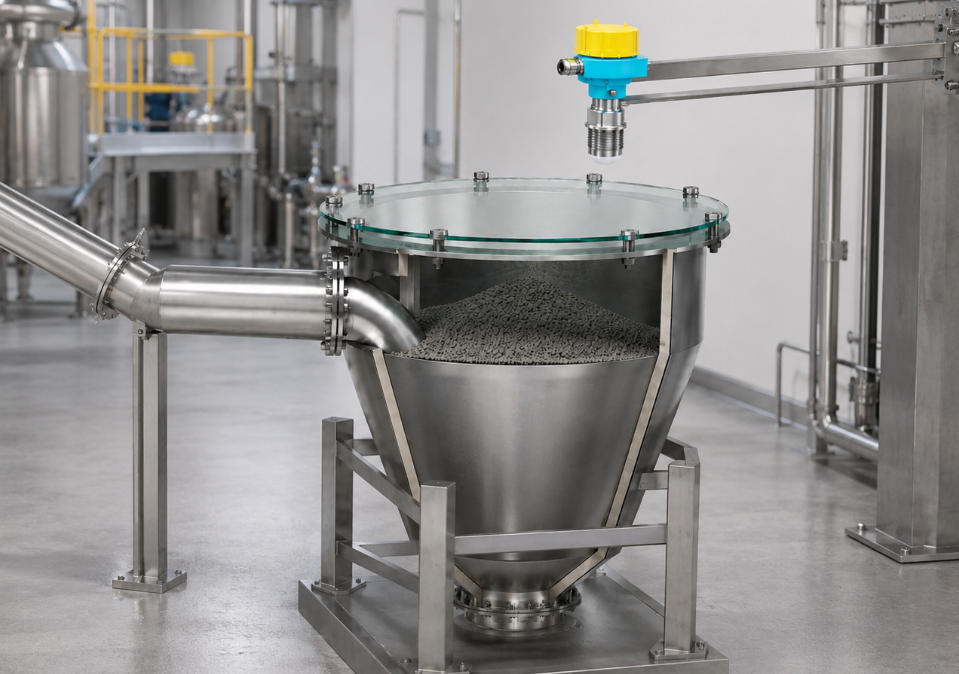
The Jiwei JWrada® 80GHz radar level transmitter enables fully non-contact measurement by installing above glass or acrylic covers. This installation method requires no modification of the vessel body. Existing observation windows or transparent covers can be directly utilized, significantly reducing installation cost and engineering risk.
In operation, the solution demonstrates excellent stability. Even under conditions such as granular material accumulation, dust variation, or slight vibration, the radar signal remains capable of reliably identifying the true material surface. For dynamic processes such as continuous feeding or intermittent discharge systems, stable real-time output can still be maintained, providing reliable data for PLC or DCS control systems.
5. Key Technical Advantages: Combination of Narrow Beam and Signal Stability
The core advantage of the Jiwei JWrada® radar level transmitter in transparent structure applications lies not only in its electromagnetic penetration capability but also in its advanced signal processing system.
First, the 80GHz narrow beam design enables extremely high energy concentration, with a beam angle of approximately 3°, effectively minimizing interference from tank walls, brackets, and other structural components. This highly directional transmission ensures sufficient echo strength even after passing through glass or acrylic layers.
Second, the independently developed echo recognition algorithm dynamically analyzes signals under complex conditions. Through multi-echo separation and noise suppression technology, it effectively filters invalid reflections, ensuring accurate identification of true level signals. This is particularly critical in transparent structures, where edge reflections may still occur under certain angles.
In addition, the device adopts a highly stable RF module and low-temperature drift circuit design, ensuring long-term measurement consistency, which is essential for continuous production systems.
6. Engineering Value and Industry Application Expansion
From an engineering perspective, the successful application of radar level measurement in glass and acrylic structures represents a shift from “structure-dependent installation” to “non-intrusive measurement.” This transformation is highly significant for modern smart manufacturing systems.
In the food and pharmaceutical industries, hygiene requirements are extremely strict, and any intrusive installation may introduce contamination risks. Non-contact radar measurement enables fully sealed, real-time monitoring. In fine chemical applications, where processes are complex and media are variable, transparent structures are often used for auxiliary observation. Radar penetration measurement avoids modifying the original process design.
In laboratory and pilot systems, where process configurations frequently change, traditional instrumentation lacks flexibility. Transparent-structure-based radar measurement offers high adaptability and can be rapidly deployed and reused.
7. Conclusion: Engineering Significance of Transparent Structure Radar Measurement Technology
Based on experimental research and field applications, it can be concluded that the Jiwei JWrada® 80GHz radar level transmitter demonstrates stable and reliable penetration capability in non-metallic transparent media such as glass and acrylic, without significant impact on measurement performance. This capability provides a new installation approach for industrial level measurement, enabling high-precision continuous monitoring without damaging tank structures.
With the continuous advancement of industrial automation, transparent storage structures and clean process equipment will become increasingly common. Non-contact measurement technology based on high-frequency radar will play a key role in future level measurement systems. Jiwei Automation will continue to focus on the development of 80GHz radar technology, enhancing adaptability in complex industrial conditions and providing global users with more stable, intelligent, and highly reliable level measurement solutions.