
Valve Positioners in Process Control: Working Principles, Engineering Value, and Application Guidelines
In industrial process control systems, the control valve is the final element responsible for executing the control signal. However, the valve body is affected by friction, fluid forces, actuator limitations, and structural nonlinearities. As a result, the actual valve position does not always match the control signal. Valve positioners were designed precisely to correct this deviation. Their purpose is not to throttle the medium but to convert a low-power control signal into pneumatic power capable of driving the actuator, while using valve-stem feedback to form a local closed loop that stabilizes the valve at the desired position.
Discussions in industry often revolve around whether a positioner is always necessary and whether smart positioners offer significant advantages. This article provides a systematic technical summary of their definition, operational principles, engineering value, and practical selection guidelines.
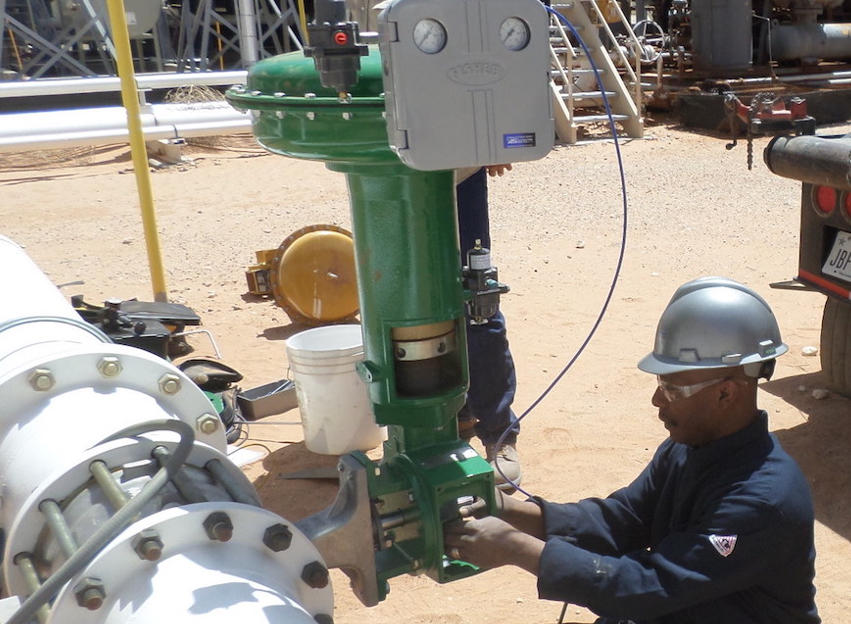
A Valve Positioner Is a Local Servo Controller for the Control Valve
Functionally, a valve positioner forms a local servo loop consisting of the control signal, actuator pressure, and valve-position feedback. Its purpose is to improve static accuracy, dynamic response, and disturbance rejection. A typical positioner signal chain includes:
Input:
Receives 4–20 mA, pneumatic, or fieldbus signals. If necessary, an I/P conversion or protocol parsing is performed.
Comparison and control:
The setpoint is compared with the feedback signal. Mechanical force-balance mechanisms were used in earlier designs; modern designs use digital computation.
Pneumatic amplification:
Supply air is used to amplify power, generating enough pressure and airflow to overcome spring force, friction, and fluid forces.
Feedback:
A linkage, cam, or displacement sensor provides continuous position feedback.
From a control-theory perspective, the positioner is a local servo loop that shields the upper-level DCS from mechanical complexity. With a positioner, the valve becomes a predictable and linearized actuator. For this reason, the positioner is not a simple accessory but one of the key components determining control-valve performance.

Operating Principles of Valve Positioners
There are two major categories: traditional pneumatic force-balance positioners and modern digital positioners using microprocessors.
Pneumatic positioners operate on force balance:
A nozzle–flapper mechanism converts displacement errors into back-pressure changes. After pneumatic amplification, the actuator moves until the feedback restores balance. This structure is robust and easy to maintain, suitable for many standard applications.
Digital positioners use microprocessor-based closed-loop control:
A sensor measures the valve position and a microprocessor computes the control output. Proportional solenoid valves or high-speed nozzles adjust output pressure. Digitalization enables linearization, gain tuning, auto-calibration, and diagnostics. Their core value lies in high repeatability, tunable parameters, and the ability to quantify valve performance.
Force-balance positioners excel in reliability and simplicity; digital positioners excel in advanced performance. They serve different engineering needs rather than competing in absolute superiority.
Why a Valve Cannot “Automatically Reach Position” Without a Positioner
A control valve relying only on actuator mechanics cannot accurately follow small signals or maintain a stable position due to:
Friction and hysteresis:
Packing friction and guide-structure friction cause deadband and reverse hysteresis.
Fluid-force disturbances:
Changes in differential pressure or flowrate add unbalanced forces that shift the valve from equilibrium.
Insufficient or unstable drive force:
Pressure fluctuations or long pneumatic lines weaken actuator force.
Nonlinear valve-body characteristics:
Different valve openings require different actuator forces that mechanical balance cannot fully accommodate.
A positioner overcomes these inherent limitations by forming a closed loop that forces the valve to track the command accurately.
When a Positioner Becomes Essential
Not all applications require a positioner. However, it is indispensable in situations such as:
High-precision control loops:
Pressure, temperature, level, and ratio-control systems where steady-state error must be minimized.
High friction or stiff mechanical design:
Metal-seated valves, high-temperature valves, bellows valves, and designs with high structural rigidity.
Strong fluid-force disturbances:
High ΔP, steam service, and slurry or solid-containing media.
Large actuators or fast response requirements:
Large volumes, long pneumatic lines, or rapid modulation requirements.
Defined fail-safe strategies:
Single-acting or double-acting actuators requiring coordinated safety-failure behavior.
In any loop requiring accurate positioning or high dynamic quality, the positioner is the more reliable approach.
Avoiding Common Misunderstandings
To ensure clear communication and avoid engineering mistakes, it is necessary to distinguish related components:
Control valve:
Includes the valve body, actuator, and accessories such as the positioner.
I/P converter:
Converts current to pressure but contains no position feedback or closed-loop control.
Solenoid valve:
Suitable for on/off control, not for continuous modulation.
“Positioning valve” interpretations vary:
In process control it refers to valve positioners; in general pneumatic systems it may refer to other positioning devices.
Clear terminology avoids misselection and performance degradation.
Key Performance Metrics for Evaluating Positioners
Engineering evaluation should focus on quantitative indicators:
Basic error and linearity:
Determine steady-state accuracy.
Hysteresis:
Indicates consistency between opening and closing strokes.
Sensitivity and deadband:
Reflect small-signal responsiveness.
Output air capacity and dynamic response:
Directly influence actuator speed and stability.
Environmental ratings:
Explosion protection, ingress protection, and corrosion resistance.
Matching these metrics with actual operating conditions is critical for reliable control-loop performance.
Engineering Practices for Installation and Commissioning
Installation quality often affects control performance more than the device itself. Key considerations include:
Correct feedback orientation and travel mapping
Zero and span must be calibrated mechanically
Stable and clean supply air
Proper protection in high-temperature or high-vibration environments
Clear bypass and switching strategy for commissioning and maintenance
These practical factors determine long-term stability and reliability.
Valve Positioners Are Evolving from “Drive” to “Diagnostics”
With digital capabilities, valve positioners now provide friction data, hysteresis trends, response time, and other health indicators. They transform the valve from a “black-box actuator” into a diagnosable asset. The goal is not cloud connectivity but actionable local data enabling predictive maintenance, more informed decision-making, and improved process stability.
Conclusion
The value of a valve positioner does not lie in whether it is “smart” but in its ability to ensure reliable, stable, and verifiable valve positioning. Understanding its principles, performance boundaries, and engineering suitability is essential for improving process-control quality. Whether using a pneumatic force-balance design or a digital controller, the objective never changes: the valve must move exactly as required by the control system—with behavior that is measurable, maintainable, and predictable.